The response factor formula helps scientists measure how strongly an analytical instrument responds to a particular substance. It is commonly used in High-Performance Liquid Chromatography (HPLC) and Gas Chromatography (GC) to calculate the amount or concentration of a compound in a sample.
Different compounds may produce different detector signals, even when they have the same concentration. A response factor helps account for these differences and makes quantitative analysis more accurate.
In this guide, you will learn the response factor formula, how to calculate it step by step, how the relative response factor (RRF) works, and how to solve practical examples.
What Is a Response Factor?
A response factor (RF) is a numerical value that describes the relationship between the signal produced by an analytical instrument and the amount or concentration of a substance.
In simple terms, it tells you how much detector signal a compound produces for a given concentration.
The detector response is usually measured through:
- Peak area: The total area under a chromatographic peak.
- Peak height: The height of the peak from its baseline.
- Concentration: The amount of a substance in a specific volume.
For example, an HPLC detector may produce a peak area of 20,000 units when testing a compound with a concentration of 5 mg/L.
The response factor helps relate these two values.
It is useful because different compounds can produce different detector signals. Without a suitable response factor, comparing their peak areas directly may give misleading results.
Response Factor Formula
The most common response factor formula expresses the detector response per unit concentration.
Formula:
[
RF=\frac{\text{Detector Response}}{\text{Concentration}}
]
When peak area is used as the detector response:
[
RF=\frac{\text{Peak Area}}{\text{Concentration}}
]
Where:
- RF = Response factor
- Peak Area = Measured detector signal
- Concentration = Known concentration of the compound
Some analytical methods use the inverse definition:
[
RF=\frac{\text{Concentration}}{\text{Peak Area}}
]
Both definitions are used in analytical software and laboratory methods. Always check which definition your instrument or test method follows before performing a calculation.
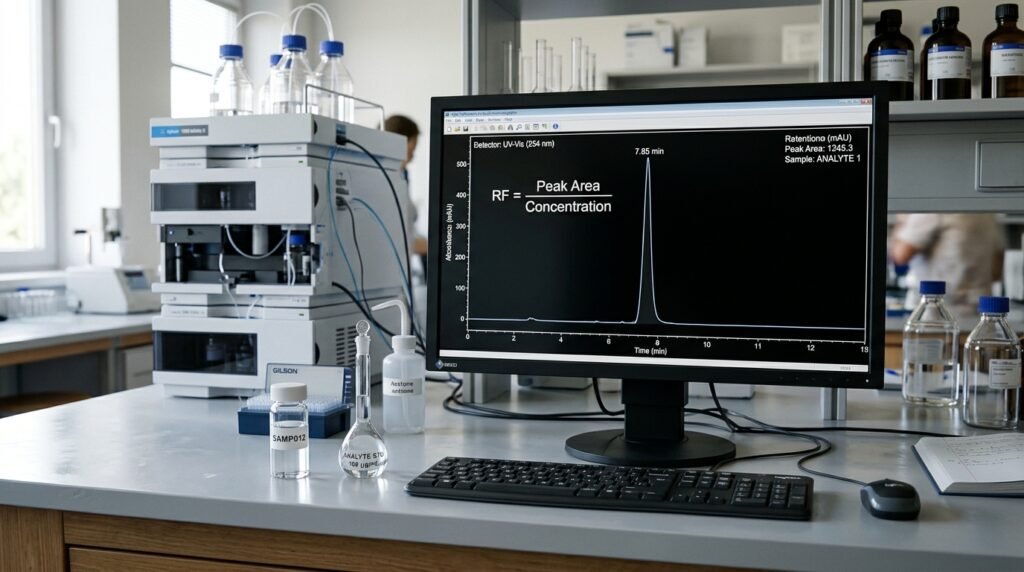
Response Factor Formula Example
Suppose an HPLC instrument produces a peak area of 15,000 units for a standard solution with a concentration of 3 mg/L.
Given:
- Peak area = 15,000
- Concentration = 3 mg/L
Using the standard response-per-concentration formula:
[
RF=\frac{15000}{3}
]
[
\boxed{RF=5000}
]
The response factor is 5,000 area units per mg/L.
Example 1:
An HPLC analyst tests a standard solution containing 3 mg/L of a chemical compound. The detector produces a peak area of 15,000 units.
The response factor is calculated by dividing the peak area by the known concentration.
[
RF=\frac{15000}{3}=5000
]
This means the detector produces 5,000 area units for each mg/L of that compound under the stated test conditions.
What Is a Relative Response Factor (RRF)?
A relative response factor (RRF) compares the detector response of one compound with the response of another compound.
It is commonly used in pharmaceutical testing and chromatographic analysis.
For example, a laboratory may need to measure an impurity in a medicine. The impurity and the main drug substance may produce different detector signals at the same concentration.
The RRF helps correct this difference.
Relative response factor formula:
[
RRF=\frac{RF_{\text{Analyte}}}{RF_{\text{Reference}}}
]
Where:
- RRF = Relative response factor
- RF Analyte = Response factor of the compound being measured
- RF Reference = Response factor of the reference compound
A reference compound may be the main active ingredient or an internal standard, depending on the analytical method.
Relative Response Factor Example
Suppose a laboratory measures two compounds:
| Measurement | Compound A | Compound B |
|---|---|---|
| Peak area | 20,000 | 25,000 |
| Concentration | 4 mg/L | 5 mg/L |
| Response factor | 5,000 | 5,000 |
The relative response factor of Compound A compared with Compound B is:
[
RRF=\frac{5000}{5000}
]
[
\boxed{RRF=1.00}
]
Both compounds have the same response factor.
Example 2:
A pharmaceutical laboratory compares an impurity with a reference drug substance. The impurity has a response factor of 4,000, while the reference compound has a response factor of 5,000.
The calculation is:
[
RRF=\frac{4000}{5000}
]
[
\boxed{RRF=0.80}
]
The impurity produces 80% of the detector response per unit concentration compared with the reference compound.
How to Calculate Response Factor Step by Step
You can calculate a response factor using a standard solution with a known concentration.
Follow these steps:
Step 1: Prepare a Standard Solution
Prepare a solution containing a known amount of the compound you want to measure.
For example, prepare a standard solution with a concentration of 10 mg/L.
Step 2: Run the Sample Through the Instrument
Inject the standard solution into an HPLC or GC instrument.
The detector measures the compound and produces a chromatographic peak.
Step 3: Record the Peak Area
Check the chromatogram and record the peak area.
Suppose the instrument reports a peak area of 50,000 units.
Step 4: Apply the Response Factor Formula
Use the formula:
[
RF=\frac{\text{Peak Area}}{\text{Concentration}}
]
Insert the values:
[
RF=\frac{50000}{10}
]
[
\boxed{RF=5000}
]
Step 5: Record the Result
The calculated response factor is 5,000 area units per mg/L.
Use the same detector settings, analytical method, and measurement conditions when applying this value.
Example 3:
A laboratory technician prepares a 10 mg/L standard solution and analyzes it using a GC instrument. The instrument reports a peak area of 50,000 units.
The technician divides 50,000 by 10 to calculate the response factor.
The result is 5,000 area units per mg/L.
This value can be used in later calculations if the analytical method remains suitable and the detector response is consistent.
Relative Response Factor Formula in HPLC
High-Performance Liquid Chromatography (HPLC) is a laboratory technique used to separate, identify, and measure compounds in a mixture.
In HPLC, the detector produces a signal for each compound. The peak area is often used to estimate the amount of a substance.
However, two compounds with equal concentrations may produce different peak areas.
The relative response factor in HPLC helps correct this difference.
A common formula is:
[
RRF=\frac{A_x/C_x}{A_s/C_s}
]
Where:
- (A_x) = Peak area of the analyte
- (C_x) = Concentration of the analyte
- (A_s) = Peak area of the standard
- (C_s) = Concentration of the standard
The analyte is the compound being measured, while the standard is the reference compound.
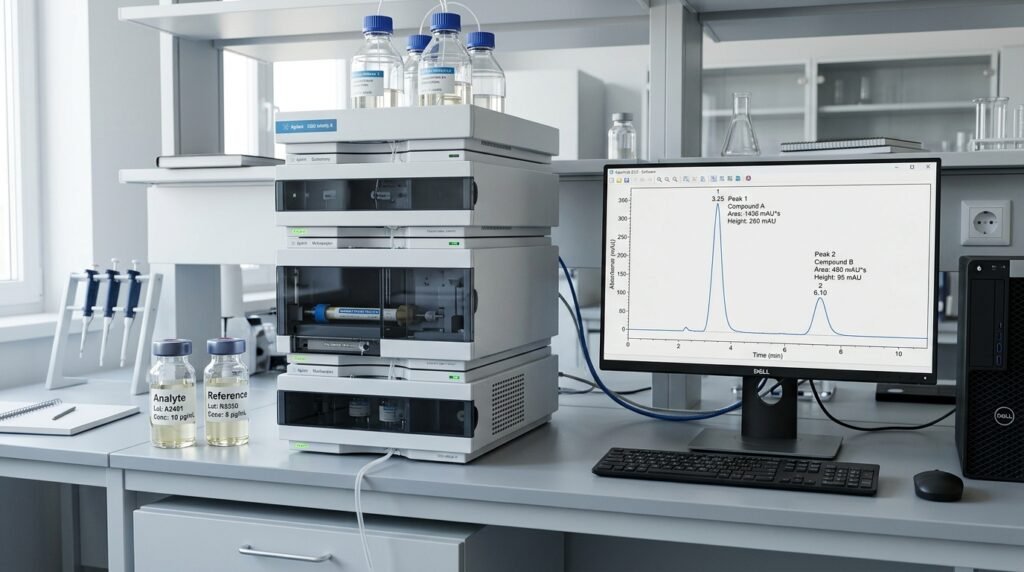
HPLC Calculation Example
Suppose an HPLC test gives these results:
| Measurement | Analyte | Standard |
|---|---|---|
| Peak area | 12,000 | 20,000 |
| Concentration | 3 mg/L | 4 mg/L |
First, calculate the analyte response factor:
[
RF_x=\frac{12000}{3}=4000
]
Next, calculate the standard response factor:
[
RF_s=\frac{20000}{4}=5000
]
Now calculate the relative response factor:
[
RRF=\frac{4000}{5000}
]
[
\boxed{RRF=0.80}
]
The analyte has a lower detector response per unit concentration than the standard.
Example 4:
A quality control analyst uses HPLC to measure an impurity in a drug sample. The impurity produces a peak area of 12,000 units at a concentration of 3 mg/L. The reference standard produces 20,000 units at 4 mg/L.
The analyst calculates both response factors and divides the analyte response factor by the standard response factor.
The final RRF is 0.80.
Relative Response Factor Formula in GC
Gas Chromatography (GC) is an analytical method used to separate and measure compounds that can be vaporized without breaking down under the test conditions.
GC commonly uses detectors such as:
- Flame Ionization Detector (FID)
- Thermal Conductivity Detector (TCD)
- Mass Spectrometer (MS)
Different compounds may produce different detector responses.
The relative response factor helps compare these responses and improve concentration calculations.
When using an external reference compound, the formula is:
[
RRF=\frac{A_x/C_x}{A_s/C_s}
]
For an internal standard method, it can be written as:
[
RRF=\frac{A_x/A_{IS}}{C_x/C_{IS}}
]
Where:
- (A_x) = Analyte peak area
- (A_{IS}) = Internal standard peak area
- (C_x) = Analyte concentration
- (C_{IS}) = Internal standard concentration
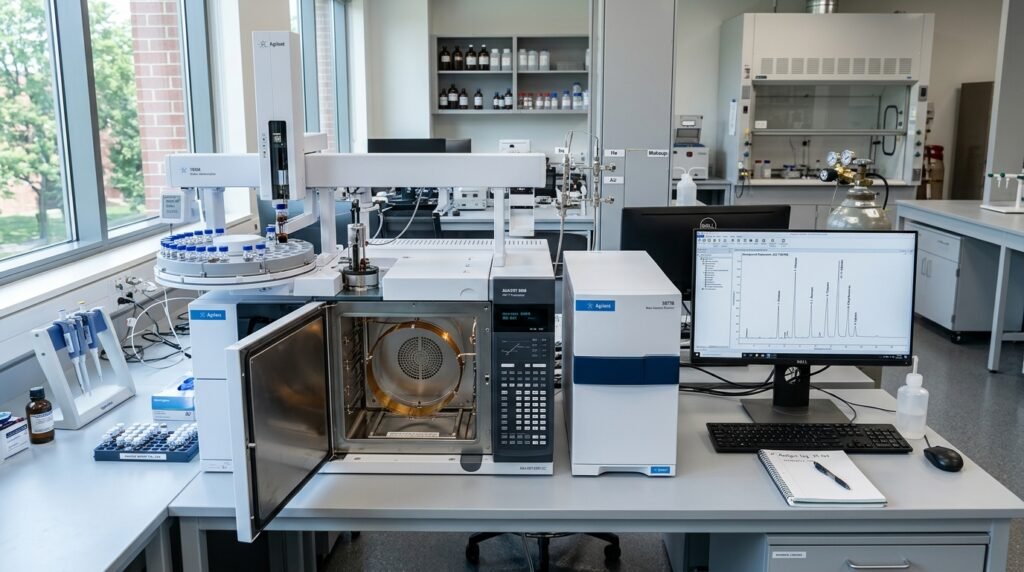
GC Calculation Example
Suppose a GC test provides the following measurements:
- Analyte peak area = 18,000
- Analyte concentration = 6 mg/L
- Reference peak area = 15,000
- Reference concentration = 5 mg/L
Calculate the analyte response factor:
[
RF_x=\frac{18000}{6}=3000
]
Calculate the reference response factor:
[
RF_s=\frac{15000}{5}=3000
]
Calculate the RRF:
[
RRF=\frac{3000}{3000}
]
[
\boxed{RRF=1.00}
]
Both compounds produce the same detector response per unit concentration.
Example 5:
A GC analyst measures two chemical compounds using a flame ionization detector. The analyte produces a peak area of 18,000, while the reference produces 15,000 units. Their concentrations are 6 mg/L and 5 mg/L, respectively.
The calculated relative response factor is 1.00, which means their response per unit concentration is equal under the test conditions.
How to Calculate Unknown Concentration Using RRF
The relative response factor can also help calculate the concentration of an unknown sample.
For an internal standard method where:
[
RRF=\frac{RF_x}{RF_{IS}}
]
The unknown analyte concentration can be calculated using:
[
C_x=\frac{A_x}{A_{IS}}\times\frac{C_{IS}}{RRF}
]
Where:
- (C_x) = Unknown analyte concentration
- (A_x) = Analyte peak area
- (A_{IS}) = Internal standard peak area
- (C_{IS}) = Known internal standard concentration
- (RRF) = Relative response factor
Worked Calculation
Suppose the laboratory has these measurements:
| Measurement | Value |
|---|---|
| Analyte peak area | 2,400 |
| Internal standard peak area | 3,000 |
| Internal standard concentration | 10 mg/L |
| Relative response factor | 0.80 |
Apply the formula:
[
C_x=\frac{2400}{3000}\times\frac{10}{0.80}
]
First, divide the peak areas:
[
\frac{2400}{3000}=0.80
]
Next:
[
\frac{10}{0.80}=12.5
]
Finally:
[
C_x=0.80\times12.5
]
[
\boxed{C_x=10\text{ mg/L}}
]
The unknown analyte concentration is 10 mg/L.
Example 6:
A laboratory technician uses an internal standard to measure an unknown chemical concentration. The analyte peak area is 2,400, and the internal standard peak area is 3,000. The internal standard concentration is 10 mg/L, and the RRF is 0.80.
After applying the internal standard formula, the technician calculates an analyte concentration of 10 mg/L.
This calculation assumes the response factor definition and analytical conditions stated in the method.
Response Factor vs. Relative Response Factor
The terms response factor (RF) and relative response factor (RRF) are related, but they have different meanings.
A response factor measures the detector response of one compound per unit concentration.
A relative response factor compares the response factor of one compound with that of another.
| Feature | Response Factor (RF) | Relative Response Factor (RRF) |
|---|---|---|
| Meaning | Detector response per unit concentration | Comparison between two response factors |
| Calculation | Peak area ÷ concentration | Analyte RF ÷ reference RF |
| Reference compound | Not required for a basic calculation | Required |
| Main use | Measuring detector sensitivity | Correcting response differences |
| Typical result | Depends on detector units and concentration units | Dimensionless ratio |
Main Difference
- RF tells you how strongly the detector responds to one compound.
- RRF tells you how that response compares with another compound.
Example 7:
A laboratory calculates an RF of 4,000 for an impurity and an RF of 5,000 for a reference compound.
The relative response factor is 0.80.
The RF values describe each compound’s detector response, while the RRF compares the two values.
Factors That Affect Response Factor
Several factors can affect the response factor during laboratory testing.
1. Detector Type
Different detectors respond differently to chemical compounds.
For example, an FID detector responds to many organic compounds, while a mass spectrometer measures ions based on their mass-to-charge ratio.
The detector type can affect the measured response.
2. Compound Properties
Chemical structure can affect how strongly a compound responds to a detector.
For example, two compounds with different structures may produce different UV detector signals at the same concentration.
3. Detector Settings
Changes in detector settings may affect the measured peak area or peak height.
Examples include:
- Detector wavelength
- Detector temperature
- Signal gain
- Sampling rate
- Instrument sensitivity
4. Sample Preparation
Incorrect sample preparation can affect the final concentration and detector response.
Common problems include:
- Incorrect dilution
- Inaccurate weighing
- Contaminated glassware
- Poor sample mixing
- Sample loss during preparation
5. Instrument Condition
Instrument condition also matters.
A dirty detector, leaking connection, unstable baseline, or poor injection system may affect measurement results.
6. Calibration Quality
A response factor is only useful when it comes from a suitable calibration method.
Incorrect standards, poor calibration, and measurements outside the detector’s validated range can lead to inaccurate results.
Example 8:
A laboratory technician prepares a standard solution but accidentally uses twice the intended dilution volume.
The actual concentration becomes lower than expected. If the technician uses the incorrect concentration in the response factor formula, the calculated RF will also be incorrect.
This shows why accurate sample preparation and calibration records matter.
Common Mistakes When Calculating Response Factor
Small calculation errors can lead to incorrect laboratory results.
Here are some common mistakes to avoid.
1. Using the Wrong Formula Direction
Some methods define RF as response divided by concentration, while others use concentration divided by response.
Always check the formula used by your laboratory method.
2. Mixing Different Concentration Units
Do not compare concentrations in mg/L and µg/mL without checking their numerical equivalence.
For example:
[
1\text{ mg/L}=1\text{ µg/mL}
]
Keep units consistent throughout your calculation.
3. Using the Wrong Peak Area
Make sure you select the correct chromatographic peak.
Using the wrong peak can produce an incorrect response factor.
4. Ignoring the Relative Response Factor
If an analytical method requires an RRF correction, using only the raw peak area ratio may produce an inaccurate concentration.
5. Using an Incorrect Reference Standard
The reference compound must match the requirements of the analytical method.
An unsuitable reference standard can affect the final calculation.
6. Ignoring the Analytical Method
Different methods may define RF and RRF differently.
Always follow the calculation instructions in the applicable laboratory procedure or official test method.
Example 9:
A technician calculates an RRF using an analyte response factor of 4,000 and a reference response factor of 5,000. The technician accidentally divides 5,000 by 4,000 instead.
The correct result is 0.80, but the incorrect calculation gives 1.25.
This mistake changes the correction factor and may affect the final concentration result.
FAQs About Response Factor Formula
What is the basic response factor formula?
The basic response factor formula is:
[
RF=\frac{\text{Peak Area}}{\text{Concentration}}
]
It measures the detector response per unit concentration. Some methods use the inverse formula, so check the definition in your analytical procedure.
How do you calculate a response factor?
Divide the measured detector response by the known concentration of the standard solution.
For example, if the peak area is 20,000 and the concentration is 4 mg/L:
[
RF=\frac{20000}{4}=5000
]
The response factor is 5,000 area units per mg/L.
What is the formula for relative response factor?
The relative response factor formula is:
[
RRF=\frac{RF_{\text{Analyte}}}{RF_{\text{Reference}}}
]
It compares the detector response of an analyte with a reference compound.
What does an RRF of 1 mean?
An RRF of 1 means the analyte and reference compound have equal response factors under the stated conditions.
Both compounds produce the same detector response per unit concentration.
What does an RRF below 1 mean?
An RRF below 1 means the analyte has a lower response per unit concentration than the reference compound, assuming the analyte response factor is divided by the reference response factor.
For example, an RRF of 0.80 means the analyte response is 80% of the reference response per unit concentration.
What does an RRF above 1 mean?
An RRF above 1 means the analyte produces a higher detector response per unit concentration than the reference compound.
For example, an RRF of 1.25 means its response is 25% higher than the reference response.
What is the response factor in HPLC?
In HPLC, the response factor describes the relationship between a compound’s detector signal and its concentration.
Peak area is commonly used to calculate the response factor.
What is the response factor in GC?
In Gas Chromatography, the response factor describes the relationship between a compound’s detector signal and its concentration or amount.
It helps measure chemical compounds in a sample using detectors such as FID and MS.
Is response factor the same as correction factor?
No. A response factor describes detector response relative to concentration or amount.
A correction factor adjusts a measured result to account for differences in detector response.
In some analytical methods, the correction factor is the reciprocal of the relative response factor:
[
CF=\frac{1}{RRF}
]
However, the exact definition depends on the applicable analytical method.
Why is the relative response factor important in pharmaceutical analysis?
The relative response factor helps laboratories measure impurities when the detector responds differently to the impurity and the main drug substance.
It supports more accurate impurity calculations and quality control testing.
Can response factor be greater than 1?
Yes. A response factor can be greater than 1, depending on the detector response and the units used.
Unlike a relative response factor, a basic response factor is not limited to values between 0 and 1.
Conclusion
The response factor formula is an important calculation in analytical chemistry. It helps scientists relate detector signals to the concentration of a chemical compound.
The basic formula is:
[
RF=\frac{\text{Peak Area}}{\text{Concentration}}
]
The relative response factor (RRF) compares the response of an analyte with a reference compound:
[
RRF=\frac{RF_{\text{Analyte}}}{RF_{\text{Reference}}}
]
These calculations are commonly used in HPLC, GC, pharmaceutical testing, and chemical analysis.
To get accurate results, use the correct formula, maintain consistent units, prepare standards carefully, and follow the analytical method’s instructions. Always check whether your method defines the response factor as response per amount or amount per response before using the result.

Emily Carter (Content Writer & Communication Specialist) is a content writer and communication specialist at AllTypeInfo.com. She writes clear, practical, and easy-to-follow guides on email responses, message replies, writing templates, and everyday communication tips. Her goal is to help readers communicate with confidence in both personal and professional settings.