Have you ever looked at a speaker’s specifications and seen something like 20Hz to 20kHz? You may have wondered what those numbers mean and whether they tell you how good the speaker sounds.
Frequency response in speakers explains how well a speaker reproduces different sound frequencies, from deep bass to high-pitched treble. It helps you see whether a speaker plays certain sounds louder or quieter than others.
In this guide, you will learn what frequency response means, how to read a frequency response graph, what Hz and dB represent, and how to compare speakers before buying one.
What Is Frequency Response in Speakers?
Frequency response is a measurement that shows how loudly a speaker reproduces different sound frequencies when it receives the same input signal.
In simple terms, it tells you how a speaker handles bass, midrange, and treble sounds.
Every sound has a frequency, measured in Hertz (Hz). Lower frequencies create deep sounds, while higher frequencies create sharp and bright sounds.
For example:
- Bass: Deep sounds from kick drums, bass guitars, and explosions.
- Midrange: Most human voices, guitars, and many musical instruments.
- Treble: High-pitched sounds such as cymbals, bells, and some vocal details.
A speaker’s frequency response shows how evenly it reproduces these different sounds.
A speaker with a smooth and relatively flat frequency response usually produces a more balanced sound. A speaker with large peaks or dips may make certain sounds seem louder or quieter than they should.
Example 1:
You are listening to a song with a deep bass guitar, a singer, and high-pitched cymbals. A speaker with a balanced frequency response can reproduce these sounds without making the bass, voice, or cymbals unusually loud.
This example shows why frequency response matters when listening to music. It affects the balance between different parts of a recording.
What Do Hz and kHz Mean in Speaker Frequency Response?
Hz (Hertz) measures how many times a sound wave completes a cycle in one second. kHz (kilohertz) means 1,000 Hertz.
These units describe the pitch of a sound.
The commonly quoted human hearing range is approximately 20Hz to 20,000Hz (20kHz), although actual hearing varies from person to person.
Here is a simple breakdown of the main sound frequency ranges:
| Frequency Range | Sound Type | Common Examples |
|---|---|---|
| 20Hz–60Hz | Deep bass | Sub-bass, powerful movie effects |
| 60Hz–250Hz | Bass | Kick drums, bass guitars |
| 250Hz–500Hz | Lower midrange | Warmth in voices and instruments |
| 500Hz–2kHz | Midrange | Speech, guitars, piano |
| 2kHz–4kHz | Upper midrange | Vocal clarity and presence |
| 4kHz–8kHz | Lower treble | Cymbals and sharp details |
| 8kHz–20kHz | High treble | Brightness and high-frequency detail |
These ranges are approximate. Musical instruments and human voices produce sound across more than one frequency range.
Example 2:
You play a movie with a deep explosion at 40Hz and a character speaking at around 1kHz. A speaker must reproduce both low and middle frequencies to make the scene sound natural.
This shows why a speaker’s bass extension and midrange performance both matter.
What Does 20Hz to 20kHz Mean on Speakers?
When a speaker specification says 20Hz to 20kHz, it describes its stated frequency response range.
The lower number represents the low-frequency limit, while the higher number represents the high-frequency limit.
However, there is something important to check: the measurement tolerance.
For example:
- Speaker A: 20Hz–20kHz, ±3dB
- Speaker B: 20Hz–20kHz, ±10dB
Both speakers show the same frequency range. However, the second specification allows much larger changes in output level.
A speaker rated at ±3dB has a tighter stated response than one rated at ±10dB, assuming the measurements use comparable testing methods.
This is why you should never judge speakers by frequency range alone.
Example 3:
You are comparing two bookshelf speakers. Both advertise 20Hz to 20kHz, but one has a ±3dB rating and the other has a ±10dB rating. The first speaker’s specification suggests more consistent output across the stated range.
This does not prove that the first speaker sounds better in every situation, but it gives you more useful information.
What Is a Flat Frequency Response?
A flat frequency response means a speaker produces different frequencies at nearly the same output level when given an equal input signal.
On a frequency response graph, a flat response appears as a mostly straight horizontal line.
A perfectly flat response is difficult to achieve in a real speaker. Good speaker designs aim for a smooth response with small variations rather than large peaks and dips.
Why does this matter?
- It helps keep bass, voices, and treble balanced.
- It reduces unwanted changes to the original recording.
- It can make music sound more natural.
- It helps audio professionals judge recordings more accurately.
A flat response is especially useful for studio monitors because music producers want to hear the recording without strong changes caused by the speakers.
However, personal taste also matters. Some listeners prefer extra bass or brighter treble.
Example 4:
A music producer uses studio monitors with a smooth frequency response to check whether a song has too much bass or too little treble before releasing it.
This example shows why balanced frequency response is useful in music production.
How to Read a Speaker Frequency Response Graph
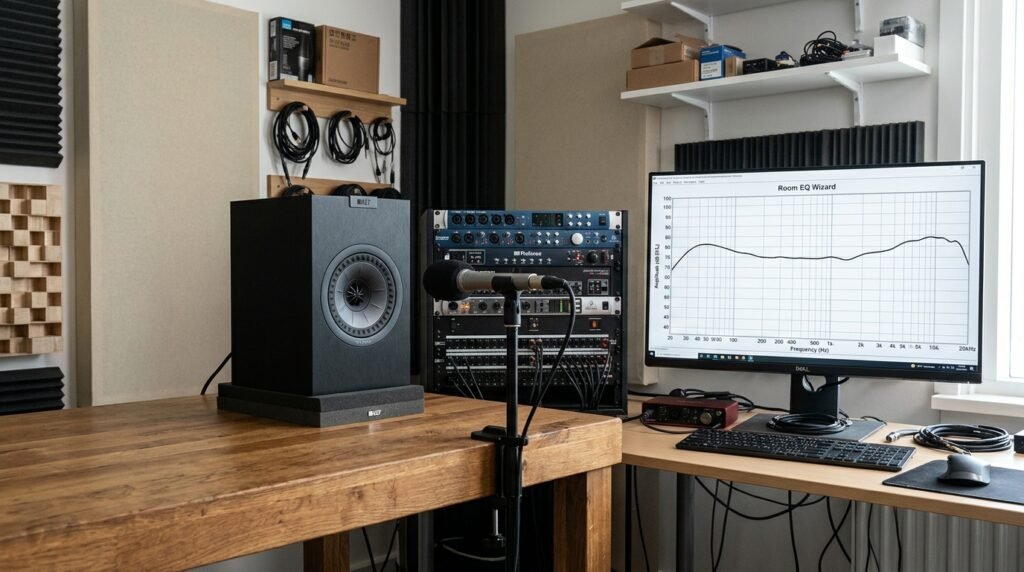
A frequency response graph shows how a speaker performs across different sound frequencies.
You will usually see two main axes:
- Horizontal axis (X-axis): Shows frequency in Hz or kHz.
- Vertical axis (Y-axis): Shows sound level in decibels (dB).
The graph helps you see which frequencies a speaker reproduces more strongly and which frequencies it reproduces less strongly.
1. Understand the Horizontal Axis
The horizontal axis represents the frequency range.
It usually moves from low frequencies on the left to high frequencies on the right.
For example:
- Left side: 20Hz and other low bass frequencies.
- Middle: 1kHz and other midrange frequencies.
- Right side: 10kHz and higher treble frequencies.
The frequency axis is often logarithmic. This means equal distances represent frequency ratios rather than equal numerical increases.
2. Understand the Vertical Axis
The vertical axis usually represents sound pressure level or relative output level in decibels (dB).
A higher point on the graph means the speaker produces a stronger output at that frequency compared with the reference level.
A lower point means the speaker produces a weaker output.
3. Look for Peaks and Dips
A peak is a section where the response rises above nearby frequencies.
A dip is a section where the response falls below nearby frequencies.
Large peaks can make certain sounds too strong. Deep dips can make some parts of music less clear or less noticeable.
4. Check the Overall Shape
Do not focus on just one point.
Look at the entire curve from bass to treble. A smooth response is often a better sign than a graph with large sudden changes.
Example 5:
You open a speaker measurement graph and see a large peak around 100Hz. This may mean the speaker produces stronger bass in that area than in nearby frequencies.
This can make some bass notes sound fuller, but it may also create an uneven sound balance.
What Do +3dB and -3dB Mean in Frequency Response?
Decibels (dB) measure changes in sound level.
When a speaker’s frequency response is described as ±3dB, it means the measured output stays within 3dB above or below the chosen reference level across the stated frequency range.
For example:
- +3dB: Output is 3dB above the reference level.
- 0dB: Output matches the reference level.
- -3dB: Output is 3dB below the reference level.
A speaker specification might look like this:
Frequency Response: 45Hz–20kHz (±3dB)
This means the speaker’s measured output stays within the stated tolerance over that frequency range, using the manufacturer’s measurement method.
A smaller tolerance generally suggests more consistent output.
Here is a simple comparison:
| Specification | What It Suggests |
|---|---|
| ±1dB | Very small variation |
| ±3dB | Relatively controlled variation |
| ±6dB | Larger variation |
| ±10dB | Much larger variation |
These figures are useful only when the measurement methods and reference conditions are comparable.
Example 6:
Two speakers have the same stated frequency range. One is rated at ±3dB, while the other is rated at ±6dB. The ±3dB model has a tighter frequency response specification.
This gives you a useful way to compare the specifications, although it does not replace listening tests.
What Factors Affect Speaker Frequency Response?
Several things can change how a speaker reproduces different frequencies.
1. Speaker Drivers
Speaker drivers are the parts that turn electrical signals into sound.
Different drivers are built to handle different frequency ranges.
- Woofers handle lower frequencies.
- Midrange drivers handle middle frequencies.
- Tweeters reproduce high frequencies.
- Subwoofers handle very low bass frequencies.
A speaker’s driver design affects its frequency response.
2. Speaker Cabinet Design
The speaker cabinet is the enclosure that holds the drivers.
Its size, shape, materials, and internal design can affect bass output and unwanted vibrations.
A poorly controlled cabinet may create unwanted sound changes.
3. Crossover Design
A crossover divides the audio signal into different frequency ranges and sends them to the correct drivers.
For example, a two-way speaker usually sends lower frequencies to its woofer and higher frequencies to its tweeter.
A well-designed crossover helps the drivers work together smoothly.
4. Room Acoustics
Your room can change the sound you hear from a speaker.
Walls, floors, ceilings, furniture, and room size all affect sound reflections and bass behavior.
A speaker may sound balanced in a testing room but produce stronger or weaker bass in your living room.
5. Speaker Placement
Where you place your speakers also matters.
Placing a speaker close to a wall or in a corner can increase some bass frequencies. Moving it away from the wall may change the bass response.
Example 7:
You place a bookshelf speaker directly in a corner. The bass sounds stronger than it did when the speaker was placed farther from the walls.
This happens because nearby room surfaces affect low-frequency sound. It shows why speaker placement matters alongside the manufacturer’s frequency response rating.
What Is the Difference Between Frequency Response and Frequency Range?
These two terms are related, but they do not mean exactly the same thing.
Frequency range tells you the span of frequencies a speaker can reproduce within a stated limit.
Frequency response shows how strongly the speaker reproduces each frequency across that range.
Consider this example:
A speaker has a frequency range of 40Hz to 20kHz.
That number tells you its stated lower and upper limits. It does not tell you whether the bass, midrange, and treble are equally strong.
The frequency response curve provides more detail about that balance.
| Feature | Frequency Range | Frequency Response |
|---|---|---|
| Meaning | Span of frequencies | Output level across frequencies |
| Main Focus | Lowest and highest frequencies | Sound balance |
| Common Display | Two frequency numbers | Graph or range with tolerance |
| Example | 40Hz–20kHz | 40Hz–20kHz, ±3dB |
Example 8:
You see two speakers with a stated range of 40Hz to 20kHz. One has a smooth response curve, while the other has a large dip in the midrange.
Even though their stated ranges match, their sound balance may be quite different.
What Is the Best Frequency Response for Speakers?
There is no single frequency response that is best for every listener or every type of speaker.
The right choice depends on how you plan to use the speakers.
However, a smooth and relatively flat frequency response is a useful starting point if you want balanced sound.
Here are some things to look for:
- A smooth response across the midrange.
- No unusually large peaks or dips.
- Enough bass extension for your listening needs.
- Clear treble without excessive sharpness.
- Reliable measurements with a stated tolerance.
Best Frequency Response for Music
For general music listening, look for speakers with a smooth response across bass, midrange, and treble.
A balanced speaker can reproduce vocals and instruments without making one part of the recording stand out too much.
Best Frequency Response for Movies
For home theater systems, speakers should reproduce dialogue clearly and handle sound effects across a wide frequency range.
A separate subwoofer can help reproduce deep bass that smaller speakers may struggle to produce.
Best Frequency Response for Studio Monitors
Studio monitors are often built to provide a smooth and controlled response.
This helps producers hear problems in a recording without strong tonal changes from the speakers.
Example 9:
A person who mainly watches action movies chooses a speaker system with good midrange performance and adds a subwoofer for deeper bass effects.
The right setup depends on room size, speaker placement, and personal listening needs.
Does a Wider Frequency Response Mean Better Speakers?
No. A wider frequency response does not automatically mean better sound quality.
For example, a speaker rated at 20Hz to 40kHz is not always better than one rated at 40Hz to 20kHz.
The wider specification tells you that the first speaker has a greater stated frequency span. It does not show how evenly it reproduces those frequencies.
You should also check:
- Frequency response tolerance
- Measurement conditions
- On-axis and off-axis performance
- Distortion
- Sensitivity
- Maximum output level
- Speaker build quality
A speaker that produces a smooth response across its useful range may be a better choice than one with a very wide range but large response variations.
Example 10:
You compare two speakers. One advertises a range up to 40kHz, while the other stops at 20kHz but has a smoother measured response across the audible range.
For most listeners, the second speaker may be the more useful choice if balanced sound is the goal.
How Can You Improve the Frequency Response of Your Speakers?
You cannot change every part of a speaker’s built-in response, but you can improve the sound you hear in your room.
Try these steps:
1. Adjust Speaker Placement
Move your speakers away from corners and experiment with the distance from nearby walls.
Small changes can affect bass response.
2. Use Room Treatment
Soft furnishings, carpets, curtains, and suitable acoustic panels can help control certain room reflections.
They do not fix every acoustic problem, but they can improve listening conditions.
3. Adjust Equalization
Equalization (EQ) allows you to increase or reduce selected frequency ranges.
For example, you can reduce a bass peak or make a small adjustment to the treble.
Avoid making large changes without checking the result carefully.
4. Use a Subwoofer Correctly
A suitable subwoofer can extend the low-frequency response of a system.
Correct crossover settings and placement help it blend with the main speakers.
5. Measure Your Room
A measurement microphone and audio measurement software can help you check the response at your listening position.
This gives you a clearer picture of how your speakers and room work together.
Example 11:
You notice that music sounds too bass-heavy in your living room. You move the speakers away from the corners and use a small EQ adjustment to reduce the bass peak.
This can improve the sound without replacing the speakers.
Frequently Asked Questions About Speaker Frequency Response
What is a good frequency response for speakers?
A good frequency response is generally smooth and relatively flat across the speaker’s useful frequency range. A specification such as ±3dB can help you compare speakers, provided the measurements use similar methods.
Is 20Hz to 20kHz good for speakers?
Yes, it is a wide stated range that covers the commonly quoted human hearing range. However, check the dB tolerance because the range alone does not show how evenly the speaker reproduces sound.
Does higher Hz mean better sound?
No. Higher frequencies represent higher-pitched sounds, not better sound quality. A speaker needs balanced bass, midrange, and treble to reproduce audio naturally.
What does 50Hz to 20kHz mean on a speaker?
It means the speaker has a stated frequency range from 50Hz to 20kHz. It indicates its low and high frequency limits, but you should also check the response tolerance.
Is a flat frequency response better?
A smooth, relatively flat response is often preferred for accurate music playback and studio work. However, some listeners prefer a different sound balance, such as stronger bass.
What frequency response is best for bass?
For deep bass, look for a speaker with good low-frequency extension. A speaker that reaches around 20Hz can reproduce very deep bass if its output remains strong enough at that frequency. A separate subwoofer may be useful for deep bass reproduction.
What is the difference between Hz and kHz?
Hz means Hertz, or cycles per second. kHz means kilohertz, equal to 1,000 Hertz. Both units measure sound frequency.
Can a speaker have a wide frequency range but poor sound quality?
Yes. A speaker can have a wide stated frequency range but still produce uneven sound. Its frequency response curve, distortion, and other performance measurements also matter.
Does room size affect speaker frequency response?
Yes. Room dimensions, wall reflections, speaker placement, and furniture can change the sound you hear. This is especially noticeable in the bass range.
How can I check my speaker’s frequency response?
You can check the manufacturer’s specifications or use a measurement microphone with suitable audio measurement software. A controlled measurement gives more useful results than relying on a phone microphone alone.
Conclusion
Frequency response in speakers tells you how evenly a speaker reproduces different sound frequencies, from deep bass to high-pitched treble.
When comparing speakers, do not focus only on numbers such as 20Hz to 20kHz. Check the frequency response graph, its dB tolerance, and the conditions used for testing.
A smooth response is a good starting point for balanced sound. Also consider your room, speaker placement, listening habits, and whether you need a separate subwoofer.
The best speaker is one that meets your listening needs and produces sound you enjoy.

Emily Carter (Content Writer & Communication Specialist) is a content writer and communication specialist at AllTypeInfo.com. She writes clear, practical, and easy-to-follow guides on email responses, message replies, writing templates, and everyday communication tips. Her goal is to help readers communicate with confidence in both personal and professional settings.