DNA carries the instructions that help cells grow, work, and reproduce. However, DNA can become damaged by sunlight, harmful chemicals, radiation, and normal cell activity. If this damage is not handled correctly, it can cause changes in genetic information and affect how cells work.
This is where the DNA damage response (DDR) comes in. It is a group of processes that help cells detect damaged DNA, send warning signals, repair the damage, or stop badly damaged cells from dividing.
The DNA damage response plays a major role in keeping genetic information stable. It also helps researchers study cancer, inherited conditions, and other diseases linked to problems in DNA repair.
In this guide, you will learn how the DNA damage response works, which proteins take part in it, the main repair pathways, and why this process matters in human health.
What Is DNA Damage Response?
The DNA damage response (DDR) is a network of proteins and cell processes that detects DNA damage, sends signals, and helps repair damaged genetic material.
DNA is made of two connected strands that form a double-helix shape. Each strand contains genetic information. When one or both strands become damaged, a cell must respond to prevent the damage from causing further problems.
The DNA damage response has three main jobs:
- Detect damage: Special proteins identify damaged areas in DNA.
- Send signals: Other proteins pass messages that help control the cell’s response.
- Repair or remove damaged cells: Repair proteins fix the DNA, while other processes may stop cell division or trigger cell death.
The response depends on the type and level of damage. Some problems can be repaired quickly, while serious damage may require the cell to stop dividing.
Example 1:
A skin cell receives damage to its DNA after exposure to ultraviolet (UV) sunlight. The DNA damage response detects the problem and activates repair proteins to help correct the damaged DNA.
This example shows how cells respond to everyday environmental exposure. The repair process helps protect genetic information from permanent changes.
What Causes DNA Damage?
DNA damage can happen for many reasons. Some sources come from outside the body, while others are part of normal cell activity.
Here are some common causes.
1. Ultraviolet Radiation
Ultraviolet (UV) radiation comes mainly from sunlight and some artificial sources, such as tanning equipment.
UV radiation can cause nearby DNA bases to form abnormal connections. These changes can interfere with normal DNA copying and reading.
For example, UV exposure can produce cyclobutane pyrimidine dimers, which are abnormal links between neighboring DNA bases.
Example 2:
A person spends several hours in strong sunlight without enough skin protection. UV radiation can damage DNA in skin cells and create problems that the cells must repair.
This shows why protection from excessive UV exposure matters for skin health.
2. Ionizing Radiation
Ionizing radiation includes certain forms of radiation that carry enough energy to damage DNA.
Examples include:
- X-rays
- Gamma rays
- Some radioactive materials
This type of radiation can damage DNA bases and break one or both DNA strands.
A double-strand break is especially serious because both strands of the DNA molecule are broken.
3. Harmful Chemicals
Some chemicals can react with DNA and change its structure.
Examples include certain substances found in tobacco smoke, industrial chemicals, and environmental pollutants.
These substances may create DNA changes called DNA adducts. An adduct forms when a chemical attaches to DNA.
4. Normal Cell Activity
DNA damage does not always come from outside the body.
Normal cell processes can also produce harmful substances called reactive oxygen species (ROS). These molecules can react with DNA and damage its bases or structure.
Cells have repair systems that deal with many of these problems.
5. Errors During DNA Replication
Before a cell divides, it copies its DNA. This process is called DNA replication.
Sometimes, the copying process makes mistakes. DNA repair systems can detect and correct many of these errors.
If a mistake remains, it may become a permanent mutation after further cell division.
How Does the DNA Damage Response Work?
The DNA damage response works through several connected steps. These steps allow a cell to detect a problem, control cell division, and select the right repair method.
Step 1: Detection of DNA Damage
The first step is identifying damaged DNA.
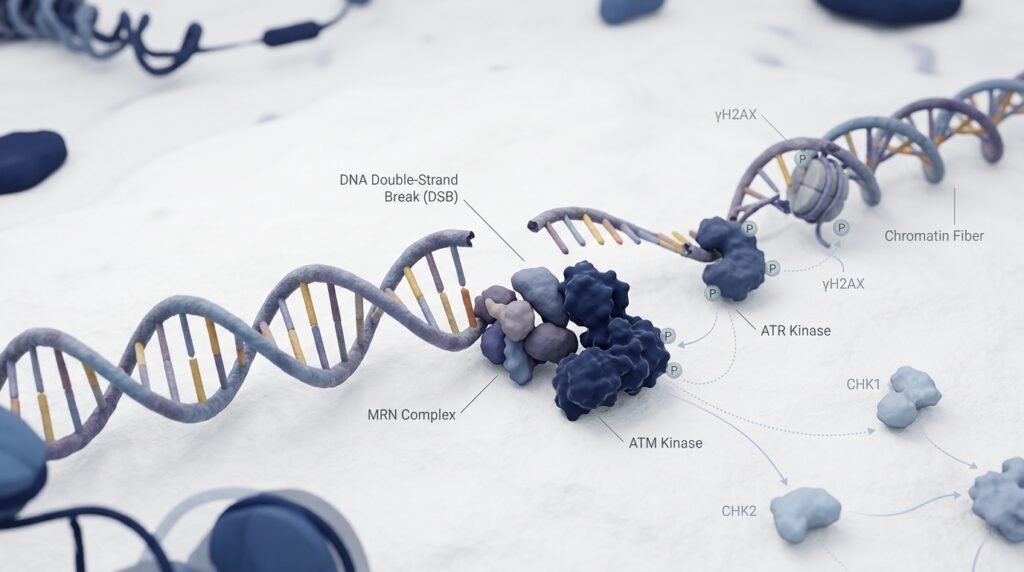
Special proteins act as damage sensors. They recognize changes such as broken DNA strands, damaged bases, and problems during DNA replication.
Different sensors respond to different types of damage.
For example:
- PARP1 helps detect and respond to DNA strand breaks.
- The MRN complex helps recognize and process double-strand breaks.
- RPA proteins bind to exposed single-stranded DNA during certain damage responses.
Once damage is detected, these proteins help activate other parts of the response.
Step 2: Damage Signaling
After detecting damage, the cell sends signals to other proteins.
Two major signaling proteins are ATM and ATR.
- ATM (Ataxia Telangiectasia Mutated): Mainly responds to DNA double-strand breaks.
- ATR (ATM and Rad3-Related): Responds to problems such as exposed single-stranded DNA and stalled DNA replication.
These proteins activate other signaling molecules, including CHK1 and CHK2.
The signals help the cell decide whether to pause division, repair DNA, or activate other protective processes.
Example 3:
A cell develops a double-strand break during DNA replication. The ATM signaling pathway helps activate proteins that control the cell cycle and support DNA repair.
This example explains how damage detection can lead to a wider response inside the cell.
Step 3: Cell Cycle Checkpoints
The cell cycle is the series of stages a cell passes through as it grows and divides.
Before moving to the next stage, cells use checkpoints to check whether important processes are complete and whether DNA is safe to copy or pass to new cells.
The DNA damage response can pause the cell cycle when damage is detected.
Important checkpoint proteins include:
- CHK1: Helps control cell cycle progression, especially during replication stress.
- CHK2: Helps control responses to DNA damage, often through ATM signaling.
- p53: A protein that can stop cell division and activate other protective responses.
A temporary pause gives repair proteins more time to correct DNA damage.
Step 4: DNA Repair
After damage is detected and the right signals are activated, repair proteins work on the damaged DNA.
The repair method depends on the type of damage.
For example, a damaged DNA base may need a different repair process from a break affecting both DNA strands.
Some repair pathways replace damaged sections, while others reconnect broken DNA ends.
Step 5: Cell Survival or Cell Death
Sometimes, DNA damage is too serious to repair safely.
In such cases, the cell may activate apoptosis, which is a controlled form of cell death.
Another possible result is cellular senescence. This means the cell permanently stops dividing but remains alive for some time.
These processes help prevent severely damaged cells from producing more cells with harmful genetic changes.
What Are the Main DNA Damage Response Pathways?
The DNA damage response includes several repair pathways. Each one deals with particular types of DNA damage.
Here are the major pathways.
1. Base Excision Repair (BER)
Base excision repair (BER) fixes small DNA base changes.
These changes may happen because of oxidation, chemical reactions, or normal cell activity.
The process generally includes:
- A DNA repair enzyme called a DNA glycosylase identifies an abnormal base.
- The damaged base is removed.
- Other enzymes process the damaged area.
- DNA polymerase adds the correct DNA building block.
- DNA ligase seals the repaired section.
BER is especially useful for repairing small changes that do not greatly affect the DNA structure.
Example 4:
A cell develops an oxidized DNA base after exposure to reactive oxygen species. Base excision repair removes the damaged base and helps restore the correct DNA sequence.
This example shows how cells deal with damage caused by normal chemical activity.
2. Nucleotide Excision Repair (NER)
Nucleotide excision repair (NER) removes larger DNA damage that changes the shape of the DNA double helix.
One common example is damage caused by UV radiation.
The NER process identifies the damaged area, removes a short section of DNA around it, and replaces that section with newly made DNA.
Two major forms of NER are:
- Global genome NER: Checks the whole genome for certain types of DNA damage.
- Transcription-coupled NER: Focuses on damage that blocks active gene transcription.
NER is important for protecting cells from DNA damage caused by sunlight and certain chemicals.
3. Mismatch Repair (MMR)
Mismatch repair (MMR) corrects mistakes that happen during DNA replication.
For example, a DNA copying error may place the wrong base opposite another base.
MMR proteins identify the mismatch, remove the incorrect section, and help replace it with the correct DNA sequence.
Important proteins include:
- MSH2
- MSH6
- MLH1
- PMS2
Problems in mismatch repair can allow DNA copying errors to build up over time.
4. Homologous Recombination (HR)
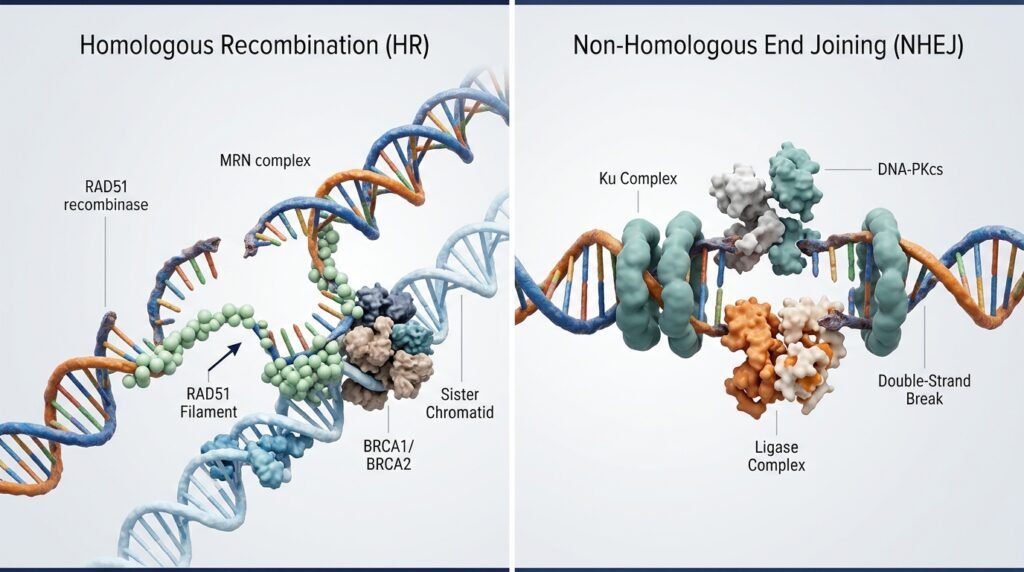
Homologous recombination (HR) is a repair pathway that fixes serious DNA damage, especially double-strand breaks.
It uses a matching DNA sequence as a guide to repair the damaged area. In many dividing cells, the matching copy comes from a sister chromatid.
This makes HR a relatively accurate repair method.
Important proteins include:
- BRCA1
- BRCA2
- RAD51
- PALB2
These proteins help prepare damaged DNA and guide the repair process.
Example 5:
A dividing cell develops a double-strand DNA break. The homologous recombination pathway uses a matching DNA copy as a guide to help restore the damaged section.
This example shows how a cell can use an existing DNA copy to make a more accurate repair.
5. Non-Homologous End Joining (NHEJ)
Non-homologous end joining (NHEJ) is another major pathway for repairing double-strand breaks.
Unlike homologous recombination, NHEJ directly reconnects the broken DNA ends. It does not need a matching DNA template.
The process is generally faster and can operate throughout the cell cycle.
Important proteins include:
- Ku70
- Ku80
- DNA-PKcs
- XRCC4
- DNA ligase IV
However, NHEJ can sometimes introduce small changes at the repair site, such as the loss or addition of DNA bases.
6. Fanconi Anemia Pathway
The Fanconi anemia (FA) pathway helps repair certain types of DNA damage, especially interstrand crosslinks.
These crosslinks occur when the two DNA strands become chemically linked together. This makes it difficult for the cell to copy or read its DNA.
The FA pathway works with other repair systems, including homologous recombination, to manage this damage.
Problems in this pathway can cause Fanconi anemia, an inherited condition linked to bone marrow failure and an increased risk of certain cancers.
What Is the Role of ATM and ATR in DNA Damage Response?
ATM and ATR are two major proteins that control DNA damage signaling.
Both belong to a group of enzymes called protein kinases. These enzymes add phosphate groups to other proteins, which can change their activity.
Although ATM and ATR work together in the wider DNA damage response, they respond to different types of problems.
ATM: Responding to Double-Strand Breaks
ATM mainly responds to DNA double-strand breaks.
When this type of damage occurs, the MRN complex helps recognize the broken DNA and supports ATM activation.
ATM can then activate proteins such as:
- CHK2
- p53
- Other proteins involved in DNA repair and cell cycle control
These signals help pause cell division and support repair.
ATR: Responding to Replication Stress
ATR mainly responds to exposed single-stranded DNA and problems during DNA replication.
For example, a replication fork may slow down or stop when it meets damaged DNA.
ATR helps protect the affected DNA and activates CHK1, which supports cell cycle control and repair.
ATM vs. ATR: Main Differences
| Feature | ATM | ATR |
|---|---|---|
| Full name | Ataxia Telangiectasia Mutated | ATM and Rad3-Related |
| Main role | Responds mainly to double-strand breaks | Responds mainly to replication stress and exposed single-stranded DNA |
| Key signaling partner | CHK2 | CHK1 |
| Main function | Damage signaling and cell cycle control | Replication protection and cell cycle control |
Both proteins help maintain genetic stability. Their activities also overlap in some DNA damage situations.
What Is the Role of p53 in DNA Damage Response?
p53 is a protein that helps protect cells from serious genetic damage.
It is often called the guardian of the genome because it can stop cells with damaged DNA from continuing to divide.
When DNA damage occurs, signaling proteins such as ATM and ATR can help activate p53.
The p53 protein can then produce several possible responses.
1. Stopping Cell Division
p53 can activate a protein called p21.
p21 helps stop certain cell cycle activities, giving the cell time to repair its DNA.
2. Supporting DNA Repair
p53 helps control genes involved in DNA repair and cell survival.
3. Triggering Apoptosis
If DNA damage is too severe, p53 can activate genes that help start apoptosis.
This process removes cells that may otherwise develop harmful genetic changes.
Example 6:
A cell experiences serious DNA damage that cannot be repaired safely. p53 activates signals that may cause the cell to stop dividing and enter controlled cell death.
This helps limit the spread of damaged genetic material to new cells.
Why Is DNA Damage Response Important?
The DNA damage response has several important roles in normal cell activity and human health.
1. Protects Genetic Information
DNA contains the instructions needed for normal cell activity.
The DDR helps correct damage before it causes lasting changes in genetic information.
2. Supports Normal Cell Division
Cells must copy their DNA before dividing.
The DNA damage response checks for problems and can pause the cell cycle when needed.
3. Helps Prevent Cancer
Cancer can develop when cells collect genetic changes that affect normal growth and division.
The DNA damage response helps limit this risk by repairing damaged DNA or stopping severely damaged cells from dividing.
However, it does not prevent every cancer. Other genetic and environmental factors also affect cancer development.
4. Supports Normal Tissue Function
Many tissues depend on healthy cells to replace old or damaged ones.
DNA repair systems help protect the genetic information needed for this process.
5. Helps Maintain Genome Stability
Genome stability means keeping genetic information as accurate and consistent as possible.
A working DNA damage response reduces the chance that DNA damage will become permanent mutations or larger chromosome changes.
What Happens When DNA Damage Is Not Repaired?
When DNA damage remains unrepaired, it can cause several problems.
The effects depend on the type of damage, the cell involved, and how the cell responds.
1. Mutations
A mutation is a permanent change in DNA sequence.
Some mutations have little effect, while others can affect important genes and cell functions.
2. Genomic Instability
Genomic instability occurs when genetic material becomes more likely to collect changes.
It may involve DNA sequence changes, chromosome breaks, or abnormal chromosome arrangements.
3. Cell Death
Severe DNA damage can activate apoptosis.
This removes cells that cannot safely continue their normal activities.
4. Cellular Senescence
Some damaged cells stop dividing permanently.
This is called cellular senescence. It can help prevent the growth of damaged cells, although senescent cells can also affect nearby tissues.
5. Cancer Development
If important genes that control cell growth and DNA repair become damaged, cells may lose normal growth controls.
Over time, this can contribute to cancer development.
However, DNA damage alone does not mean that a person will develop cancer.
What Is the Connection Between DNA Damage Response and Cancer?
The DNA damage response is closely linked to cancer research.
Cancer cells often have changes in genes and proteins involved in DNA repair. These changes can allow genetic errors to build up.
Some cancer cells also depend heavily on their remaining DNA repair pathways to survive.
Researchers use these differences to study treatments that target the DNA repair systems of cancer cells.
BRCA1 and BRCA2 Mutations
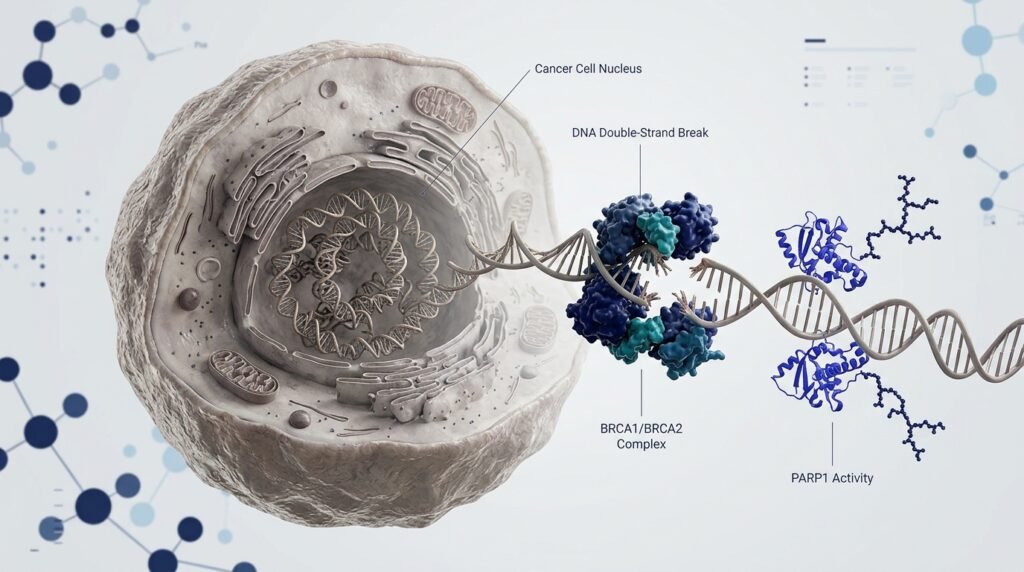
BRCA1 and BRCA2 are genes involved in homologous recombination.
Certain inherited harmful variants in these genes increase the risk of breast, ovarian, prostate, and other cancers.
Cells with defective BRCA-related repair may have trouble fixing double-strand DNA breaks through homologous recombination.
PARP Inhibitors
PARP inhibitors are medicines that block the activity of PARP proteins, which take part in DNA repair.
Some cancers with harmful BRCA1 or BRCA2 changes are especially sensitive to these medicines.
This approach is an example of synthetic lethality.
Synthetic lethality happens when a cell can survive one damaged repair pathway but dies when a second pathway is also blocked.
Example 7:
A cancer cell has a harmful BRCA-related repair defect. A doctor may consider a PARP inhibitor if the cancer type and approved treatment guidelines support its use.
This example shows how knowledge of DNA repair can help guide certain cancer treatments. Treatment decisions depend on the patient’s diagnosis, test results, and medical team.
Other DNA Damage Response Targets
Scientists are also studying medicines that target proteins such as:
- ATM
- ATR
- CHK1
- WEE1
- DNA-PK
These targets are being studied in different cancer types and treatment combinations. Their clinical status and approved uses vary.
How Do Scientists Study DNA Damage Response?
Researchers use laboratory methods to study how cells detect, signal, and repair DNA damage.
These methods help scientists identify repair proteins and learn how DNA damage affects cell behavior.
1. Western Blotting
Western blotting is a laboratory method used to detect specific proteins in a sample.
Researchers may use it to check whether proteins such as ATM, ATR, or p53 become activated after DNA damage.
2. Immunofluorescence
Immunofluorescence uses antibodies linked to fluorescent markers to identify proteins inside cells.
Scientists can use this method to observe DNA damage markers, such as gamma-H2AX (γH2AX).
3. Comet Assay
The comet assay is a laboratory test used to measure DNA damage in individual cells.
Damaged DNA can move through a gel during the test, creating a shape that may look like a comet under a microscope.
The test can help researchers study DNA strand breaks.
4. Flow Cytometry
Flow cytometry measures different features of individual cells as they pass through a laser-based instrument.
Researchers may use it to study cell cycle changes, cell death, and other responses after DNA damage.
5. DNA Sequencing
DNA sequencing helps scientists examine the order of DNA bases.
It can be used to identify mutations and study changes in genes involved in DNA repair.
What Factors Affect DNA Repair?
DNA repair depends on several factors.
Type of DNA Damage
Different types of damage require different repair pathways.
For example, base excision repair handles certain damaged bases, while homologous recombination can repair double-strand breaks.
Cell Cycle Stage
Some repair pathways work best at particular stages of the cell cycle.
For example, homologous recombination mainly operates during the S and G2 phases, when a matching DNA copy is available.
Repair Protein Activity
Cells need working repair proteins to respond to DNA damage.
Changes in genes such as BRCA1, BRCA2, ATM, and other repair-related genes can affect this process.
Age and Cell Type
DNA damage and repair activity can vary between cell types and across different stages of life.
Cells that divide often may face different repair needs from cells that rarely divide.
Environmental Exposure
Factors such as UV radiation, certain chemicals, and ionizing radiation can increase the amount or type of DNA damage that cells face.
DNA Damage Response vs. DNA Repair: What Is the Difference?
These two terms are closely related, but they do not mean exactly the same thing.
DNA repair refers to the processes that correct damaged DNA.
DNA damage response (DDR) is the wider system that detects damage, sends signals, controls the cell cycle, coordinates repair, and may trigger cell death.
| Feature | DNA Damage Response | DNA Repair |
|---|---|---|
| Meaning | Complete response to DNA damage | Process of correcting DNA damage |
| Main role | Detects, signals, and manages damage | Fixes damaged DNA |
| Proteins | ATM, ATR, CHK1, CHK2, p53, and repair proteins | DNA glycosylases, polymerases, ligases, RAD51, and others |
| Cell cycle control | Yes | Not its main role |
| Cell death control | Can activate apoptosis | Does not directly describe cell death |
In simple terms, DNA repair is one part of the DNA damage response.
Common Misconceptions About DNA Damage Response
There are several common misunderstandings about this topic.
Misconception 1: All DNA Damage Causes Cancer
Fact: Many types of DNA damage are repaired successfully. Some damage has little effect, while other damage may lead to cell death. Cancer risk depends on several factors.
Misconception 2: DNA Repair and DNA Damage Response Are the Same
Fact: DNA repair is one part of the wider DDR system. The response also includes damage detection, signaling, and cell cycle control.
Misconception 3: Every DNA Repair Pathway Works the Same Way
Fact: Different pathways repair different types of DNA damage. Each has its own proteins and steps.
Misconception 4: ATM and ATR Have Identical Functions
Fact: ATM mainly responds to double-strand breaks, while ATR has a major role in replication stress and exposed single-stranded DNA. Their functions can overlap.
Misconception 5: DNA Damage Always Leads to Cell Death
Fact: Cells can repair many types of DNA damage. Cell death is one possible response when damage is too serious to repair safely.
Frequently Asked Questions About DNA Damage Response
What does DDR stand for in biology?
DDR stands for DNA Damage Response. It refers to the network of proteins and processes that detect DNA damage, send signals, and help cells repair damaged genetic material.
What are the three main steps of DNA damage response?
The three broad stages are damage detection, damage signaling, and DNA repair or cell fate control. The cell may also stop dividing or activate apoptosis if the damage is too serious.
What proteins are involved in DNA damage response?
Important proteins include ATM, ATR, CHK1, CHK2, p53, PARP1, BRCA1, BRCA2, and RAD51. Different proteins perform different jobs in damage detection, signaling, and repair.
What is the difference between ATM and ATR?
ATM mainly responds to DNA double-strand breaks. ATR mainly responds to replication stress and exposed single-stranded DNA. Both help control cell cycle checkpoints and DNA repair.
What are the main DNA repair pathways?
Major DNA repair pathways include base excision repair (BER), nucleotide excision repair (NER), mismatch repair (MMR), homologous recombination (HR), and non-homologous end joining (NHEJ). Other pathways handle specific types of DNA damage.
How is DNA damage response linked to cancer?
Problems in DNA repair can allow genetic changes to build up inside cells. These changes can contribute to cancer development. Researchers also study repair defects to find ways to make certain cancer treatments more effective.
What is the role of p53 in DNA damage response?
p53 helps protect cells by controlling cell division and activating genes involved in repair. When DNA damage is too serious, it can also help trigger apoptosis.
Can DNA damage be repaired?
Yes. Cells have several repair pathways that correct many types of DNA damage. However, some damage may remain unrepaired or be repaired incorrectly.
What is synthetic lethality in DNA repair?
Synthetic lethality occurs when a cell can survive one repair pathway defect but dies when another pathway is also blocked. Researchers use this idea in treatments such as certain PARP inhibitors for selected cancers.
Why is DNA damage response important in research?
It helps scientists study how cells protect genetic information, how cancer develops, and why some cancer cells respond to specific treatments. It also supports research into inherited conditions linked to DNA repair problems.
Conclusion
The DNA damage response (DDR) is an important system that protects cells from harmful changes in their genetic material. It detects damaged DNA, sends signals, controls cell division, and activates repair pathways.
Proteins such as ATM, ATR, CHK1, CHK2, and p53 help manage this process. Repair pathways such as BER, NER, MMR, HR, and NHEJ deal with different types of DNA damage.
When these systems do not work correctly, DNA changes can build up and contribute to diseases, including cancer. Studying the DNA damage response helps researchers learn how cells maintain genetic stability and how certain cancer treatments can target weaknesses in DNA repair.
Learning the difference between DNA damage signaling and DNA repair is a useful starting point for anyone studying genetics, cell biology, or cancer research.

Emily Carter (Content Writer & Communication Specialist) is a content writer and communication specialist at AllTypeInfo.com. She writes clear, practical, and easy-to-follow guides on email responses, message replies, writing templates, and everyday communication tips. Her goal is to help readers communicate with confidence in both personal and professional settings.