Pivotal Response Training (PRT) is an approach used in Applied Behavior Analysis (ABA) to support autistic children as they develop communication, social interaction, play, and learning skills. It uses a child’s interests and everyday activities to create natural learning opportunities.
Many parents want to know how pivotal response training ABA works and whether it could help their child. Unlike teaching every skill through repeated instructions, PRT uses activities that interest the child. A therapist or parent can use toys, games, snacks, and daily routines to encourage communication and participation.
In this guide, you will learn what PRT means, its four main skill areas, how therapists use it, practical examples, possible benefits, and how parents can take part.
What Is Pivotal Response Training ABA?
Pivotal Response Training (PRT) is a naturalistic behavioral intervention based on the principles of Applied Behavior Analysis (ABA). It is used to support autistic children by teaching important developmental skills through everyday activities and interactions.
The word pivotal refers to skills that may affect several areas of a child’s development. Instead of teaching only one specific behavior at a time, PRT focuses on skills such as motivation, communication, social initiation, and self-management.
For example, a child who learns to ask for a favorite toy may begin using communication skills in other situations. The same skill could help the child request food, choose an activity, or ask someone for help.
PRT often takes place in natural settings, including:
- The family home
- Preschool classrooms
- Play areas
- Therapy rooms
- Community settings
A trained therapist, teacher, or parent may use PRT strategies during play and daily routines.
What Does PRT Stand For?
PRT stands for Pivotal Response Training or Pivotal Response Treatment. Both names are commonly used to describe this approach.
It is also called a naturalistic intervention because teaching takes place during normal activities instead of relying only on formal lessons.
What Is the Main Goal of PRT?
The main goal is to support important skills that may help children communicate, participate, make choices, and learn in different situations.
PRT may focus on:
- Encouraging communication.
- Supporting social interaction.
- Building motivation to participate.
- Teaching children to make choices.
- Developing independent skills.
- Supporting flexible responses to different instructions.
The goals should be meaningful to the child and should respect their needs, preferences, and communication style.
The Four Pivotal Skills in PRT
PRT focuses on four main areas of development. These skills are called pivotal because progress in one area may support learning in other areas.
1. Motivation
Motivation means helping a child become interested in an activity and willing to participate.
PRT uses a child’s favorite toys, games, foods, and activities to create learning opportunities.
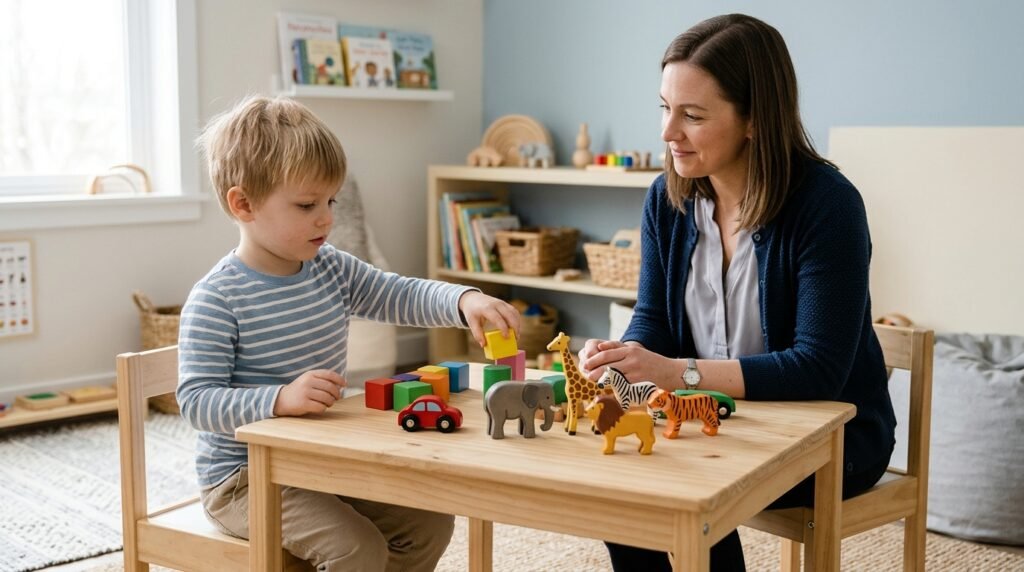
For example, a therapist may use a child’s favorite toy car to encourage communication. Instead of asking the child to repeat unrelated words, the therapist creates an opportunity to request the car.
Example 1:
A child enjoys playing with toy cars. The therapist places a favorite car nearby and waits for the child to communicate that they want it. The child says “car,” and the therapist gives them the toy.
This example shows how a child’s interest can create a natural opportunity to practice communication.
2. Responding to Multiple Cues
Responding to multiple cues means noticing and responding to more than one piece of information.
A child may need to consider different details, such as an object’s color, size, shape, or name.
For example, a therapist may ask a child to find a large red ball among several toys. The child needs to pay attention to both the size and color.
Example 2:
A therapist places a small blue ball and a large red ball on a table. The therapist asks the child to pick up the large red ball. The child looks at both details and selects the correct one.
This activity gives the child an opportunity to practice responding to multiple instructions and visual cues.
3. Self-Management
Self-management means helping children take part in managing their own activities and goals.
Depending on the child’s age and abilities, this may include:
- Following a simple activity plan.
- Checking completed tasks.
- Choosing between activities.
- Recognizing when a task is finished.
- Asking for a break.
- Tracking progress with visual support.
Example 3:
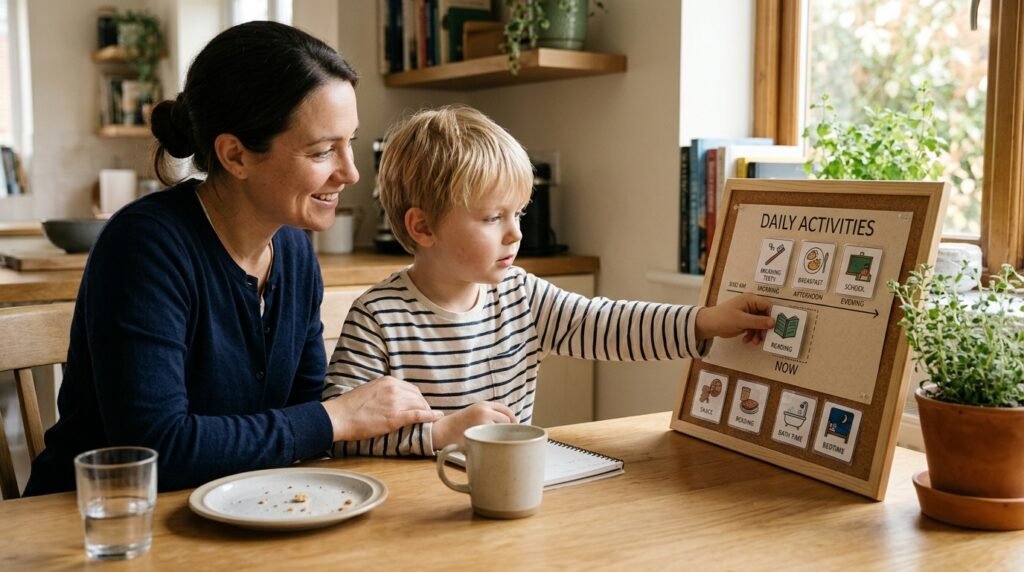
A child uses a picture schedule to complete a morning routine. After brushing their teeth, they move the picture card to the completed section.
This example shows how visual tools can support independence and self-management.
4. Self-Initiation
Self-initiation means starting an interaction, activity, or communication without waiting for someone else to give an instruction.
This skill can help children express their needs and interests more independently.
Examples include:
- Asking someone to play.
- Requesting a favorite snack.
- Starting a conversation.
- Asking for assistance.
- Bringing a toy to another person.
- Using speech, gestures, pictures, or an AAC device to communicate.
Example 4:
A child sees their parent sitting nearby with a favorite book. The child brings the book over and uses a word or gesture to ask the parent to read it.
This example shows how a child can start an interaction based on their own interest.
How Does Pivotal Response Training Work?
PRT uses everyday situations to create learning opportunities. A therapist follows the child’s interests while encouraging useful communication and social skills.
The exact activities depend on the child’s goals, age, abilities, and preferences.
Here are some common steps used during a PRT activity.
Step 1: Follow the Child’s Interests
The therapist observes what the child enjoys.
This may include building blocks, drawing, puzzles, toy animals, or outdoor games.
Following the child’s interests can make activities more engaging.
Step 2: Offer Choices
The child receives opportunities to choose between activities or objects.
For example, the therapist may offer a choice between a ball and a toy train.
The child can communicate their choice through speech, gestures, pointing, pictures, or an Augmentative and Alternative Communication (AAC) device.
Step 3: Create Natural Learning Opportunities
The therapist creates a situation in which the child has a reason to communicate or participate.
For example, a favorite toy may be placed within view but outside easy reach.
The therapist gives the child time to request it without forcing a response.
Step 4: Encourage Attempts
PRT recognizes meaningful attempts, even when a child does not use a complete word or sentence.
If a child says part of a word, points, or uses an appropriate gesture, the therapist can respond to that communication.
Step 5: Use Natural Reinforcement
Natural reinforcement means providing a result that directly relates to the child’s action.
For example, if a child asks for a ball, the natural response is to give the child the ball.
This makes the connection between communication and its result clear.
Step 6: Practice During Different Activities
Children can practice the same skills in different settings.
A child who learns to request a toy during therapy may also practice requesting food at home or asking for a game at school.
Example 5:
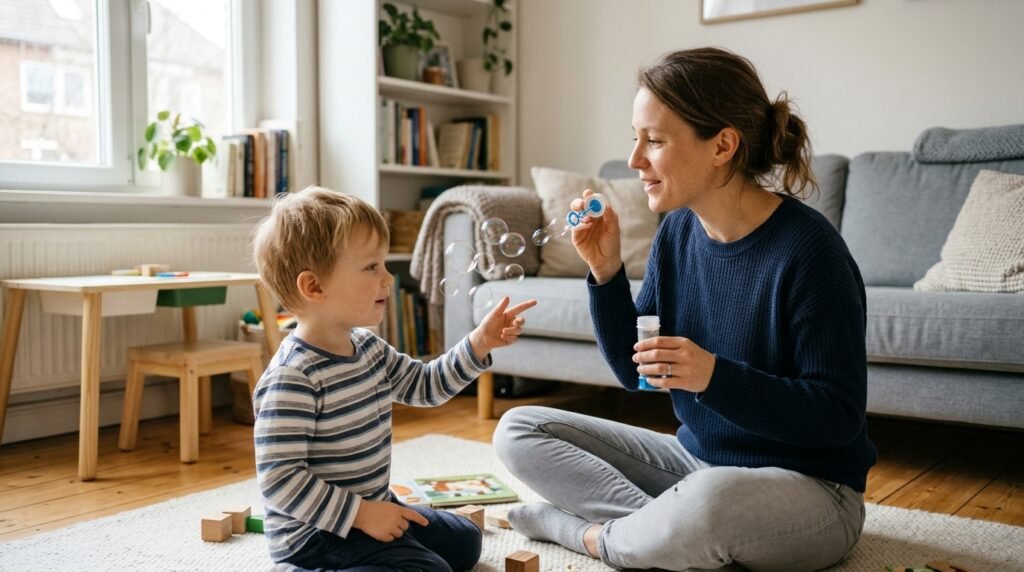
During playtime, a child points toward bubbles. The parent says, “Bubbles?” and waits for the child to communicate. When the child makes a request, the parent blows more bubbles.
The activity gives the child a natural reason to communicate while enjoying a favorite game.
Common Pivotal Response Training Techniques
PRT uses several teaching strategies to support learning. These strategies are adjusted to the child’s needs.
Child Choice
The child gets a chance to select toys, games, and activities.
This helps make learning more connected to the child’s interests.
Interspersing Easy and New Tasks
A therapist may mix familiar activities with new learning goals.
For example, a child who already knows how to name animals may practice a new word between familiar activities.
Reinforcing Attempts
A child does not always need to produce a perfect response to receive a positive result.
Meaningful attempts at communication can be recognized and encouraged.
Natural Reinforcement
The response should relate directly to the child’s action.
If a child asks for music, playing the requested song is a natural result.
Turn-Taking
The therapist and child take turns during an activity.
This may involve rolling a ball, building a tower, or completing a puzzle together.
Multiple Cues
Activities may include more than one instruction or detail.
For example, the child may be asked to select a small yellow block rather than simply choosing any block.
Example 6:
A child and therapist build a tower together. The therapist takes one turn, then gives the child a chance to add another block. The child practices turn-taking while enjoying the activity.
This activity combines play, social interaction, and communication.
Benefits of Pivotal Response Training for Autistic Children
PRT may support several areas of development. Results vary from child to child, and no single approach works for everyone.
Improved Communication Skills
PRT creates opportunities for children to request objects, express choices, and communicate their needs.
Communication can include spoken words, gestures, signs, pictures, or AAC.
More Social Interaction
Activities such as shared games and turn-taking may give children opportunities to interact with parents, teachers, and peers.
Increased Participation
Using preferred activities may help some children become more interested in learning tasks.
Greater Independence
Self-management and self-initiation activities may help children make choices, start tasks, and express when they need assistance.
Learning Across Different Settings
PRT strategies can be used at home, school, and other everyday places.
This can give children opportunities to practice skills outside formal therapy sessions.
Parent Involvement
Parents can learn strategies that support communication during normal family routines.
This may help them create more learning opportunities throughout the day.
Pivotal Response Training Examples in Everyday Life
PRT does not have to take place only in a therapy room. Many learning opportunities can happen during normal family activities.
Here are some practical examples.
Example: During Mealtime
A child wants a glass of water.
The parent places the glass within view and gives the child time to communicate their request.
Example 7:
A child points toward a water bottle. The parent responds by saying, “Water?” The child uses their preferred communication method to request water, and the parent gives it to them.
This activity supports functional communication during a normal daily routine.
Example: During Outdoor Play
A child enjoys playing on a swing.
The parent can use the activity to encourage communication and choices.
Example 8:
A child approaches the swing and gestures to request a turn. The parent helps the child get started and gives them time to communicate when they want another push.
This activity provides an opportunity to practice self-initiation.
Example: During Building Activities
A child enjoys building towers with blocks.
The parent can introduce different block sizes and colors.
Example 9:
A parent asks the child to choose a small blue block. The child looks at the blocks and selects the requested one.
This activity supports responding to multiple cues.
Example: During Story Time
A child enjoys looking at picture books.
The parent can encourage the child to choose a story and turn the pages.
Example 10:
A parent offers two picture books. The child points to the animal book, and the parent reads the selected story.
This gives the child an opportunity to make a choice and start an interaction.
Pivotal Response Training vs. Discrete Trial Training
Pivotal Response Training and Discrete Trial Training (DTT) are both approaches based on ABA principles. However, they use different teaching styles.
PRT usually takes place during natural activities, while DTT often uses more structured teaching sessions.
| Feature | PRT | DTT |
|---|---|---|
| Teaching style | Natural and play-based | Structured and step-by-step |
| Child involvement | Strong focus on child choice | Often follows planned instructions |
| Learning setting | Everyday activities | Usually a planned teaching area |
| Reinforcement | Often related to the activity | May use planned rewards |
| Main focus | Pivotal developmental skills | Specific skills and responses |
| Activities | Toys, games, daily routines | Repeated teaching trials |
Which Approach Is Better?
There is no single answer for every child.
Some children may benefit from naturalistic teaching, while others may need structured instruction for certain skills. A qualified professional can help families decide which methods fit the child’s goals.
Some programs may also use more than one teaching approach.
How Can Parents Use PRT at Home?
Parents can support their child’s learning by using simple activities during everyday routines.
They do not need to turn every family activity into a therapy session.
Here are some practical ideas.
1. Observe Your Child’s Interests
Notice which activities your child enjoys.
These may include:
- Drawing and coloring.
- Playing with toy animals.
- Building blocks.
- Water play.
- Reading picture books.
- Outdoor activities.
Use these interests to create enjoyable interactions.
2. Give Your Child Choices
Offer two or more suitable options.
For example, ask whether your child wants to play with a ball or build a tower.
Accept their preferred form of communication.
3. Give Enough Time to Respond
Some children need extra time to process information and communicate.
Pause after asking a question or offering a choice.
Avoid repeating instructions too quickly.
4. Respond to Communication Attempts
Recognize different ways your child communicates.
A gesture, picture, spoken word, or AAC response can all express a meaningful message.
5. Use Everyday Activities
Try creating learning opportunities during:
- Breakfast.
- Bath time.
- Shopping.
- Outdoor play.
- Family games.
- Bedtime routines.
6. Work With a Qualified Professional
A trained PRT professional can help parents choose suitable goals and use strategies correctly.
Parents should receive guidance that fits their child’s communication style and needs.
Example 11:
During grocery shopping, a parent offers a choice between two fruits. The child points to an apple, and the parent places the apple in the shopping basket.
This simple activity encourages choice-making and communication in a real-life setting.
Who Can Provide Pivotal Response Training?
PRT may be provided by professionals who have suitable training in autism support and behavioral intervention.
Depending on the program, these professionals may include:
- Board Certified Behavior Analysts (BCBAs).
- PRT-trained therapists.
- Special education professionals.
- Speech-language pathologists with relevant training.
- Other qualified developmental specialists.
Parents and caregivers may also receive training so they can use suitable strategies at home.
When choosing a provider, ask about their PRT training, experience, treatment goals, and how they track progress.
You can also ask whether they include the child’s preferences and communication needs in the treatment plan.
Is Pivotal Response Training Evidence-Based?
PRT has been studied as an intervention for autistic children.
Research has examined its possible effects on communication, language, social interaction, and other developmental skills.
A randomized controlled trial published in 2024 reported improvements in language functions among autistic children receiving PRT in special schools. A 2024 systematic review and network meta-analysis also reported positive findings for parent-mediated PRT in social and language skills.
However, research findings should be viewed carefully. The U.S. Department of Education’s What Works Clearinghouse reported no discernible effect on communication and language in its review of two qualifying studies in 2016.
This means that results can depend on the study, participants, teaching methods, and outcome being measured.
PRT should not be presented as a guaranteed treatment or a cure for autism.
Families should discuss possible benefits, limits, and other available options with qualified professionals.
Possible Challenges and Limitations of PRT
PRT may be helpful for some children, but it also has limitations.
Training Is Needed
Parents and professionals need suitable training to use PRT strategies correctly.
Without guidance, it may be difficult to select appropriate goals or track progress.
Progress Can Differ
Children have different abilities, interests, and communication needs.
One child may make progress in requesting objects, while another may need more time to develop social communication skills.
Consistency Can Be Difficult
Using strategies across home, school, and community settings may require teamwork between parents, teachers, and therapists.
It May Not Meet Every Need
Some children may need additional support in areas that PRT does not directly address.
A professional can help determine whether other therapies or educational supports are also suitable.
Goals Must Respect the Child
Therapy should focus on meaningful skills that improve communication, independence, comfort, and participation.
A child’s harmless movements, sensory needs, and preferred communication style should be respected. Therapy should not force eye contact, suppress harmless self-stimulatory behavior, or make a child appear less autistic simply to meet someone else’s expectations.
Frequently Asked Questions About Pivotal Response Training ABA
What does PRT mean in ABA?
PRT means Pivotal Response Training or Pivotal Response Treatment. It is a naturalistic ABA-based approach that focuses on skills such as motivation, communication, self-management, and social initiation.
What are the four areas of PRT?
The four main areas are motivation, responding to multiple cues, self-management, and self-initiation. These skills may support learning and communication in different situations.
Is PRT the same as ABA therapy?
No. PRT is one approach within ABA. ABA is a broader field that includes different methods for teaching skills and supporting behavior.
What age is PRT suitable for?
PRT has been used with children and young people with autism. The suitable age and goals depend on the child’s developmental level, needs, and individual treatment plan.
How is PRT different from DTT?
PRT uses natural activities, child interests, and everyday interactions. DTT uses more structured teaching sessions with planned instructions and responses. Both can be used to teach skills.
Can parents use PRT at home?
Yes. Parents can learn suitable PRT strategies from a trained professional and use them during play, mealtime, reading, and other daily activities.
Does PRT help with speech?
PRT may support communication and language development. Some children may increase their use of spoken words, while others may communicate through gestures, pictures, signs, or AAC.
How long does PRT take to show results?
There is no fixed timeline. Progress depends on the child’s needs, goals, learning opportunities, and the quality of implementation. A qualified professional can help monitor progress over time.
Is PRT better than other autism therapies?
No single therapy is best for every autistic child. The right approach depends on the child’s needs, preferences, communication style, and family goals.
What is an example of PRT in ABA?
A simple example is using a child’s favorite toy to encourage communication. When the child requests the toy using their preferred communication method, the therapist gives them the toy. This connects communication with a natural result.
Conclusion
Pivotal Response Training ABA is an approach that uses a child’s interests and everyday activities to support communication, motivation, social interaction, and independence.
Its four main skill areas are motivation, responding to multiple cues, self-management, and self-initiation. Parents and trained professionals can use these strategies during play, family routines, and other daily activities.
Every autistic child has different needs and preferences. Families should work with qualified professionals to select meaningful goals and check whether PRT is a suitable option. The main aim should be to help the child communicate, make choices, and take part in daily life in ways that work for them.

Emily Carter (Content Writer & Communication Specialist) is a content writer and communication specialist at AllTypeInfo.com. She writes clear, practical, and easy-to-follow guides on email responses, message replies, writing templates, and everyday communication tips. Her goal is to help readers communicate with confidence in both personal and professional settings.