The human sexual response cycle describes the physical and emotional changes that happen when a person experiences sexual stimulation. These changes can affect the brain, heart rate, breathing, blood flow, and reproductive organs.
Learning about this cycle can help people understand normal body responses and recognize possible sexual health concerns. Researchers have developed different models to explain these changes, but the traditional model describes four main stages: excitement, plateau, orgasm, and resolution.
This guide explains each stage, how the body responds, how male and female responses may differ, and why every person’s experience can be different.
What Is the Human Sexual Response Cycle?
The human sexual response cycle is a model that explains the physical and emotional reactions people may experience during sexual activity. It describes how the body moves from initial excitement to increased arousal, orgasm, and eventually a return to its normal resting state.
The traditional four-stage model was introduced by researchers William Masters and Virginia Johnson in 1966. Later, sex researcher Helen Singer Kaplan developed another model that included sexual desire as an important part of the process.
The traditional model includes:
- Excitement: The body begins responding to sexual stimulation.
- Plateau: Sexual excitement increases and becomes stronger.
- Orgasm: The body reaches a peak of sexual pleasure and releases built-up tension.
- Resolution: The body gradually returns to its resting state.
Some modern explanations use four stages called desire, arousal, orgasm, and resolution. Others treat excitement and plateau as separate stages.
These models are useful educational tools, but they do not describe every person’s experience perfectly.
Example 1:
A person may begin feeling sexually interested, experience physical arousal, reach orgasm, and then feel relaxed as the body returns to its normal state.
This example shows the general pattern described by the sexual response cycle. However, a person may experience some stages differently or may not experience every stage during an intimate encounter.
The Four Stages of the Human Sexual Response Cycle
The traditional Masters and Johnson model divides human sexual response into four stages. Each stage involves different physical and emotional changes.
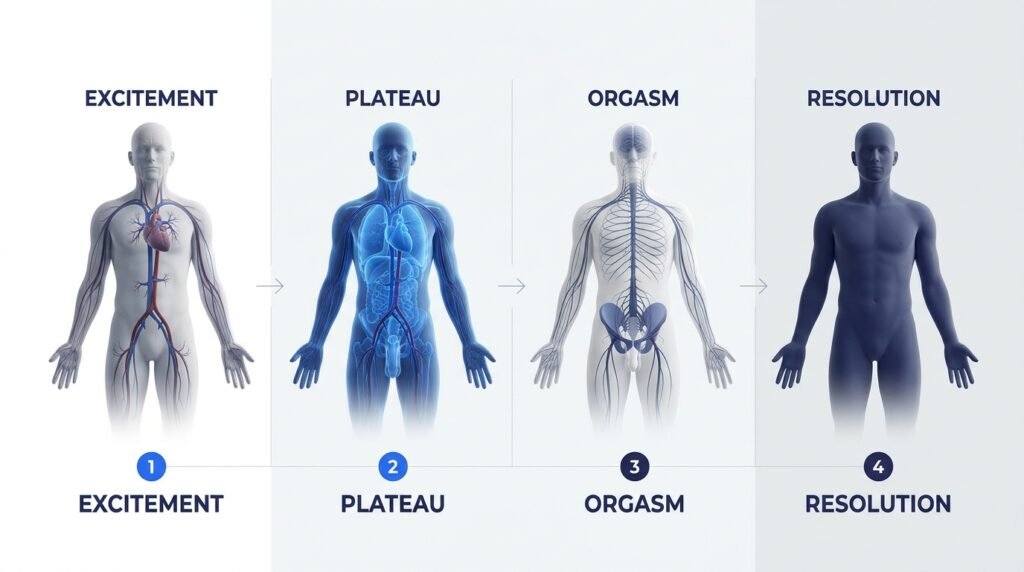
1. Excitement Phase
The excitement phase is the first stage of the traditional sexual response cycle. It begins when the brain and body respond to sexual stimulation.
Sexual stimulation may come from physical touch, emotional closeness, thoughts, or other personal experiences. The response can develop slowly or quickly.
Common physical changes include:
- Increased heart rate.
- Faster breathing.
- Increased blood flow to the genital area.
- Penile erection in people with a penis.
- Increased vaginal lubrication in some people with a vagina.
- Increased sensitivity in certain body areas.
- Muscle tension.
- Possible skin flushing.
These changes happen because the nervous system and blood circulation respond to sexual stimulation.
The length of this phase varies. It may last several minutes or longer, depending on the person and situation.
Example 2:
During an intimate moment, a person notices a faster heartbeat and increased physical sensitivity as their body begins responding to stimulation.
This example shows how the excitement phase may involve changes throughout the body, rather than only in the reproductive organs.
2. Plateau Phase
The plateau phase is the second stage. During this period, sexual excitement becomes stronger and the body maintains a higher level of arousal.
Physical changes that started during the excitement phase may become more noticeable.
Common changes include:
- Continued increases in heart rate and breathing.
- Greater blood flow to the genital area.
- Increased sensitivity of the clitoris or penis.
- Increased muscle tension.
- Continued vaginal lubrication.
- Greater physical excitement.
In people with a vagina, the outer portion of the vaginal canal may become more engorged with blood. In people with a penis, an erection may become firmer.
The plateau phase does not have a fixed length. Some people may remain in this stage for a short time, while others may experience a longer period of arousal.
Example 3:
A person continues experiencing physical arousal, and their heart rate and breathing remain faster than usual.
This example represents the plateau phase, during which the body maintains a heightened level of sexual excitement.
3. Orgasm Phase
The orgasm phase is the third stage of the traditional model. It is often described as the peak of sexual pleasure and the release of built-up sexual tension.
Orgasm usually lasts for a short period, although its length and intensity vary.
Possible physical responses include:
- Rhythmic contractions of muscles around the pelvic area.
- Increased heart rate and breathing.
- Involuntary muscle movements.
- A sudden release of sexual tension.
- A strong feeling of pleasure.
- Ejaculation in some people with a penis.
Orgasm and ejaculation are related but are not exactly the same process.
Orgasm refers to the experience of sexual climax. Ejaculation refers to the release of semen through the penis. They often happen together, but one can occur without the other.
People with a vagina may experience rhythmic contractions of muscles around the vagina and pelvic floor during orgasm. However, these responses are not identical for everyone.
Not every sexual encounter leads to orgasm. This is a normal variation and does not automatically indicate a health problem.
Example 4:
During sexual activity, a person experiences a brief peak of pleasure accompanied by rhythmic pelvic muscle contractions.
This example describes some common physical signs of orgasm. The exact sensations and muscle responses can differ between individuals.
4. Resolution Phase
The resolution phase is the final stage of the traditional sexual response cycle. During this period, the body gradually returns to its usual resting condition.
Physical changes that occurred during arousal begin to decrease.
Common changes include:
- Heart rate returns to its normal level.
- Breathing becomes slower.
- Blood flow to the genital area decreases.
- Muscle tension decreases.
- Erections usually disappear.
- Swelling in genital tissues gradually decreases.
- A person may feel relaxed, satisfied, or tired.
Some people may also experience emotional closeness or a desire to rest.
People with a penis commonly experience a refractory period after orgasm. This is a recovery period during which another orgasm or erection may be difficult or temporarily impossible.
The length of this period varies. It can depend on age, health, hormones, and individual body responses.
Some people with a vagina may be able to experience additional orgasms without the same type of refractory period. However, this ability also varies from person to person.
Example 5:
After orgasm, a person notices that their breathing slows, their muscles relax, and their body gradually returns to its normal resting condition.
This example illustrates the resolution phase and the body’s gradual recovery after sexual activity.
How Does the Sexual Response Cycle Work in Men and Women?
The general stages of sexual response can occur in people of different sexes. However, the physical signs, timing, and intensity may differ.
Biological factors, emotional health, hormones, medications, and personal circumstances can all affect sexual responses.
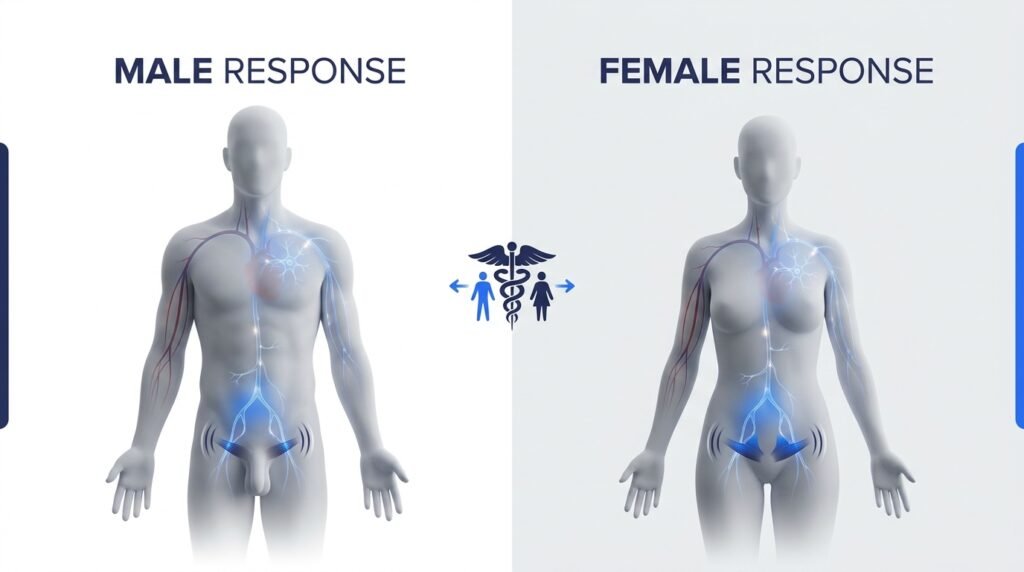
Sexual Response Cycle in Men
In men, sexual stimulation may cause increased blood flow to the penis, resulting in an erection.
The traditional stages may involve:
- Excitement: Blood flow to the penis increases, and an erection may develop.
- Plateau: The erection is maintained, and sexual excitement increases.
- Orgasm: Sexual climax may occur, often alongside ejaculation.
- Resolution: The erection usually decreases, and the body enters a recovery period.
The refractory period is one feature commonly associated with male sexual response. During this time, another erection or orgasm may be difficult to achieve.
Its duration differs between individuals and may change with age.
Example 6:
A man experiences an erection during sexual stimulation, reaches orgasm, and then needs a recovery period before another orgasm is possible.
This example describes a common pattern, but it does not apply to every man or every sexual experience.
Sexual Response Cycle in Women
In women, sexual stimulation may increase blood flow to the clitoris and vaginal tissues.
Possible physical changes include:
- Increased vaginal lubrication.
- Clitoral swelling and sensitivity.
- Increased blood flow to pelvic tissues.
- Faster heart rate and breathing.
- Increased muscle tension.
- Pelvic muscle contractions during orgasm.
However, women’s sexual responses do not always follow a straight, predictable sequence.
Some women may experience sexual desire before physical arousal. Others may begin feeling interested in intimacy after emotional closeness or physical stimulation has started.
Some women may also experience multiple orgasms, while others may experience one or none during a particular encounter.
Example 7:
A woman may begin feeling interested in intimacy after emotional closeness develops, even if she did not feel strong sexual desire beforehand.
This example shows why sexual desire and physical arousal do not always begin at the same time.
What Is the Difference Between Sexual Desire and Sexual Arousal?
Sexual desire and sexual arousal are connected, but they describe different parts of sexual response.
Sexual desire refers to a person’s interest or motivation for sexual activity. Sexual arousal refers to the physical and emotional responses that may happen during sexual stimulation.
Here are the main differences:
| Sexual Desire | Sexual Arousal |
|---|---|
| Refers to interest in sexual activity | Refers to the body’s response to stimulation |
| May involve thoughts or fantasies | May involve physical changes |
| Can occur before physical stimulation | May develop during stimulation |
| Can be affected by emotions and relationships | Can involve blood flow and nervous system activity |
A person can experience desire without strong physical arousal. Similarly, physical arousal can happen without a person feeling interested in sexual activity.
Physical arousal is not proof of consent or sexual interest. Consent must always be freely given.
Example 8:
A person may feel emotionally interested in intimacy but experience little physical arousal because of stress or tiredness.
This example shows that mental interest and physical responses do not always match.
What Is the Difference Between the Masters and Johnson and Kaplan Models?
Researchers have proposed different ways to explain human sexual response.
Two well-known models are the Masters and Johnson model and the Kaplan model.
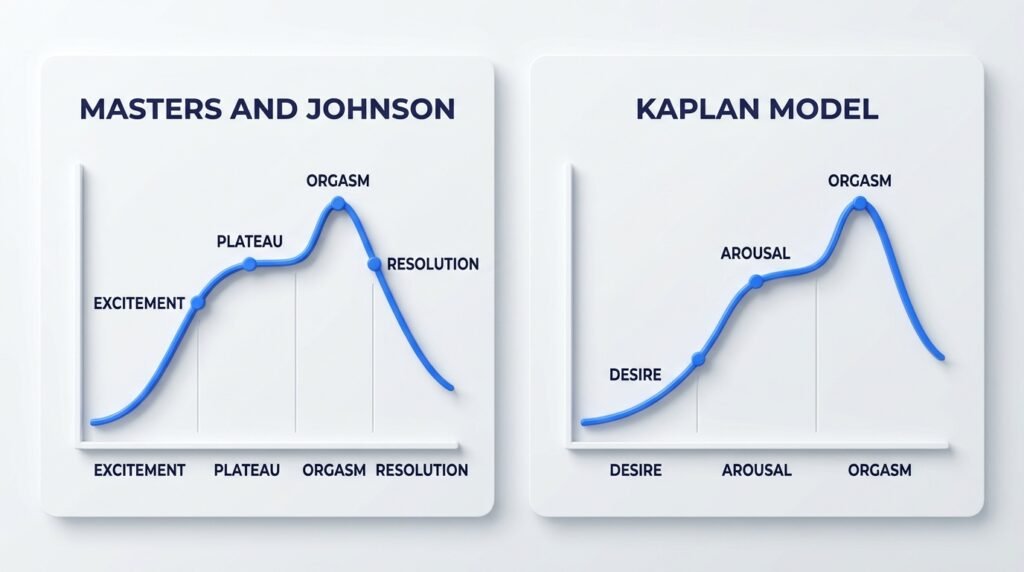
Masters and Johnson Model
William Masters and Virginia Johnson introduced the traditional four-stage model in 1966.
Their model includes:
- Excitement.
- Plateau.
- Orgasm.
- Resolution.
It focuses mainly on the physical changes that occur during sexual activity.
Kaplan Model
Helen Singer Kaplan later proposed a three-stage model that gave more attention to sexual desire.
Her model includes:
- Desire: Interest or motivation for sexual activity.
- Excitement or arousal: Physical and emotional responses to stimulation.
- Orgasm: The peak of sexual pleasure.
The Kaplan model highlights the role of sexual desire, which was not listed as a separate stage in the original Masters and Johnson model.
Comparison of Both Models
| Feature | Masters and Johnson | Kaplan |
|---|---|---|
| Number of stages | Four | Three |
| First stage | Excitement | Desire |
| Middle stage | Plateau | Excitement |
| Final stage | Resolution | Orgasm |
| Main focus | Physical responses | Desire, arousal, and orgasm |
Both models have helped researchers and healthcare professionals discuss sexual function. However, neither model explains every possible pattern of human sexual response.
Example 9:
A healthcare professional may use the Masters and Johnson model to discuss physical arousal stages and the Kaplan model to discuss concerns about low sexual desire.
This example shows how different models can help explain different parts of sexual health.
Factors That Can Affect the Human Sexual Response Cycle
The sexual response cycle can be affected by physical, emotional, and relationship-related factors.
A person’s response may change from one situation to another. This does not always mean that something is wrong.
1. Stress and Anxiety
Stress can affect sexual desire and physical arousal.
Work pressure, financial concerns, family problems, and anxiety may make it harder for someone to feel relaxed during intimacy.
2. Hormonal Changes
Hormones play a role in sexual desire and reproductive health.
Changes associated with aging, pregnancy, menopause, and certain medical conditions may affect sexual interest and physical responses.
3. Medications
Some medications can affect sexual function.
For example, certain antidepressants and blood pressure medicines may affect sexual desire, erection, lubrication, or orgasm.
Anyone concerned about medication-related changes should speak with a healthcare professional before changing or stopping a prescribed medicine.
4. Physical Health
Conditions such as diabetes, heart disease, and some neurological disorders may affect blood flow, nerve function, or sexual response.
General health, sleep quality, and energy levels can also influence sexual function.
5. Relationship and Emotional Factors
Trust, communication, emotional safety, and relationship concerns can affect sexual desire and satisfaction.
A person may respond differently depending on their comfort level and personal circumstances.
Example 10:
A person who is dealing with work stress and poor sleep may notice less sexual interest than usual, even when their relationship is healthy.
This example shows how everyday health and emotional factors can influence sexual response.
Is the Human Sexual Response Cycle the Same for Everyone?
No. The human sexual response cycle is a general model, not a strict rule that every person must follow.
People may experience different patterns depending on their bodies, emotions, health, and circumstances.
Some common differences include:
- Some people experience desire before physical arousal.
- Others develop desire after stimulation or emotional closeness begins.
- Some people experience orgasm, while others do not during a particular encounter.
- The time spent in each stage can vary.
- Some people may experience more than one orgasm.
- Some people may skip certain stages or experience them in a different order.
The traditional model is useful for education, but it should not be treated as a test of normal sexual function.
The Nonlinear Sexual Response Model
Some researchers have suggested that sexual response, particularly in women, may follow a nonlinear pattern.
This idea is associated with sex researcher Rosemary Basson.
In this model, sexual desire may not always come first. Emotional closeness, relationship satisfaction, and a positive intimate experience may help create interest in sexual activity.
For example, a person may begin with a desire for closeness rather than spontaneous sexual desire. Physical arousal may develop later.
This model provides another way to describe experiences that do not fit the traditional four-stage sequence.
Example 11:
A woman may begin an intimate moment because she wants emotional closeness with her partner. As the experience continues, she may develop sexual interest and physical arousal.
This example illustrates how desire and arousal can develop in different orders.
When Should You Speak With a Healthcare Professional?
Changes in sexual response are common. However, some ongoing symptoms may need medical attention.
Consider speaking with a qualified healthcare professional if you experience:
- Persistent difficulty with erections.
- Ongoing pain during sexual activity.
- Regular difficulty with vaginal lubrication.
- A sudden or lasting decrease in sexual desire that causes distress.
- Repeated difficulty reaching orgasm that concerns you.
- Unexpected bleeding or unusual genital symptoms.
- Sexual function changes after starting a medication.
A healthcare professional can review your symptoms, health history, medications, and possible causes.
Treatment depends on the reason for the problem. It may include medical care, medication changes, counseling, or other forms of support.
You should not stop prescribed medication without speaking to the prescribing professional.
Example 12:
A person notices ongoing pain during sexual activity and schedules an appointment with a healthcare professional to find the cause.
This example shows when professional advice may help identify and treat a sexual health concern.
Frequently Asked Questions About the Human Sexual Response Cycle
1. What are the four stages of the human sexual response cycle?
The traditional four stages are excitement, plateau, orgasm, and resolution. They describe the physical and emotional changes that may occur during sexual activity.
2. Who developed the human sexual response cycle?
Researchers William Masters and Virginia Johnson introduced the traditional four-stage model in 1966. Later, Helen Singer Kaplan developed a model that included sexual desire as a separate stage.
3. What is the first stage of the sexual response cycle?
In the traditional Masters and Johnson model, the first stage is excitement. The body begins responding to sexual stimulation through changes such as increased blood flow and physical sensitivity.
Some later models list desire as the first stage.
4. What is the shortest stage of the sexual response cycle?
The orgasm phase is generally the shortest stage. It usually lasts for a brief period, although its length and intensity differ between individuals.
5. What happens during the plateau phase?
During the plateau phase, sexual arousal increases and the body maintains a higher level of excitement. Heart rate, breathing, blood flow, and muscle tension may remain elevated.
6. What happens during the resolution phase?
During resolution, the body gradually returns to its normal resting state. Heart rate and breathing slow down, muscle tension decreases, and physical arousal fades.
7. Do men and women experience the same sexual response cycle?
Men and women can experience similar general stages, but the physical responses and timing may differ. Individual health, hormones, age, and emotional factors can also affect the cycle.
8. Can a person skip a stage of the sexual response cycle?
Yes. The stages do not always happen in the same order. Some people may skip a stage, experience overlapping stages, or have different responses during different encounters.
9. What is the refractory period?
The refractory period is a recovery period after orgasm during which another orgasm or erection may be difficult to achieve. It is commonly associated with male sexual response, and its length varies.
10. Is sexual desire the same as sexual arousal?
No. Sexual desire refers to interest or motivation for sexual activity, while sexual arousal refers to the physical and emotional responses that may happen during stimulation.
11. Can stress affect the sexual response cycle?
Yes. Stress and anxiety may affect sexual desire, physical arousal, and orgasm. Poor sleep, relationship concerns, and some health conditions may also influence sexual function.
12. Is the sexual response cycle a medically fixed process?
No. It is an educational model that describes common patterns. People can experience different stages, timing, and responses without having a medical problem.
Conclusion
The human sexual response cycle explains the physical and emotional changes that may happen during sexual activity. The traditional model includes four stages: excitement, plateau, orgasm, and resolution.
Each stage describes a different part of the body’s response, from initial arousal to the return to a resting state. Other models, including Kaplan’s model, also give attention to sexual desire.
The main point is that sexual responses differ between people. There is no single pattern or timeline that everyone must follow. If ongoing pain, sexual difficulties, or other concerning changes affect your well-being, speaking with a qualified healthcare professional is a sensible next step.

Emily Carter (Content Writer & Communication Specialist) is a content writer and communication specialist at AllTypeInfo.com. She writes clear, practical, and easy-to-follow guides on email responses, message replies, writing templates, and everyday communication tips. Her goal is to help readers communicate with confidence in both personal and professional settings.