A survey can collect hundreds or even thousands of answers, but that does not always mean its results represent the views of everyone. The way people are selected for a survey can affect how accurate the results are.
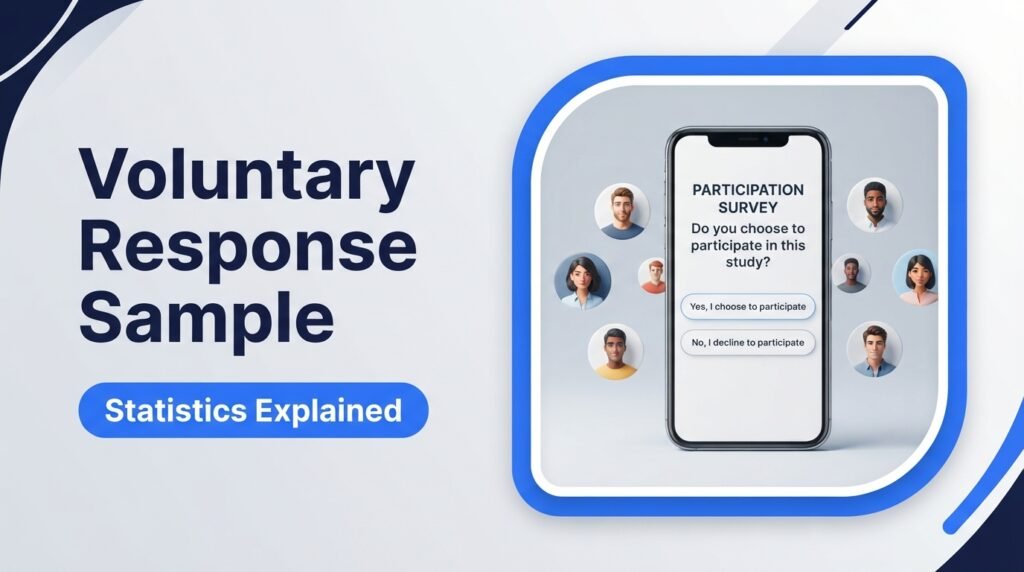
A voluntary response sample is a common sampling method used in online polls, customer surveys, public opinion polls, and research studies. It allows people to decide for themselves whether they want to participate.
In this guide, you will learn what a voluntary response sample is, how it works, its advantages and disadvantages, and why it can produce biased results. You will also see practical examples and comparisons with other sampling methods.
What Is a Voluntary Response Sample?
A voluntary response sample is a group of people who choose to participate in a survey or study after receiving an open invitation. The researcher does not randomly select the participants. Instead, people decide whether to respond.
This method is also called voluntary response sampling or self-selected sampling.
For example, a news website may publish an online poll asking readers whether they support a new law. Visitors can choose to vote or ignore the poll. The people who submit their answers become the voluntary response sample.
The main feature of this method is self-selection. Participants include themselves in the study instead of being selected by the researcher.
This method is easy to use, but it can produce voluntary response bias because people with strong opinions may be more likely to participate than people who feel neutral.
Example 1:
A local newspaper posts an online poll asking readers whether the city should build a new public park. Readers can vote yes or no, but participation is optional.
This is a voluntary response sample because readers decide whether to take part. People who feel strongly about the park may be more likely to vote.
How Does Voluntary Response Sampling Work?
Voluntary response sampling follows a simple process. A researcher invites people to participate, and anyone who chooses to respond can become part of the sample.

Here are the main steps:
- Choose a research question: Decide what information you want to collect.
- Create a survey: Prepare questions that help answer the research question.
- Invite participants: Share the survey through a website, email, social media, or another public channel.
- Allow people to respond: People decide whether they want to participate.
- Collect the answers: Record the responses from those who complete the survey.
- Analyze the results: Review the answers and explain any possible sampling bias.
Example 2:
A school wants to know whether students support longer lunch breaks. The school sends an optional survey link to all students. Students who complete the survey become part of the sample.
The school does not select students at random. Each student decides whether to respond, making this a voluntary response sampling method.
Examples of Voluntary Response Samples
Voluntary response samples appear in many everyday situations. They are especially common when organizations invite people to share their opinions.
1. Online Opinion Polls
A website publishes a question and allows visitors to submit their answers.
Example 3:
A sports website asks visitors whether they think a particular team will win its next championship. Readers can click yes or no to submit their votes.
This is a voluntary response sample because visitors choose whether to participate. People who are passionate about the team may be more likely to vote.
2. Customer Feedback Surveys
Businesses often invite customers to share their experiences through optional surveys.
Example 4:
A restaurant sends customers an email asking them to rate their recent dining experience. Customers who complete the survey become part of the sample.
People with very positive or negative experiences may be more likely to respond. As a result, the answers may not represent every customer.
3. Radio Call-In Polls
Radio stations sometimes ask listeners to call and share their opinions about a particular issue.
Example 5:
A radio host asks listeners whether the city should increase public transportation funding. Listeners who choose to call and share their views become part of the sample.
This is a voluntary response sample because callers decide for themselves whether to participate.
4. Social Media Surveys
Social media platforms make it easy to ask large groups of people for their opinions.
Example 6:
A college posts a poll on its social media page asking students whether classes should start later in the morning. Students who see the poll can choose an answer.
Only people who see and respond to the poll become part of the sample. Students who do not use that social media platform may be left out.
5. Product Reviews
Online stores allow customers to leave reviews after purchasing products.
Example 7:
An online store allows customers to rate a kitchen appliance after buying it. Customers who decide to leave a review become part of the sample.
Customers with very good or very bad experiences may be more motivated to write reviews. Therefore, online reviews may not represent the experience of every buyer.
What Is Voluntary Response Bias?
Voluntary response bias occurs when people who choose to participate in a survey differ in important ways from the larger population being studied.
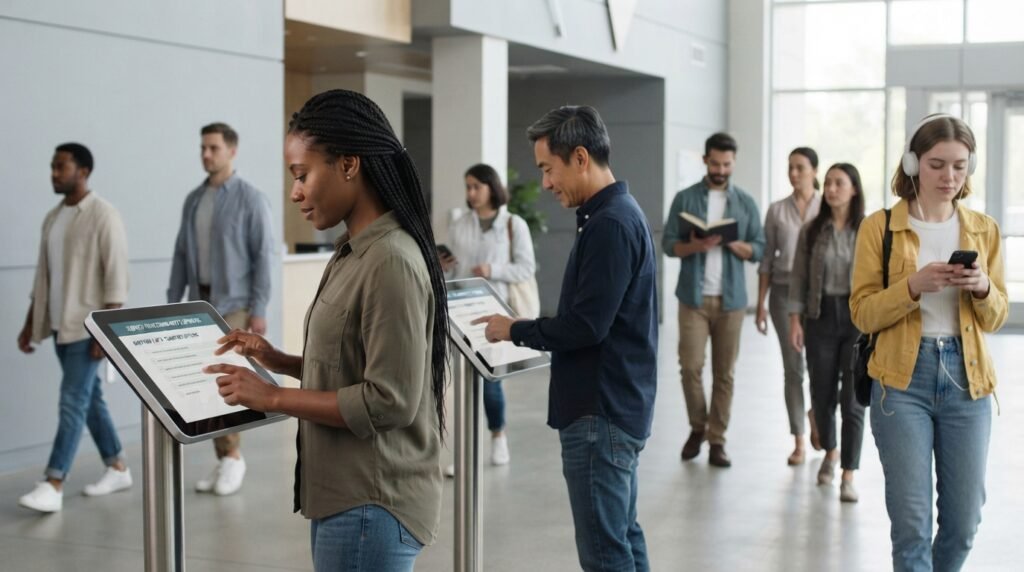
People with strong opinions, unusual experiences, or personal interest in a topic may be more likely to respond. Those who feel neutral may decide not to participate.
This can make survey results misleading.
For example, suppose a city publishes an online poll asking residents whether they support a new parking fee. People who strongly oppose the fee may be more motivated to vote than people who do not care about it.
The results may show more opposition than exists among all city residents.
Why Does Voluntary Response Bias Happen?
Several factors can lead to this type of bias:
- Strong opinions: People who strongly agree or disagree may be more likely to respond.
- Personal interest: People directly affected by an issue may be more motivated to participate.
- Lack of interest: People who feel neutral may ignore the survey.
- Limited exposure: Some members of the population may never see the invitation.
- Optional participation: People decide for themselves whether to submit an answer.
Example 8:
A company posts a public survey asking customers whether they are happy with its new delivery service. Customers who experienced serious delivery problems may be especially motivated to respond.
The company may receive more negative answers than it would from a randomly selected group of customers. This is a possible case of voluntary response bias.
Does a Larger Sample Remove Voluntary Response Bias?
No. A larger sample does not automatically remove sampling bias.
Suppose an online poll receives 10,000 responses. Even though this is a large number, the results may still be biased if participants selected themselves.
A survey with 500 randomly selected participants may provide more useful information about a population than an open online poll with 10,000 volunteers.
The selection method matters just as much as the number of responses.
Advantages and Disadvantages of Voluntary Response Sampling
Voluntary response sampling has some useful benefits, but it also has limitations. Researchers should consider both before choosing this method.
Advantages of Voluntary Response Sampling
1. Easy to organize
Researchers can share a survey through websites, emails, or social media without selecting each participant individually.
2. Low cost
Online surveys and public polls can collect answers without the expense of contacting every person directly.
3. Quick data collection
People can respond whenever they have time. Researchers can often collect answers without arranging individual interviews.
4. Allows people to share their opinions
Participants can freely express their views on topics that matter to them.
5. Useful for gathering feedback
Businesses, schools, and public organizations can use voluntary surveys to collect comments and identify concerns.
Example 9:
A school creates an optional online form asking students to suggest improvements to the library. Students can submit their ideas without attending a meeting.
This method is useful because students can share feedback at a convenient time, and the school does not need to contact each student individually.
Disadvantages of Voluntary Response Sampling
1. High risk of bias
People with strong opinions may be more likely to participate, which can affect the results.
2. May not represent the population
The people who respond may have different opinions or experiences from those who do not participate.
3. Neutral opinions may be missed
People who do not feel strongly about the topic may ignore the survey.
4. Results can be misleading
Researchers may draw incorrect conclusions if they treat volunteer responses as the opinions of the entire population.
5. Participation can be unpredictable
Researchers cannot know in advance how many people will choose to respond.
Example 10:
A city asks residents to complete an optional survey about traffic problems. Most responses come from people who experience traffic delays every day.
The results may show serious traffic concerns, but they may not reflect the views of all residents. People who rarely experience delays may be less likely to participate.
Voluntary Response Sample vs. Convenience Sample
A voluntary response sample and a convenience sample are both non-random sampling methods. However, they use different ways to include participants.
In voluntary response sampling, people choose to join the study. In convenience sampling, the researcher selects people who are easy to reach.
| Feature | Voluntary Response Sample | Convenience Sample |
|---|---|---|
| Selection method | People volunteer | Researcher selects accessible people |
| Participant choice | Participants choose to respond | Researcher chooses whom to approach |
| Main reason | Open invitation | Easy access |
| Random selection | No | No |
| Risk of bias | High | High |
| Common example | Optional online poll | Surveying people at a nearby mall |
Example 11:
A researcher posts an online survey asking people about their exercise habits. Anyone can choose to complete it.
This is a voluntary response sample because participants select themselves.
Example 12:
A researcher visits a local gym and asks the first 30 people they meet about their exercise habits.
This is a convenience sample because the researcher selects people who are easy to reach.
The main difference is who makes the selection. In voluntary response sampling, participants choose themselves. In convenience sampling, the researcher chooses accessible participants.
Voluntary Response Sample vs. Random Sample
A random sample uses chance to select participants from a population. Each eligible member has a known chance of selection under the sampling plan.
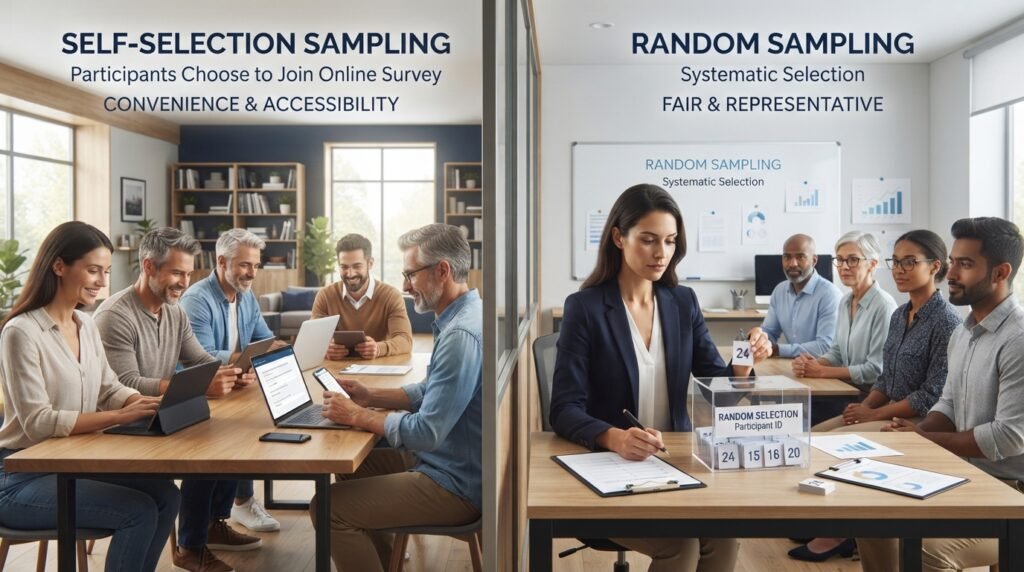
A voluntary response sample allows people to decide whether to participate after an open invitation.
| Feature | Voluntary Response Sample | Random Sample |
|---|---|---|
| Selection | Self-selected | Selected using chance |
| Researcher control | Limited | Uses a planned selection process |
| Risk of selection bias | High | Lower when properly conducted |
| Representativeness | Not guaranteed | Often better for population estimates |
| Example | Public online poll | Randomly selected households |
Example 13:
A university asks all students to complete an optional survey about campus food services.
This is a voluntary response sample because students decide whether to participate.
Example 14:
A university randomly selects 200 students from its enrollment list and invites them to complete the same survey.
This is a random sample because students are selected using chance rather than volunteering through an open invitation.
Random sampling can reduce selection bias, but it does not guarantee perfect results. Poor survey questions, low participation, and other problems can still affect the findings.
How Can Researchers Reduce Voluntary Response Bias?
Researchers can take several steps to reduce bias and collect more useful information.
1. Use Random Sampling
Select participants randomly from the target population instead of relying only on volunteers.
This gives eligible people a chance to be selected based on the sampling plan.
2. Contact Selected Participants Directly
Invite randomly selected people to take part instead of posting an open survey for anyone to complete.
3. Follow Up With Nonrespondents
Send polite reminders to selected participants who have not replied. This may help improve participation and reduce differences between respondents and nonrespondents.
4. Use Different Contact Methods
Some people prefer email, while others may respond more easily by phone or mail. Offering several ways to participate can help reach more members of the selected sample.
5. Use Neutral Survey Questions
Avoid questions that push people toward a particular answer.
For example, instead of asking, “Don’t you agree that the school needs a better library?” ask, “Do you think the school library needs improvement?”
Neutral wording helps reduce response bias.
6. Report Sampling Limitations
If a study uses volunteers, researchers should clearly explain how participants were recruited and warn readers that the results may not represent the full population.
Example 15:
A college wants to measure student satisfaction with its meal plans. Instead of relying only on an open social media poll, it randomly selects students from its enrollment list and sends them a survey.
This approach gives the study a better chance of collecting opinions from different types of students.
How to Identify a Voluntary Response Sample in a Statistics Question
You can identify a voluntary response sample by looking for signs that people choose whether to participate.
Watch for these common clues:
- An optional online survey.
- A public poll asking people to vote.
- A radio program asking listeners to call.
- A website inviting visitors to submit feedback.
- A social media post asking followers to share opinions.
- A customer survey that people can choose to complete.
If people include themselves in the sample by responding to an open invitation, the method is usually voluntary response sampling.
Quick Statistics Example
A local news website asks readers whether they support a new school funding plan. A total of 800 readers submit their votes.
Question: What type of sampling method did the website use?
Answer: Voluntary response sampling.
Why? Readers chose whether to participate. The website did not randomly select the 800 participants.
Is the sample likely to be representative? Not necessarily. Readers with strong opinions about school funding may be more likely to vote.
This is a common type of voluntary response bias.
Frequently Asked Questions About Voluntary Response Samples
What is a voluntary response sample in simple terms?
A voluntary response sample is a group of people who choose to participate in a survey after receiving an invitation. They decide for themselves whether to answer the questions.
Is a voluntary response sample biased?
Yes, it has a high risk of voluntary response bias. People with strong opinions or personal interest in a topic may be more likely to respond than people who feel neutral.
Is voluntary response sampling random?
No. It is a non-random sampling method because participants choose to join the sample instead of being selected through chance.
What is an example of voluntary response sampling?
An online newspaper poll asking readers whether they support a new law is a common example. Readers decide whether to vote, and those who submit an answer become part of the sample.
Why is voluntary response sampling unreliable?
It may produce unreliable estimates because the people who respond may differ from the larger population. Their opinions may not represent everyone being studied.
What is the main difference between voluntary response and convenience sampling?
In voluntary response sampling, people choose themselves by responding to an invitation. In convenience sampling, the researcher selects people who are easy to reach.
Can a voluntary response sample be representative?
It is possible for a volunteer sample to reflect the population by chance, but researchers cannot assume that it does. The method has a high risk of bias because participants select themselves.
Does a larger voluntary response sample reduce bias?
No. A larger number of volunteers does not fix the selection problem. Even thousands of responses may fail to represent the target population.
What are the advantages of voluntary response sampling?
Its main advantages are low cost, quick data collection, easy organization, and the ability to collect feedback from people who want to share their opinions.
What is another name for a voluntary response sample?
It is also called a self-selected sample because participants decide whether they want to be included in the study.
Conclusion
A voluntary response sample is a group of people who choose to participate in a survey or study after receiving an open invitation. It is commonly used in online polls, customer feedback surveys, social media polls, and radio call-in programs.
This method is easy and inexpensive, but it has a high risk of voluntary response bias. People with strong opinions may be more likely to respond, so the results may not represent the entire population.
The best way to recognize this sampling method is to ask one simple question: Did the participants choose themselves? If the answer is yes, the study most likely uses a voluntary response sample. For research that needs reliable population estimates, random sampling is usually a better choice.

Emily Carter (Content Writer & Communication Specialist) is a content writer and communication specialist at AllTypeInfo.com. She writes clear, practical, and easy-to-follow guides on email responses, message replies, writing templates, and everyday communication tips. Her goal is to help readers communicate with confidence in both personal and professional settings.