Receiving a Request for Evidence (RFE) from U.S. Citizenship and Immigration Services (USCIS) can be stressful. You may spend days collecting documents, preparing explanations, and sending everything before the deadline. After USCIS receives your response, another question comes up: How long will you have to wait for a decision?
The RFE response time depends on your application type, the service center handling your case, the evidence you submitted, and the current USCIS workload. Some applicants receive an update within a few weeks, while others wait several months.
There is no single guaranteed processing time for every case. However, knowing what happens after USCIS receives your response can help you plan your next steps.
This guide explains how long USCIS may take after an RFE response, what different case status messages mean, how premium processing works, and what you can do if your case remains pending.
What Is RFE Response Time?
RFE response time refers to the time it takes USCIS to review additional evidence after an applicant or petitioner responds to a Request for Evidence.
An RFE is a notice from USCIS asking for more documents or information before making a decision on an immigration application or petition.
USCIS may send an RFE if an officer needs additional evidence to confirm that an applicant meets the requirements for an immigration benefit.
For example, an officer reviewing a marriage-based green card application may request more proof of a genuine marriage. An employment-based petition may require additional job details, qualifications, or employer documents.
Once USCIS receives your response, the officer reviews the new evidence along with the documents already in your case file.
There is no official fixed number of days for every RFE decision. The time can vary based on the application and the office handling it.
Example 1:
Maria receives an RFE for her green card application because USCIS needs additional financial documents. She sends the requested evidence and receives a case status update confirming that USCIS received her response.
This means USCIS has received her documents. It does not mean her green card has been approved. An officer must still review the evidence and make a decision.
How Long Does USCIS Take After Receiving an RFE Response?
Many applicants use 60 days as a useful point for checking their case status after submitting an RFE response.
However, this is not a guaranteed decision deadline. USCIS does not promise to approve or deny every application within 60 days.
The agency’s case inquiry system treats cases that received an RFE response within the past 60 days as actively processing. This means the 60-day period is useful for understanding when a delay inquiry may become appropriate.
Here is a general guide:
| Time After RFE Response | What May Happen |
|---|---|
| First 1–2 weeks | USCIS may update the case status to show receipt of the response. |
| 2–4 weeks | The case may return to review. |
| 30–60 days | Some applicants may receive a decision or another update. |
| 60–90 days | Some cases remain pending while USCIS reviews the evidence. |
| More than 90 days | Applicants may need to check their case and review available inquiry options. |
| Several months | Some cases may require additional review or remain in a processing queue. |
These are general waiting periods, not official USCIS processing guarantees.
Your actual USCIS RFE response time may be shorter or longer.
Example 2:
David submits his RFE response for an employment-based immigration petition. USCIS confirms receipt after several days, but his case remains pending for another two months.
David’s case is still waiting for a decision. The receipt update confirms that USCIS has his response, but it does not show how long the officer will need to complete the review.
Why Is There No Fixed RFE Decision Time?
USCIS handles many types of immigration applications. Each type has different requirements and review steps.
For example, reviewing a missing bank statement may take less time than checking complicated employment records or a large collection of supporting documents.
The agency also has to manage its existing workload. This can affect how soon an officer reviews a case after receiving additional evidence.
What Happens After USCIS Receives Your RFE Response?
After receiving your response, USCIS adds the submitted evidence to your case record and continues the review.
The next steps depend on your application and the information requested in the RFE.
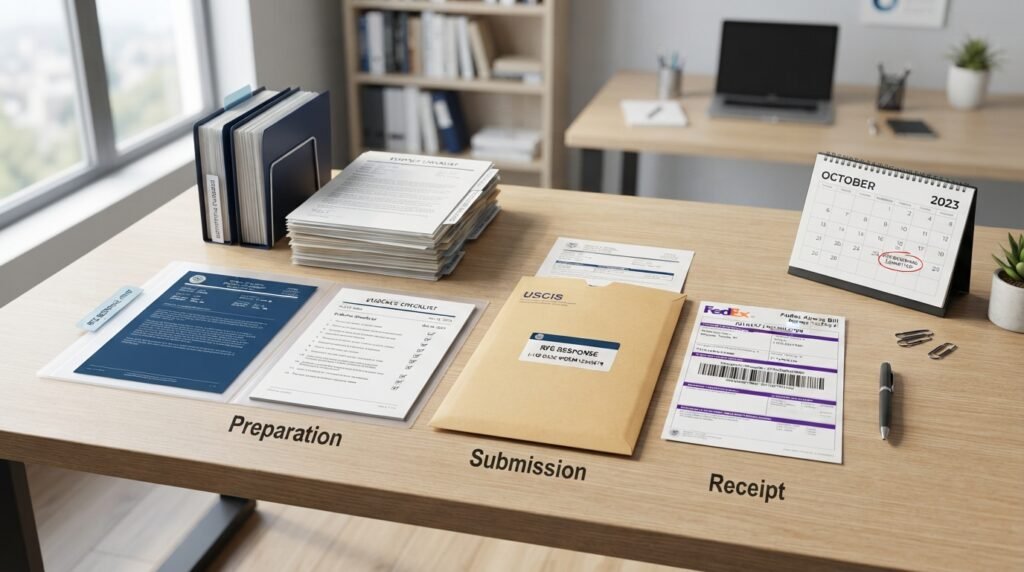
Here is how the process generally works.
1. USCIS Receives Your Documents
USCIS first receives your response through the method listed in your RFE notice.
Depending on the instructions, you may submit your documents through your online account or by mail.
If you use a delivery service, keep your tracking number and delivery confirmation.
Example 3:
John sends his RFE response through a tracked delivery service. The tracking record shows that USCIS received the package at its designated address.
This gives John proof of delivery. He should also keep a copy of the full response and all documents he submitted.
2. USCIS Updates Your Case Status
After receiving your documents, USCIS may update your online case status.
One common message is:
Response To USCIS’ Request For Evidence Was Received
This message confirms that USCIS has received your response.
It does not confirm that the evidence is complete or that the application will be approved.
3. An Officer Reviews Your Evidence
An immigration officer reviews the additional documents and compares them with the original application.
The officer checks whether the new evidence answers the questions raised in the RFE.
For example, if USCIS requests proof of employment, the officer may review employment letters, pay records, job duties, and other related documents.
4. USCIS Makes a Decision
After reviewing the complete case, USCIS may:
- Approve the application or petition.
- Deny the application or petition.
- Issue another RFE in certain circumstances.
- Send a Notice of Intent to Deny (NOID) when the agency plans to deny the case but gives the applicant an opportunity to respond.
The outcome depends on whether the applicant meets the legal requirements for the requested immigration benefit.
What Does Response To USCIS’ Request For Evidence Was Received Mean?
This is one of the most common status messages applicants see after sending additional evidence.
The message Response To USCIS’ Request For Evidence Was Received means USCIS has recorded your RFE response in its system.
It is a positive administrative update because it confirms receipt of your documents.
However, it does not mean:
- Your application has been approved.
- An officer has completed the review.
- Your case will receive a decision within a few days.
- USCIS has accepted every document as sufficient evidence.
Your application remains pending until USCIS makes a final decision or takes another action.
Is RFE Response Received a Good Sign?
Yes, it is a useful sign because it confirms that USCIS received your response.
However, it should not be treated as an approval notice.
Example 4:
Sarah checks her online account and sees that USCIS received her RFE response. She expects an approval notice immediately, but the case status remains unchanged for several weeks.
Sarah should keep her receipt notice and delivery confirmation. She can continue checking her case status while USCIS reviews the evidence.
Factors That Affect USCIS RFE Response Time
Several factors can affect how long USCIS takes to make a decision after receiving additional evidence.
1. Type of Immigration Application
Your application type can affect the waiting period.
For example:
- Form I-130: Petition for an Alien Relative.
- Form I-485: Application to Register Permanent Residence or Adjust Status.
- Form I-140: Immigrant Petition for Alien Workers.
- Form I-129: Petition for a Nonimmigrant Worker.
- Form I-765: Application for Employment Authorization.
- Form I-539: Application to Extend or Change Nonimmigrant Status.
Each form has different eligibility rules and processing requirements.
2. USCIS Service Center Workload
USCIS processes applications through different service centers and field offices.
The number of pending cases, available staff, and review requirements can affect the time needed to make a decision.
Two applicants who submit similar applications may receive decisions at different times.
3. Type of Evidence Requested
The amount and type of evidence can also affect review time.
A request for one missing document may be easier to review than a request involving several legal, financial, or employment records.
For example, an employment petition may require detailed information about the employer, position, salary, and employee qualifications.
4. Quality of Your RFE Response
A complete response can help USCIS review your case without needing more information.
Your response should address each point in the RFE notice.
Missing documents, unclear explanations, or conflicting information may create additional questions.
5. Additional Background or Security Checks
Some applications require extra checks before USCIS can make a decision.
If additional review is needed, the case may remain pending even after USCIS receives all requested documents.
Example 5:
Michael submits all the documents requested for his adjustment of status application. USCIS receives his response, but his case remains pending while additional checks are completed.
This shows why a complete RFE response does not always lead to an immediate decision.
RFE Response Time for Different USCIS Forms
The waiting period after an RFE response can vary depending on the immigration form.
Here is a closer look at some common applications.
Form I-485 RFE Response Time
Form I-485 is used by eligible applicants to apply for lawful permanent residence while inside the United States.
USCIS may request additional evidence about:
- Financial support.
- Marriage or family relationships.
- Medical examination records.
- Immigration history.
- Identity documents.
- Employment or other eligibility requirements.
After receiving the response, USCIS continues reviewing the application.
Some applicants receive a decision within weeks, while others wait several months. There is no fixed post-RFE decision deadline for all I-485 cases.
Example 6:
A married couple submits additional joint bank statements and insurance records after receiving an I-485 RFE. USCIS records the response and continues reviewing their green card application.
The receipt update confirms delivery, but the couple must wait for the final decision.
Form I-130 RFE Response Time
Form I-130 is used by a U.S. citizen or lawful permanent resident to petition for certain family members.
An RFE may request:
- Birth certificates.
- Marriage certificates.
- Divorce records.
- Proof of family relationships.
- Additional identity documents.
For a marriage-based petition, USCIS may request more evidence showing that the marriage is genuine.
After receiving the response, USCIS reviews the evidence before deciding whether the family relationship meets the requirements.
Form I-140 RFE Response Time
Form I-140 is an employment-based immigrant petition.
An RFE may involve:
- Employer financial records.
- Job requirements.
- Employee qualifications.
- Work experience.
- Educational documents.
- Evidence related to the requested employment category.
The review period depends on the petition category and the issues raised in the RFE.
Example 7:
An employer receives an I-140 RFE asking for more information about an employee’s qualifications. The employer submits education records, experience letters, and a detailed explanation of the job requirements.
USCIS must review these documents before making a decision on the petition.
Form I-765 RFE Response Time
Form I-765 is used to apply for an Employment Authorization Document (EAD).
USCIS may request missing information or documents related to eligibility.
After receiving the response, the agency continues reviewing the application. The waiting period can vary based on the eligibility category and current workload.
Form I-129 RFE Response Time
Form I-129 is used by employers to petition for certain nonimmigrant workers.
For example, an H-1B petition may receive an RFE involving:
- Job duties.
- Employer-employee relationships.
- Educational qualifications.
- Specialty occupation requirements.
- Work location.
- Salary details.
After receiving the employer’s response, USCIS reviews the additional information and decides whether the petition meets the requirements.
Does Premium Processing Reduce RFE Response Time?
Premium processing is a paid USCIS service available for certain eligible immigration applications and petitions.
It requires filing Form I-907, Request for Premium Processing Service, and paying the required fee.
It can reduce the time USCIS takes to take an action on an eligible case.
However, premium processing does not mean USCIS will approve your application.
USCIS may take one of several actions within the applicable premium processing period:
- Approve the application.
- Deny the application.
- Issue an RFE.
- Issue a NOID.
- Take another qualifying action under the applicable rules.
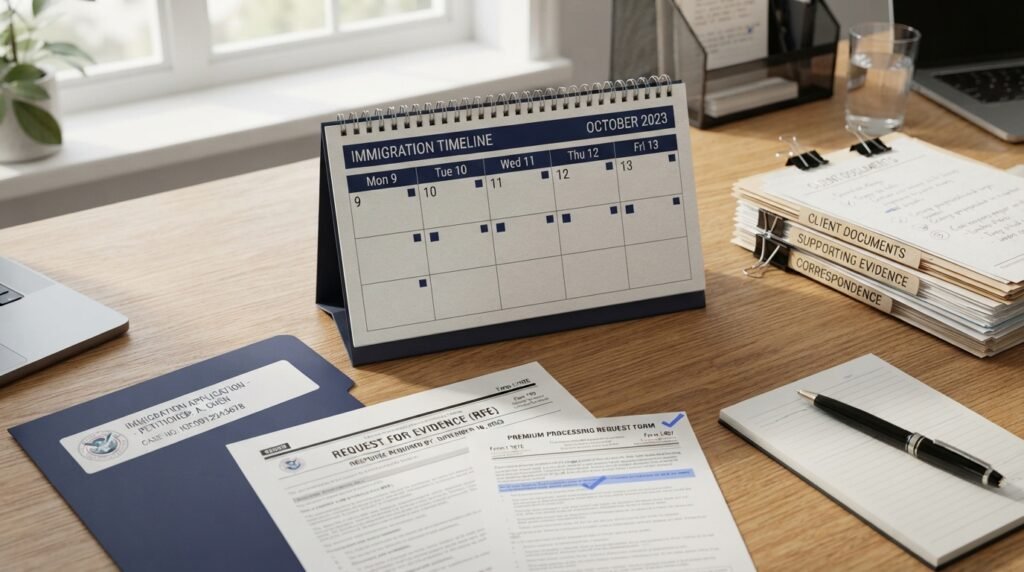
What Happens to Premium Processing After an RFE?
If USCIS issues an RFE during premium processing, the premium processing clock stops.
It starts again when USCIS receives your RFE response.
The new deadline depends on the form and immigration category.
For example, certain eligible cases have a 15-business-day premium processing period, while other categories have 30 or 45 business days.
Do not assume every immigration application has the same premium processing deadline.
Example 8:
An employer files an eligible H-1B petition with premium processing. USCIS issues an RFE, so the premium processing clock stops. The employer submits the requested documents, and USCIS receives the response.
The applicable premium processing period starts again from the date USCIS receives the response.
Does Premium Processing Guarantee Approval?
No. Premium processing guarantees a qualifying USCIS action within the required time, subject to the applicable rules.
It does not guarantee a positive decision.
If USCIS issues another RFE, the case may need more review and the premium processing clock may stop again.
How to Check Your USCIS RFE Response Status
You can check your case status online using your USCIS receipt number.
Follow these steps:
- Find your USCIS receipt number on your receipt notice.
- Open the USCIS Case Status Online page.
- Enter your receipt number.
- Submit the information.
- Review the latest case status message.
Your receipt number usually contains 13 characters, including three letters followed by 10 numbers.
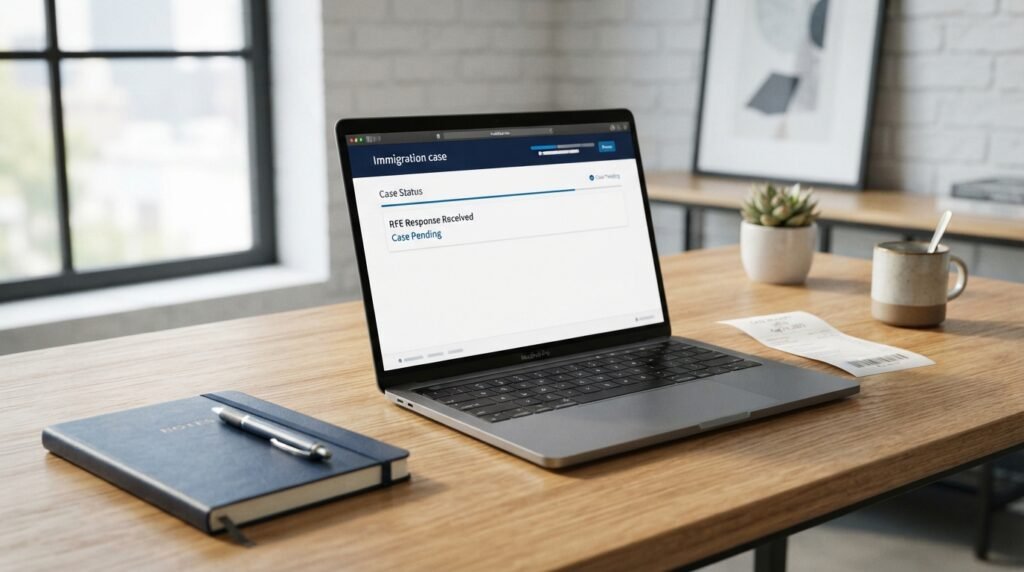
Common USCIS Case Status Messages After an RFE
| USCIS Status Message | What It Means |
|---|---|
| RFE Was Sent | USCIS has issued a request for additional evidence. |
| Response To USCIS’ Request For Evidence Was Received | USCIS has recorded your response. |
| Case Is Being Actively Reviewed | USCIS is reviewing or processing your application. |
| Case Was Approved | USCIS has approved the application or petition. |
| Notice Of Intent To Deny Was Sent | USCIS has sent a notice explaining its proposed denial and response requirements. |
| Case Was Denied | USCIS has denied the application or petition. |
Your online status may not show every step in the review process.
You should also check your physical mail and USCIS online account for official notices.
What Should You Do If USCIS Takes Too Long After an RFE Response?
Waiting for USCIS can be stressful, especially if you need a decision for work, travel, or family plans.
If your case remains pending, take these steps.
1. Check Your Case Status Regularly
Use your receipt number to check your case online.
You should also review your USCIS account and email for new notices.
2. Confirm That USCIS Received Your Response
If you mailed your documents, check the delivery record.
If you submitted your response online, keep the electronic submission confirmation.
Make sure you have a complete copy of everything you sent.
3. Check the USCIS Processing Times Page
USCIS publishes processing time estimates for different application types and offices.
To check your case:
- Open the USCIS Processing Times page.
- Select your form.
- Choose the correct form category.
- Select the office handling your case, if required.
- Review the available processing time information.
Keep in mind that published processing times generally cover the full period from the original filing to completion. They are not a separate countdown that begins when USCIS receives your RFE response.
4. Review Your Case Inquiry Options
USCIS has an online e-Request service for certain cases.
You may be able to submit an inquiry if your case meets the agency’s requirements.
The system considers recent RFE responses within the past 60 days as actively processing.
This means you should check the available inquiry rules rather than assume that every case can be reported as delayed after 60 days.
5. Contact USCIS
If your case appears outside normal processing times or you need help with a case status issue, you can contact the USCIS Contact Center.
The general phone number is 1-800-375-5283.
Have your receipt number and basic case information ready.
6. Speak With an Immigration Attorney
If your case involves serious legal issues, a previous denial, a complicated RFE, or a possible status problem, consider speaking with a qualified immigration attorney.
An attorney can review the RFE notice and help explain your available options.
Example 9:
Alex submits his RFE response and receives confirmation from USCIS. After several months, his case remains pending and the processing time page shows that his case may be outside the normal range.
Alex checks his receipt number, reviews the available inquiry options, and contacts USCIS for an update.
What Happens If You Miss the RFE Response Deadline?
Missing an RFE deadline can put your immigration application at risk.
USCIS sets a deadline in the RFE notice. You must submit the requested evidence within that period.
Under the current USCIS policy, the maximum response period for most RFEs cannot exceed 84 days, but the officer may set a shorter deadline based on the case.
Certain Form I-539 and Form I-601A requests have a 30-day maximum response period.
For mailed notices, the applicable mailing rules may add three days. Do not assume that applicants outside the United States automatically receive an extra 14 days under the updated 2026 guidance.
Can You Request More Time?
Generally, USCIS does not grant extensions beyond the response deadline for an RFE.
This makes it important to start collecting the documents as soon as you receive the notice.
What If You Do Not Respond?
If you fail to respond, USCIS may decide your case based on the existing record.
Depending on the application and the RFE, this may lead to a denial.
If you cannot obtain a requested document, speak with an immigration attorney about how to address the issue before the deadline.
Example 10:
Robert receives an RFE asking for additional employment records. He waits until the final week to request the documents from his employer, but they are not ready before the deadline.
Robert may face a serious problem because USCIS is not generally required to grant extra time. He should seek legal advice as soon as possible.
Common Mistakes to Avoid After Receiving an RFE
A careful response can help prevent avoidable problems.
Avoid these common mistakes:
- Ignoring the deadline: Always follow the date printed on your RFE notice.
- Sending incomplete evidence: Address every request listed in the notice.
- Providing unclear explanations: Explain how each document supports your eligibility.
- Sending documents without checking them: Review names, dates, signatures, and other details.
- Using the wrong submission method: Follow the instructions in your RFE notice.
- Failing to keep copies: Save a full copy of your response and proof of delivery.
- Assuming receipt means approval: Wait for an official decision notice.
- Sending extra documents without guidance: Unrequested evidence may not solve the issue and may not be matched to your case.
A well-prepared response should make it easy for the officer to find the evidence requested and see how it answers each question.
What Are the Possible Outcomes After an RFE Response?
After reviewing your response, USCIS may take different actions.
Approval
If the evidence meets the requirements, USCIS may approve your application or petition.
You will receive an approval notice or an online case status update.
Denial
If the officer finds that you do not meet the legal requirements, USCIS may deny your case.
The denial notice usually explains the reasons for the decision and any available options.
Another RFE
In some cases, your response may raise new questions or fail to address all the issues.
USCIS may issue another RFE if additional information is needed.
Notice of Intent to Deny
A NOID means USCIS plans to deny the case but is giving you an opportunity to respond to the stated reasons.
A NOID has its own deadline. Read it carefully and consider getting legal advice before submitting your response.
Example 11:
Emily responds to an RFE about her family-based petition. USCIS reviews her documents but finds that another issue needs clarification and sends a new notice.
Emily should read the new notice carefully because it may require a separate response before USCIS makes a final decision.
Frequently Asked Questions About RFE Response Time
1. How long does USCIS take after receiving an RFE response?
There is no fixed decision deadline for all applications. Some applicants receive an update within a few weeks, while others wait 60–90 days or longer. The 60-day period is an important case inquiry reference, not a guaranteed decision date.
2. Does USCIS approve cases within 60 days after an RFE response?
No. USCIS does not guarantee approval within 60 days. The agency may need more time to review your evidence, complete additional checks, or make a decision.
3. What does RFE response received mean?
It means USCIS has received and recorded your additional documents. Your case will continue through the review process. This message does not mean your application has been approved.
4. Can USCIS deny my case after receiving an RFE response?
Yes. USCIS can deny your application if the evidence does not establish that you meet the immigration requirements. A receipt confirmation does not guarantee approval.
5. Can USCIS send another RFE after receiving my response?
Yes. USCIS may issue another RFE if your response raises new questions or the officer needs more information. However, a second RFE is not automatic.
6. Does premium processing speed up an RFE response?
Yes, for eligible applications. The premium processing clock stops when USCIS issues an RFE and starts again when USCIS receives your response. The applicable deadline depends on your application type.
7. Can I check my RFE response online?
Yes. Use your USCIS receipt number on the Case Status Online page. You can also check your USCIS online account for notices and updates.
8. What if USCIS has not updated my case after receiving my RFE response?
Keep your delivery confirmation and check your case status regularly. If your case is outside normal processing times, review the USCIS inquiry options or contact the USCIS Contact Center.
9. Can I submit additional documents after my RFE response?
You should follow the instructions in your RFE notice. USCIS generally expects one complete response. Sending extra documents without instructions may not help your case. Ask an immigration attorney before making an additional submission if you are unsure.
10. Does an RFE mean my immigration application will be denied?
No. An RFE means USCIS needs more evidence before making a decision. If you provide sufficient evidence and meet the eligibility requirements, your application may be approved.
11. How long does an RFE response take with premium processing?
The applicable premium processing period restarts when USCIS receives your RFE response. Depending on the immigration category, the deadline may be 15, 30, or 45 business days. Check the current rules for your specific form and category.
12. What is the maximum time USCIS gives to respond to an RFE?
Under the current rules, the maximum response period for most RFEs is 84 days. Certain Form I-539 and Form I-601A requests have a 30-day maximum. The actual deadline may be shorter, so always follow your notice.
Conclusion
The RFE response time depends on your immigration form, the evidence requested, and the workload at the USCIS office handling your case. Some applicants receive an update within weeks, while others wait several months.
The 60-day period is a useful point for checking your case and reviewing inquiry options, but it is not a promise that USCIS will make a decision within that time.
If USCIS has received your response, keep your delivery confirmation, save a copy of your documents, and check your case status regularly. If your case goes beyond normal processing times, review the available USCIS inquiry options.
Most importantly, make sure your RFE response addresses every request in the notice. A complete and well-organized response gives USCIS the evidence it needs to review your application.

Emily Carter (Content Writer & Communication Specialist) is a content writer and communication specialist at AllTypeInfo.com. She writes clear, practical, and easy-to-follow guides on email responses, message replies, writing templates, and everyday communication tips. Her goal is to help readers communicate with confidence in both personal and professional settings.