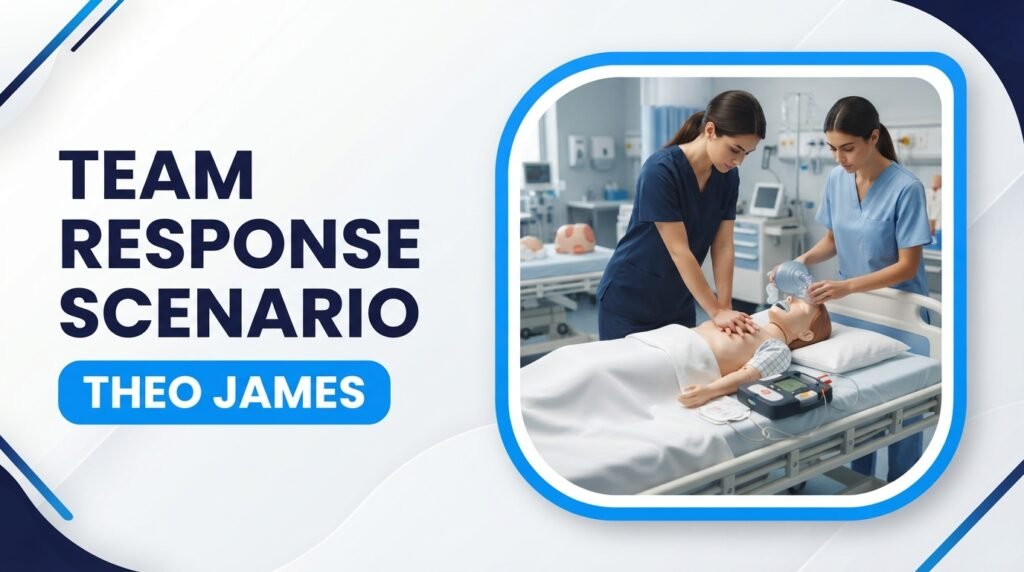
The Team Response Scenario Theo James is a child emergency training exercise used in Basic Life Support (BLS) education. It helps healthcare providers practice their response when a child becomes unresponsive and needs emergency care.
The scenario follows a six-year-old boy named Theo James. Healthcare providers must assess his condition, check his breathing, recognize cardiac arrest, perform CPR, and work together as a team.
If you are preparing for a BLS or PALS assessment, this guide covers the main questions, answers, and explanations from the Theo James scenario. It also explains the correct actions and common mistakes to avoid during a child emergency.
What Is the Team Response Scenario Theo James?
The Team Response Scenario Theo James is a pediatric emergency training exercise that teaches healthcare providers how to respond to a child experiencing a serious medical emergency.
Theo is a six-year-old child who becomes unresponsive. The healthcare team must assess his condition and provide the right emergency care.
The exercise focuses on Pediatric Basic Life Support (BLS) skills, including:
- Checking responsiveness and breathing.
- Opening the child’s airway.
- Checking the pulse when appropriate.
- Recognizing cardiac arrest.
- Starting high-quality CPR.
- Using an Automated External Defibrillator (AED).
- Working with other healthcare providers.
- Providing effective bag-mask ventilation.
The scenario also tests communication, teamwork, and the ability to assign tasks during an emergency.
Example 1:
A healthcare provider finds Theo unresponsive and asks another team member to activate the emergency response system and bring the AED.
This example shows why clear instructions matter during an emergency. Team members should know their responsibilities and act without unnecessary delays.
Team Response Scenario Theo James: Questions and Answers
The following questions cover the main points commonly included in the Theo James training exercise.
1. How Should Amy Open Theo’s Airway?
Answer: Slightly past-neutral position.
Amy should use the head-tilt/chin-lift technique to open Theo’s airway. For a child, the head should be positioned slightly past neutral to help maintain an open airway.
The correct position helps air move into and out of the lungs.
Example 2:
Amy gently uses the head-tilt/chin-lift technique to open Theo’s airway and checks whether he is breathing normally.
This shows how proper head positioning helps a healthcare provider assess a child’s breathing.
2. Where Should Amy Check Theo’s Pulse?
Answer: At the carotid pulse point.
The carotid pulse is checked on the side of the neck in a child.
Healthcare providers should assess breathing and pulse at the same time. The assessment should take no more than 10 seconds under the AHA healthcare-provider approach.
A pulse check should never delay CPR when cardiac arrest is clear.
3. Should Amy Check for Life-Threatening Bleeding?
Answer: Yes.
Amy should look for signs of life-threatening bleeding while assessing Theo.
Severe bleeding can cause a serious drop in blood circulation. It needs prompt attention along with the assessment of breathing and circulation.
Example 3:
While another team member prepares the emergency equipment, Amy checks Theo for abnormal breathing, pulse problems, and severe bleeding.
This example shows how team members can complete different tasks at the same time.
4. What Should Amy Do If Theo Has a Heart Rate of 60 BPM or Less With Poor Perfusion?
Answer: Start CPR when the condition meets the pediatric CPR criteria.
If Theo has a heart rate below 60 beats per minute with signs of poor perfusion, despite adequate oxygenation and ventilation, the healthcare provider should start CPR.
Poor perfusion means the body is not receiving enough blood flow.
Possible signs include:
- Weak or absent peripheral pulses.
- Pale or mottled skin.
- Cold hands and feet.
- Reduced level of consciousness.
- Poor blood circulation.
The team should also activate the emergency response system and prepare the AED.
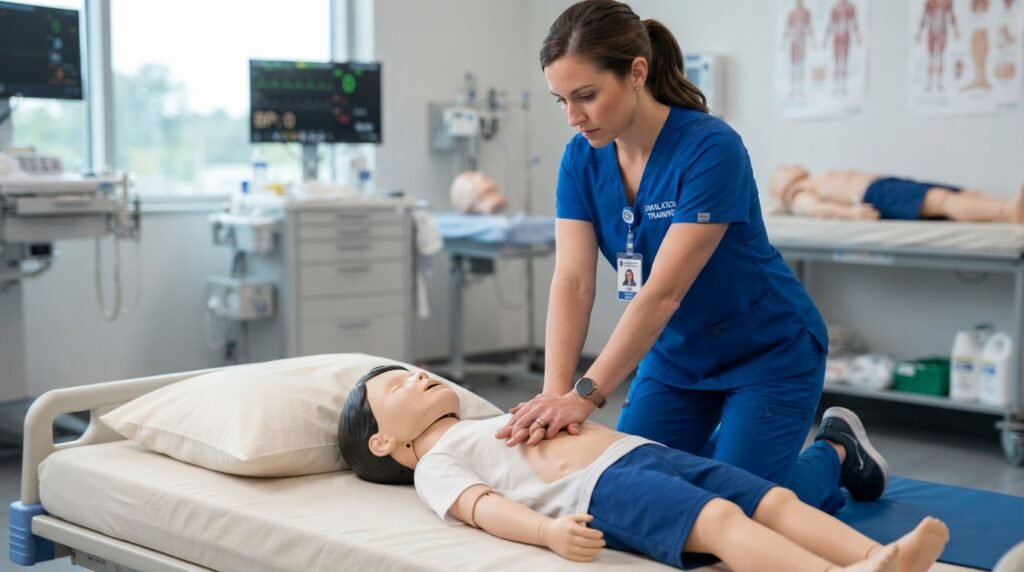
5. What Is the Correct Chest Compression Depth for a Child?
Answer: About 2 inches (5 cm), or one-third of the chest’s front-to-back diameter.
For a child, chest compressions should reach approximately 2 inches (5 cm).
The compression depth matters because shallow compressions may fail to move enough blood to the brain and other organs.
Healthcare providers should also:
- Maintain a rate of 100–120 compressions per minute.
- Allow the chest to return fully after each compression.
- Avoid unnecessary pauses.
- Keep compressions consistent.
Example 4:
Amy performs chest compressions on Theo, pressing approximately 2 inches (5 cm) into his chest and allowing full chest recoil after every compression.
This example shows the correct compression depth and the need for full chest recoil.
6. Can Amy Use One Hand to Perform CPR on a Smaller Child?
Answer: Yes.
For children, healthcare providers may use either a one-hand or two-hand chest compression technique.
The correct technique depends on the child’s size and the provider’s ability to reach the required compression depth.
A smaller child may need only one hand to achieve effective compressions.
The provider must still maintain the recommended compression depth and rate.
7. What Is the Compression-to-Ventilation Ratio for Single-Provider Child CPR?
Answer: 30:2.
When one healthcare provider performs CPR on a child without an advanced airway, the recommended ratio is:
- 30 chest compressions
- 2 rescue breaths
This ratio helps provide both blood circulation and oxygen.
Example 5:
Amy performs 30 chest compressions on Theo and then gives 2 rescue breaths before repeating the cycle.
This is the standard single-rescuer compression-to-ventilation ratio for pediatric CPR.
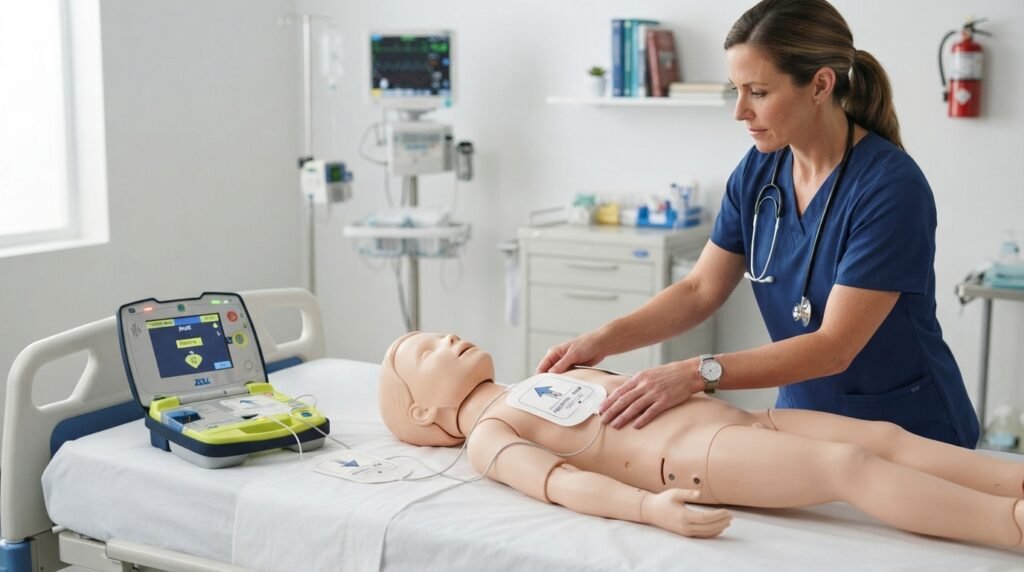
8. When Should AED Pads Be Placed in the Anterior-Posterior Position?
Answer: When the pads may touch each other or when the manufacturer recommends this placement.
The anterior-posterior position means placing one AED pad on the front of the chest and the other on the back.
This placement may be used for a child when the chest is too small for the pads to fit safely in the usual front-side position.
The pads must not touch each other.
Always follow the AED manufacturer’s instructions and use pediatric pads or an energy-reducing setting when available.
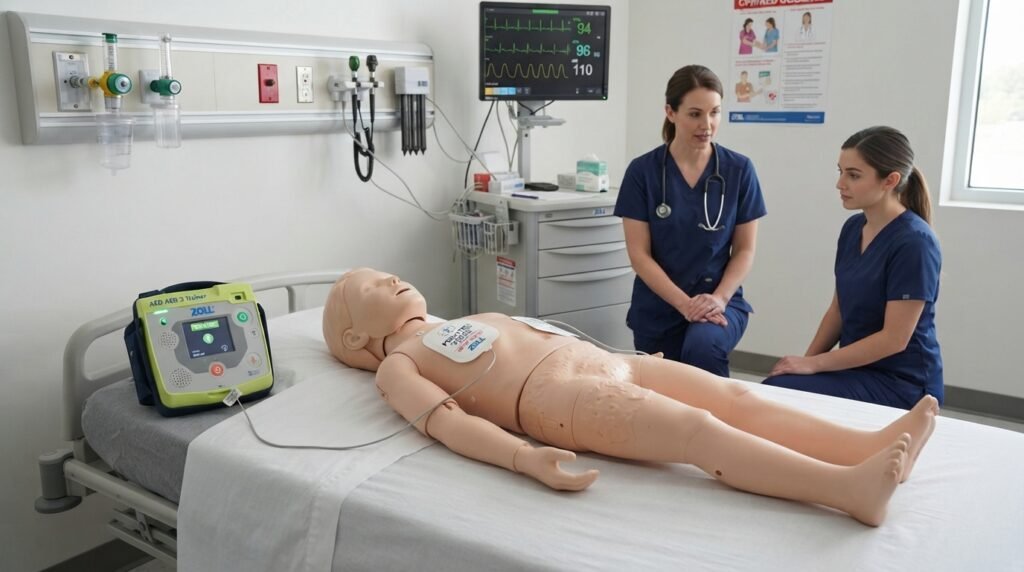
Example 6:
Ana-Lisa places one AED pad on Theo’s chest and the other on his back because the standard placement could cause the pads to touch.
This example explains when the anterior-posterior method may be needed.
9. What Compression-to-Ventilation Ratio Should the Team Use During Two-Provider CPR?
Answer: 15:2.
When two or more healthcare providers perform child CPR without an advanced airway, they use:
- 15 chest compressions
- 2 rescue breaths
This ratio allows the team to provide effective compressions and ventilation.
One provider can perform chest compressions while another provides breaths.
Example 7:
Ana-Lisa takes over chest compressions while Amy prepares to provide breaths using the 15:2 CPR ratio.
This example shows how two providers can share CPR tasks.
10. What Is the Correct Two-Person Bag-Mask Ventilation Technique?
Answer: One provider maintains the airway and mask seal while the other delivers breaths.
The bag-mask ventilation (BVM) technique helps provide air to a patient who cannot breathe effectively on their own.
When two trained providers are available:
- One provider opens and maintains the airway.
- The provider uses both hands to hold the mask and create a tight seal.
- The second provider squeezes the ventilation bag.
- Each breath should produce visible chest rise.
The two-person method can provide a better mask seal and more effective ventilation.
Example 8:
Joe holds the mask over Theo’s face using both hands while Amy squeezes the bag-mask ventilation device to deliver breaths.
This shows how two providers can work together to support a child’s breathing.
11. How Often Should a Child Receive Ventilations During CPR With an Advanced Airway?
Answer: 20–30 breaths per minute under the 2025 AHA guidelines.
When a child has an advanced airway in place during CPR, continuous chest compressions are provided with separate ventilations.
The current recommended ventilation rate is 20–30 breaths per minute.
This equals approximately one breath every 2–3 seconds.
Providers should avoid giving breaths too quickly or using excessive ventilation pressure.
12. When Should the Team Stop Performing CPR on Theo?
Answer: When appropriate signs of recovery appear or trained providers take over.
The team should continue CPR until one of the accepted stopping conditions occurs.
These may include:
- Theo shows signs of return of spontaneous circulation (ROSC).
- Theo starts moving or breathing normally.
- A trained resuscitation team takes over.
- The scene becomes unsafe.
- The team cannot continue because of physical exhaustion.
- A valid medical order directs the team to stop, according to applicable rules.
ROSC means the return of a person’s natural heartbeat and circulation after cardiac arrest.
A provider should not stop CPR simply because the child has not responded after a short period.
Team Roles During the Theo James Scenario
Teamwork is a major part of the Theo James exercise. Every healthcare provider should have a clear role during the emergency.
Here are the common responsibilities in a pediatric resuscitation team.
Team Leader
The team leader directs the response and makes sure the team follows the correct steps.
Responsibilities include:
- Giving clear instructions.
- Assigning team roles.
- Monitoring the patient’s condition.
- Checking that tasks are completed.
- Making decisions based on the patient’s condition.
Chest Compression Provider
This provider performs chest compressions and maintains the correct compression rate and depth.
They should allow complete chest recoil and avoid unnecessary interruptions.
Airway Provider
The airway provider maintains an open airway and helps deliver effective ventilation.
They may use a bag-mask device when appropriate.
AED Operator
The AED operator prepares the defibrillator, applies the pads, and follows the device’s voice instructions.
The team should minimize interruptions in chest compressions when using the AED.
Example 9:
The team leader asks one provider to perform compressions, another to manage the airway, and a third to prepare the AED.
This example shows how clear role assignments help the team work together.
Common Mistakes in the Theo James Team Response Scenario
Students may lose marks during practical assessments because they miss simple steps or use incorrect CPR techniques.
Here are some common mistakes to avoid.
| Common mistake | Correct approach |
|---|---|
| Taking too long to assess breathing | Complete the assessment promptly |
| Using incorrect head positioning | Open the airway using the correct head-tilt/chin-lift position |
| Performing shallow compressions | Reach about 2 inches (5 cm) in a child |
| Using 30:2 with two providers | Use 15:2 without an advanced airway |
| Allowing long CPR interruptions | Keep pauses as short as possible |
| Placing AED pads too close together | Use a safe pad position |
| Giving excessive breaths | Follow the recommended ventilation rate |
| Failing to assign team roles | Give each provider a clear task |
How to Prepare for the Assessment
You can prepare for the Theo James scenario by reviewing these key skills:
- Learn the correct pediatric airway position.
- Practice checking breathing and pulse within the recommended time.
- Learn the difference between 30:2 and 15:2 CPR.
- Practice child chest compressions.
- Review correct AED pad placement.
- Practice two-person bag-mask ventilation.
- Learn the responsibilities of each team member.
- Review the latest BLS and PALS guidelines.
Practice with a qualified instructor and use the current course materials for your assessment.
Frequently Asked Questions
1. Who Is Theo James in the Team Response Scenario?
Theo James is a six-year-old boy featured in a pediatric CPR training exercise. The scenario teaches healthcare providers how to respond to a child who becomes unresponsive.
2. Is the Theo James Scenario Part of BLS or PALS Training?
The scenario is used in Basic Life Support (BLS) training for children and is also discussed in connection with pediatric emergency response education. PALS covers more advanced pediatric emergency care.
3. What Is the CPR Ratio for One Rescuer Performing Child CPR?
The ratio is 30:2. The rescuer performs 30 chest compressions followed by two rescue breaths.
4. What Is the CPR Ratio for Two Rescuers Performing Child CPR?
The ratio is 15:2 when two or more providers perform CPR without an advanced airway.
5. How Deep Should Chest Compressions Be for a Child?
Chest compressions should reach approximately 2 inches (5 cm) or one-third of the child’s chest depth.
6. Where Should You Check a Child’s Pulse?
Healthcare providers traditionally check the carotid pulse on the side of the neck. The assessment should take no more than 10 seconds under the AHA healthcare-provider algorithm.
7. What Does BVM Mean in the Theo James Scenario?
BVM stands for Bag-Valve-Mask. It is a device used to provide breaths to someone who cannot breathe effectively without help.
8. What Is the Correct Ventilation Rate With an Advanced Airway?
The 2025 AHA pediatric guidelines recommend 20–30 breaths per minute during CPR when an advanced airway is in place.
9. When Should CPR Stop During the Theo James Scenario?
CPR may stop when the child shows signs of recovery, trained providers take over, the scene becomes unsafe, or another accepted stopping condition occurs.
10. What Is the Main Purpose of the Theo James Training Exercise?
The main purpose is to help healthcare providers practice child CPR, airway management, AED use, emergency communication, and team coordination.
Conclusion
The Team Response Scenario Theo James teaches healthcare providers how to respond to a child experiencing a serious emergency. It covers airway management, pulse assessment, chest compressions, AED use, and teamwork.
For exam preparation, focus on the key CPR ratios: 30:2 for one rescuer and 15:2 for two or more rescuers without an advanced airway. Also review the correct compression depth, ventilation rate, and AED pad placement.
Regular practice with a qualified instructor can help you perform each step correctly and respond with confidence during a pediatric emergency.

Emily Carter (Content Writer & Communication Specialist) is a content writer and communication specialist at AllTypeInfo.com. She writes clear, practical, and easy-to-follow guides on email responses, message replies, writing templates, and everyday communication tips. Her goal is to help readers communicate with confidence in both personal and professional settings.