The Team Response Scenario Esther Clark is part of BLS Lesson 5: Obstructed Airway. It tests how healthcare providers work together when a patient experiences a severe airway blockage. The scenario focuses on recognizing choking, giving the correct emergency care, and starting CPR if the patient becomes unresponsive.
If you are preparing for the BLS Lesson 5 post-assessment, this guide covers the main questions, answers, and reasons behind each action. It also explains how team members should respond during an airway emergency.
What Is the Team Response Scenario Esther Clark?
The Team Response Scenario Esther Clark is a Basic Life Support (BLS) training exercise about an adult patient with an obstructed airway. It tests a healthcare provider’s ability to recognize severe choking and take the right steps to help the patient.
The scenario focuses on several important skills:
- Recognizing the signs of a severe airway obstruction.
- Giving effective back blows.
- Performing the correct type of chest or abdominal thrusts.
- Recognizing when the patient becomes unresponsive.
- Starting CPR without delay.
- Checking the mouth for a visible object before giving breaths.
- Working as a team during an emergency.
The main goal is to help healthcare providers respond quickly and safely when someone cannot breathe because an object is blocking the airway.
Example 1:
A healthcare provider notices that Mrs. Clark cannot speak, breathe, or cough after choking on food. The provider calls for help and begins the correct choking response.
This example shows why recognizing severe airway obstruction is important. A person who cannot breathe, speak, or cough needs immediate help.
Esther Clark BLS Scenario: Post-Assessment Questions and Answers
The following questions cover the six-question Esther Clark study set and explain the expected answers.
Question 1: What Is the Correct Way to Perform Back Blows?
Answer: Using the heel of your hand, firmly strike between the patient’s shoulder blades (scapulae).
Explanation:
Back blows help create pressure that may remove an object blocking the airway.
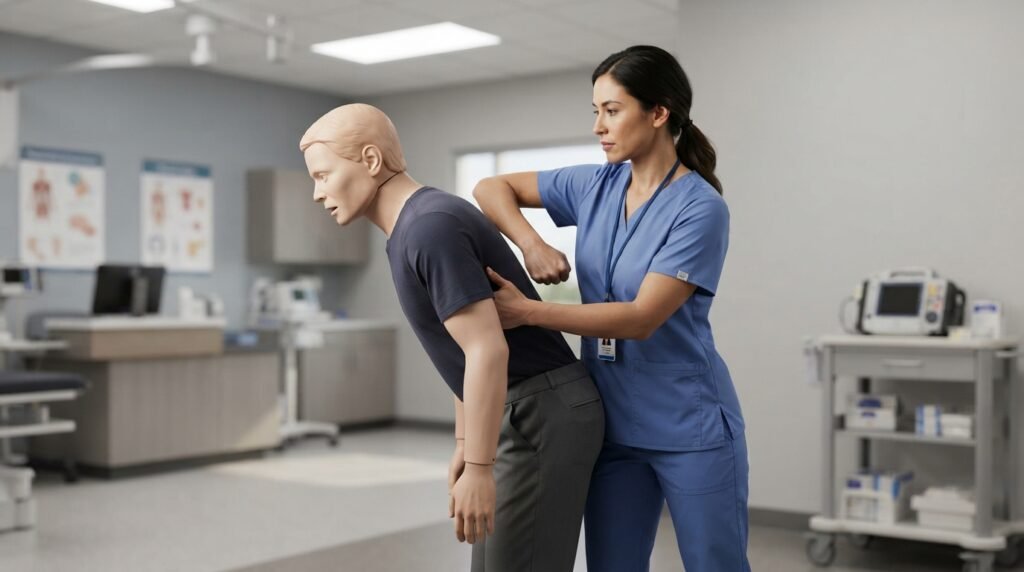
For an adult with severe choking, position yourself slightly behind the patient. Support the person’s chest and lean them forward. Give five separate, firm back blows between the shoulder blades.
Each blow should be strong enough to help remove the blockage.
Example 2:
A patient begins choking while eating lunch. A trained healthcare provider supports the patient’s chest, leans the patient forward, and gives five firm back blows between the shoulder blades.
This example shows the correct position and hand placement for back blows.
Question 2: What Is the Correct Area of the Chest to Perform Chest Thrusts?
Answer: The center of the chest on the lower half of the sternum.
Explanation:
The sternum is the breastbone in the center of the chest. The lower half is the correct area for chest thrusts when this technique is indicated.
Chest thrusts may be used for a severely choking adult when abdominal thrusts cannot be performed, such as when the person is in the late stages of pregnancy or the rescuer cannot encircle the person’s abdomen.
For the course’s Esther Clark question, the expected answer is the lower half of the sternum.
Example 3:
A pregnant patient experiences severe choking. The healthcare provider uses chest thrusts on the lower half of the sternum instead of abdominal thrusts.
This example explains why chest thrusts may be needed in certain emergency situations.
Question 3: Chest Thrusts Were Not Effective. You Should Now Attempt a Series of Five Back Blows and Five Chest Thrusts to Clear the Airway. True or False?
Answer in the study set: True.
Explanation:
The question tests whether the provider knows how to repeat choking relief actions when the first attempt does not remove the blockage.
However, the correct technique depends on the patient’s condition and the BLS guideline version being used.
Important current guideline update: The 2025 American Heart Association guidelines recommend repeated cycles of five back blows followed by five abdominal thrusts for a conscious adult with severe airway obstruction.
Use five chest thrusts instead of abdominal thrusts when the patient is in late-stage pregnancy or the rescuer cannot encircle the patient’s abdomen.
Therefore, the study set’s answer should not be treated as the current standard for every adult choking patient.
Example 4:
A conscious adult continues to show signs of severe choking after five back blows. The provider follows the current guideline and performs five abdominal thrusts before repeating the cycle if needed.
This example shows the updated adult choking response.
Question 4: What Should You Do Now?
Answer: Carefully lower Mrs. Clark to a firm, flat surface. Then immediately begin CPR, starting with chest compressions.
Explanation:
When a severely choking adult becomes unresponsive, the response changes.
The healthcare team should:
- Make sure the emergency response system has been activated.
- Carefully lower the patient to a firm, flat surface.
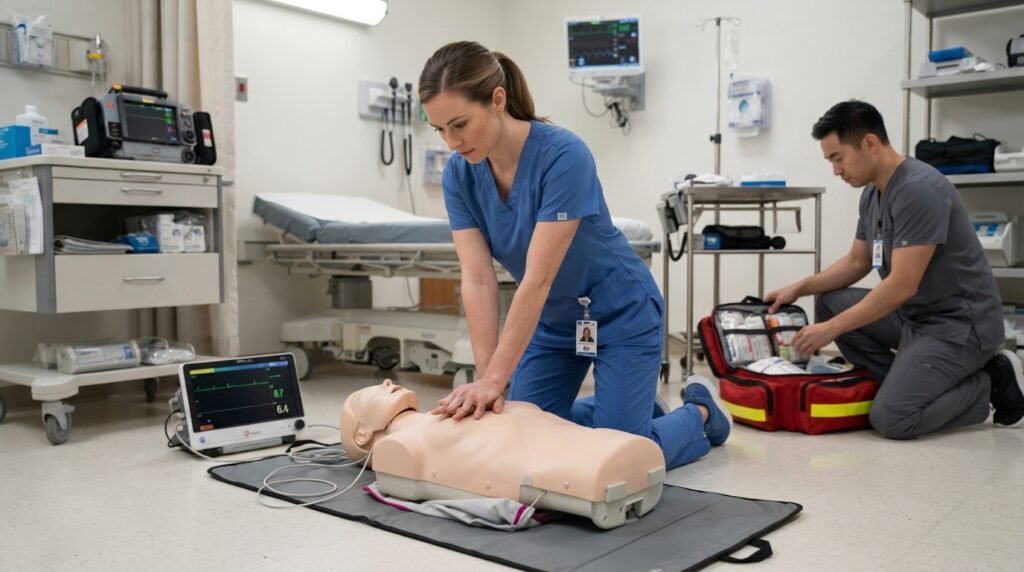
- Begin CPR, starting with chest compressions.
- Continue following the adult BLS procedure.
- Check the mouth for a visible object before attempting breaths.
Do not waste time repeating back blows or thrusts after the patient becomes unresponsive.
Example 5:
Mrs. Clark becomes unresponsive after repeated choking relief attempts. The healthcare provider lowers her onto a firm surface and immediately begins chest compressions.
This example shows why the team must change its response when the patient loses responsiveness.
Question 5: What Should the Team Do After Jenna Completes 30 Chest Compressions?
Answer: Open Mrs. Clark’s mouth and look for an object. Remove it only if a visible object is present.
Explanation:
After completing 30 chest compressions, the team prepares to give ventilations.
Before giving breaths, the provider should open the patient’s airway and check the mouth.
If an object is clearly visible and can be safely removed, remove it.
Never perform a blind finger sweep. Putting a finger into the mouth without seeing an object may push the blockage deeper into the airway.
This is an important safety point in choking emergencies.
Example 6:
Jenna completes 30 chest compressions. Another team member opens Mrs. Clark’s mouth and sees a piece of food blocking the airway. The provider carefully removes the visible object.
This example shows the difference between removing a visible obstruction and performing an unsafe blind finger sweep.
Question 6: What Is the Best Course of Action?
Answer: Continue performing cycles of 30 chest compressions and 2 ventilations, checking for a visible object before each set of ventilations.
Explanation:
The expected study-set answer is to continue the CPR cycle while checking the mouth for a visible obstruction before giving breaths.
The team should maintain good chest compression quality and avoid unnecessary interruptions.
The team must also follow the patient’s condition and the current adult BLS algorithm.
Example 7:
Jenna continues CPR while another provider prepares to give two ventilations. Before giving the breaths, the provider checks Mrs. Clark’s mouth for a visible object.
This example shows how team members can share tasks while keeping CPR going.
How Should a BLS Team Respond to an Obstructed Airway?
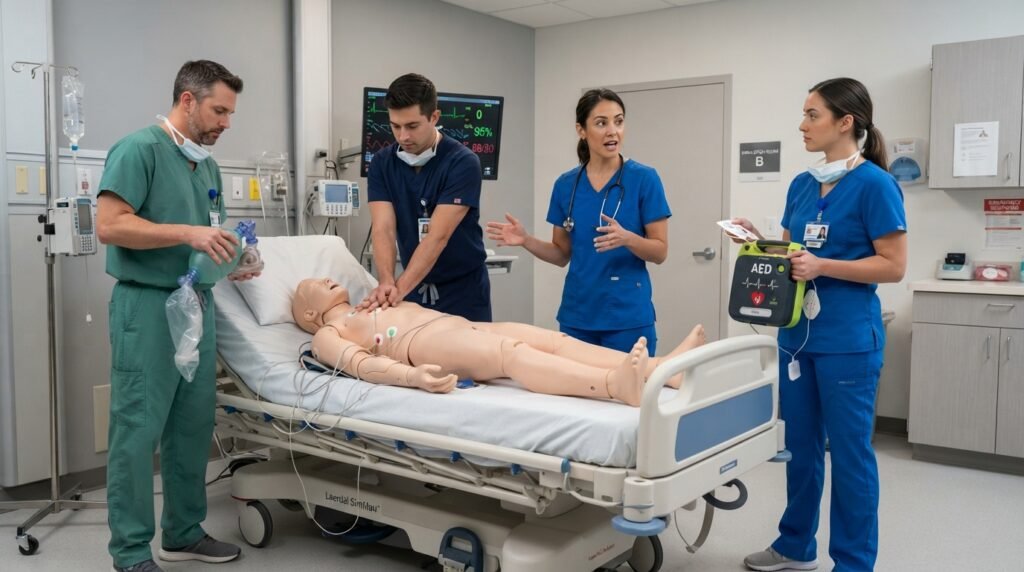
A good team response depends on clear communication, quick action, and assigned responsibilities.
Each team member should know their role and communicate with the others.
1. Recognize Severe Airway Obstruction
The team should look for signs such as:
- Inability to speak.
- Inability to breathe normally.
- Weak or absent cough.
- Changes in skin color.
- Loss of responsiveness.
A person with a mild obstruction may still cough effectively. In that situation, encourage coughing and monitor the patient for signs of severe obstruction.
2. Activate the Emergency Response System
When severe choking is identified, call for emergency assistance.
In a healthcare facility, activate the facility’s emergency response system according to its protocol.
One team member can call for help while another begins the appropriate choking response.
3. Assign Team Roles
Clear roles help reduce confusion.
A team may include:
- Team leader: Directs the response and monitors patient care.
- Compressor: Performs chest compressions when CPR is needed.
- Airway provider: Manages the airway and gives ventilations.
- AED operator: Retrieves and operates the automated external defibrillator.
The exact number of team members and their duties depend on the emergency and available staff.
4. Communicate Clearly
Team members should use short, direct instructions.
For example:
Team leader: “Start chest compressions.”
Team member: “Starting chest compressions.”
Team leader: “Bring the AED.”
Team member: “I’ll bring the AED.”
This is an example of closed-loop communication. The person receiving an instruction repeats or confirms it so the team leader knows the task was understood.
5. Monitor CPR Quality
If the patient becomes unresponsive and needs CPR, the team should maintain good compression quality.
Team members should:
- Allow the chest to return fully after each compression.
- Avoid unnecessary pauses.
- Give appropriate ventilations.
- Switch compressors when needed.
- Follow AED instructions.
- Continue care until the patient recovers or advanced help takes over.
Example 8:
The team leader asks one provider to begin compressions and another to prepare the AED. Both providers confirm their assignments and begin their tasks.
This example shows how clear roles and communication help the team work together.
Common Mistakes to Avoid in the Esther Clark Scenario
The Esther Clark scenario also tests whether providers can avoid common mistakes during an airway emergency.
1. Giving the Wrong Type of Thrust
Use the correct technique for the patient’s condition. Current adult guidance recommends abdominal thrusts after five back blows, except in situations where chest thrusts are indicated.
2. Delaying CPR
If the patient becomes unresponsive, start CPR with chest compressions. Do not continue the conscious choking response.
3. Performing a Blind Finger Sweep
Never search the mouth with your fingers without seeing an object. Remove only an obstruction that is visible.
4. Forgetting to Call for Help
The emergency response system should be activated when severe airway obstruction is identified.
5. Poor Team Communication
Unclear instructions can cause delays and repeated actions. Team members should confirm instructions and report when tasks are complete.
6. Stopping Compressions for Too Long
Avoid unnecessary interruptions. When switching compressors or preparing for another action, keep pauses as short as possible.
Esther Clark BLS Scenario: Quick Answer Review
Here is a quick review of the six questions in the study set.
| Question | Expected Answer |
|---|---|
| Correct way to perform back blows | Heel of the hand between the scapulae |
| Correct area for chest thrusts | Lower half of the sternum |
| Repeat five back blows and five chest thrusts | True in the supplied study set |
| What to do when Mrs. Clark becomes unresponsive | Lower her to a firm surface and begin CPR |
| What to do after 30 chest compressions | Check for a visible object and remove it if seen |
| Best course of action | Continue 30 compressions and 2 ventilations, checking for an object before breaths |
Study tip: The answers above reflect the six-question study set. Some wording and techniques may differ from newer BLS guidelines. Always follow your current training materials and facility protocol.
Frequently Asked Questions About the Esther Clark BLS Scenario
What is the main topic of the Esther Clark scenario?
The main topic is obstructed airway management. The scenario tests how healthcare providers respond when an adult patient experiences severe choking and becomes unresponsive.
What is the correct way to perform back blows?
Use the heel of your hand to deliver five separate, firm blows between the patient’s shoulder blades while supporting the chest and leaning the person forward.
Where should chest thrusts be performed?
Perform chest thrusts on the lower half of the sternum, in situations where chest thrusts are indicated.
What should you do if Mrs. Clark becomes unresponsive?
Carefully lower her onto a firm, flat surface and start CPR, beginning with chest compressions. Activate the emergency response system if this has not already been done.
Should you perform a blind finger sweep during CPR?
No. Only remove an object if you can clearly see it in the mouth. A blind finger sweep may push the obstruction farther into the airway.
What is the correct CPR cycle in the Esther Clark study set?
The expected answer is 30 chest compressions followed by 2 ventilations. Before giving breaths, check the mouth for a visible object.
What is the difference between chest thrusts and abdominal thrusts?
Chest thrusts apply pressure to the lower half of the sternum. Abdominal thrusts apply pressure to the upper abdomen. Current adult choking guidance uses abdominal thrusts after back blows in most cases, with chest thrusts used in certain special situations.
Why is teamwork important during an airway emergency?
Teamwork helps providers share tasks, communicate clearly, avoid delays, and provide coordinated patient care.
Conclusion
The Team Response Scenario Esther Clark tests important BLS skills related to severe choking and emergency team response. The six-question study set covers back blows, chest thrusts, CPR, airway checks, and continued resuscitation.
The main lesson is to recognize severe airway obstruction, take the correct action, and respond immediately if the patient becomes unresponsive. Healthcare providers should also communicate clearly and avoid unsafe actions such as blind finger sweeps.
For assessment preparation, review each question and understand why the answer is correct. Also check your current BLS course materials for updated procedures, especially the 2025 changes to adult choking care.

Emily Carter (Content Writer & Communication Specialist) is a content writer and communication specialist at AllTypeInfo.com. She writes clear, practical, and easy-to-follow guides on email responses, message replies, writing templates, and everyday communication tips. Her goal is to help readers communicate with confidence in both personal and professional settings.