Finding good winning RFP response examples PDF files can help you write better business proposals and respond to important contract opportunities. A strong Request for Proposal (RFP) response explains what your company offers, how it will meet the buyer’s needs, and why your business is a good choice.
However, simply downloading a proposal template is not enough. You need to answer the buyer’s questions clearly, provide relevant proof, explain your approach, and follow every submission rule.
This guide includes practical RFP response examples, sample answers, a complete response structure, and a reusable template. You will also learn how to prepare a proposal that is easy for evaluators to review and score.
What Are Winning RFP Response Examples?
Winning RFP response examples are sample business proposals that show how a company can answer a Request for Proposal (RFP) in a clear, professional, and convincing way.
An RFP is a document that an organization sends to potential suppliers or service providers. It explains what the organization needs, what requirements vendors must meet, and how proposals will be evaluated.
A company responds by submitting an RFP proposal that explains its services, pricing, qualifications, project plan, and ability to complete the work.
Winning examples show how to connect a company’s services with the buyer’s actual needs. They also show how to support claims with evidence, past results, and a clear delivery plan.
For example, a company applying for a website development contract should explain how it will build the website, manage the project, meet security requirements, and deliver the work on time.
The strongest sample responses are useful as learning tools. They should not be copied word for word because every RFP has different requirements.
What Makes an RFP Response Successful?
A strong proposal usually includes:
- A clear executive summary.
- A professional cover letter.
- A direct response to every requirement.
- A detailed proposed solution.
- Relevant company experience.
- Client references and case studies.
- A realistic project timeline.
- Clear and complete pricing.
- Supporting documents and required certifications.
- A professional closing statement.
Example 1:
Our company will develop a secure customer management system that meets your listed requirements. The project will include system planning, development, testing, employee training, and technical support after launch.
This example works because it explains the actual services the company will provide instead of making general promises.
Winning RFP Response Examples for Different Sections
A complete RFP response contains several sections. Each section has a different purpose and should answer a specific question from the buyer.
Below are practical sample responses you can study and adapt.
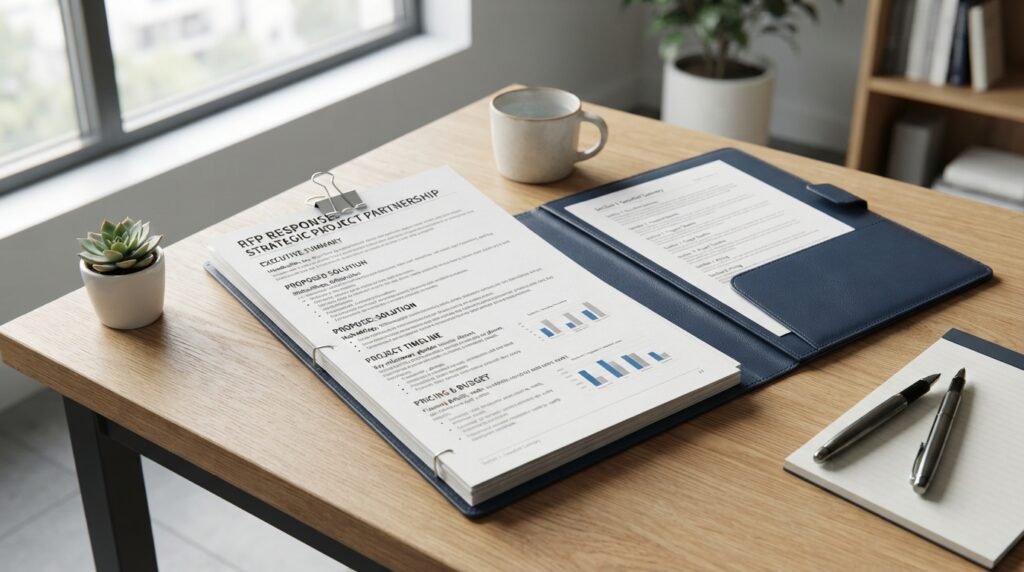
1. RFP Cover Letter Example
A cover letter introduces your company and explains why you are submitting a proposal.
Keep it short, professional, and specific to the buyer.
Example 2:
Dear Procurement Manager,
Thank you for inviting us to submit a proposal for your website development project. We reviewed your requirements and are confident that our team can deliver a secure, mobile-friendly website that meets your business goals.
Our team has experience in website development, user experience, content management systems, and ongoing technical support. We have included our proposed solution, project timeline, pricing, and relevant experience in this response.
We appreciate the opportunity to work with your organization and look forward to discussing our proposal.
Sincerely,
[Your Name]
[Company Name]
[Contact Information]
This sample uses a professional tone and tells the buyer what the proposal contains. Replace the project details with information from the actual RFP.
2. Executive Summary RFP Response Example
The executive summary is a short overview of your complete proposal. It should explain the buyer’s problem, your proposed solution, and the main benefits of choosing your company.
Example 3:
Your organization needs a modern website that improves the customer experience, supports mobile users, and makes website management easier for your staff.
Our team proposes a complete website development solution that includes planning, custom design, development, testing, and staff training.
We will assign a dedicated project manager and provide weekly progress reports. Our proposed delivery period is 12 weeks, subject to final project scope and approval.
Our goal is to deliver a secure, easy-to-manage website that meets your requirements and supports your long-term business plans.
This example works because it focuses on the buyer’s goals rather than spending too much space discussing the vendor’s company history.
3. Company Background and Experience Example
This section explains who you are, what your company does, and why your team is qualified for the project.
Include relevant information such as:
- Company history.
- Main services.
- Industry experience.
- Team qualifications.
- Similar completed projects.
- Professional certifications.
- Client references.
Example 4:
ABC Digital Solutions provides website development and digital services to small and medium-sized businesses.
Our team includes website developers, project managers, designers, and quality assurance specialists. We work with content management systems, website security, mobile-friendly design, and website maintenance.
For this project, we will assign a dedicated project manager, two developers, and a quality assurance specialist.
This response gives the buyer a clear picture of the team. In a real proposal, add verified company details and relevant project history.
4. Understanding of Project Requirements Example
This section shows that you have read the RFP and understand what the buyer wants.
Avoid repeating the entire RFP. Explain the main requirements in your own words.
Example 5:
Based on the RFP, we understand that your organization needs a website that:
- Works on desktop computers, tablets, and mobile phones.
- Includes a content management system.
- Meets the required security standards.
- Loads efficiently and supports accessibility.
- Allows staff to update website content without technical help.
Our proposed solution addresses these requirements through a mobile-friendly design, a suitable content management system, security testing, and staff training.
This example makes it easier for evaluators to see how your proposal relates to their requirements.
5. Proposed Solution RFP Response Example
The proposed solution explains exactly how your company will complete the project.
Avoid vague statements such as “We provide excellent service.” Instead, explain the steps, tasks, and deliverables.
Example 6:
Our website development project will follow four stages:
Stage 1: Planning
We will review the project requirements, identify the website’s main features, and prepare a development plan.
Stage 2: Design and Development
Our team will create the website layout, develop the required pages, and configure the content management system.
Stage 3: Testing
We will test website performance, mobile display, security settings, navigation, and important website functions.
Stage 4: Launch and Training
After receiving approval, we will launch the website and train the client’s staff to manage website content.
This example works because it gives the buyer a clear picture of how the project will move from planning to delivery.
6. Past Performance and Case Study Example
Buyers often want proof that your company has completed similar work.
A past performance section should include relevant projects, your responsibilities, and measurable results.
Never invent client names, project results, or performance figures.
Example 7:
Project Name: Business Website Development
Client Type: Small Business
Project Scope: Website design, development, mobile optimization, and staff training.Challenge: The client needed a modern website that could display its services and make it easier for customers to contact the business.
Solution: Our team developed a mobile-friendly website with service pages, contact forms, and a content management system.
Outcome: The website was delivered according to the agreed project scope, and the client’s staff received training on content updates.
This example follows a simple case study format. Replace the fictional project details with genuine work from your company.
7. Pricing Proposal Example
Your pricing section should explain how much the project will cost and what the buyer will receive.
Make sure all prices match your actual quotation.
Example 8:
| Service | Description | Sample Cost |
|---|---|---|
| Planning | Requirements and project planning | $1,000 |
| Design | Website layout and visual design | $2,000 |
| Development | Website development | $5,000 |
| Testing | Quality and security checks | $1,000 |
| Training | Staff training and handover | $500 |
| Total | Complete project | $9,500 |
These figures are illustrative only, not market price estimates.
A good pricing response should also explain:
- What is included in the price.
- What is excluded.
- Payment terms.
- Additional service costs.
- Any optional services.
- How changes to the project scope will be priced.
8. Project Timeline Example
A project timeline shows how long each stage will take and when the buyer can expect important deliverables.
Example 9:
| Project Stage | Estimated Duration | Deliverable |
|---|---|---|
| Planning | 2 weeks | Approved project plan |
| Design | 2 weeks | Design approval |
| Development | 5 weeks | Working website |
| Testing | 2 weeks | Testing report |
| Launch and Training | 1 week | Live website and staff training |
The estimated project duration is 12 weeks. The actual schedule should account for client feedback, approvals, access to materials, and any dependencies.
Complete Winning RFP Response Template
You can use the following RFP response template as a starting point for your next proposal.
Replace the bracketed details with accurate information from your company and the buyer’s RFP.
1. Cover Page
Proposal Title: [Project Name]
Submitted To: [Client Organization]
Submitted By: [Your Company Name]
Submission Date: [Date]
RFP Reference Number: [Reference Number]
Contact Person: [Name and Job Title]
2. Cover Letter
Dear [Client Name],
Thank you for inviting [Company Name] to submit a proposal for [Project Name].
We have reviewed your requirements and prepared this response to explain how our company can meet your needs.
Our proposed solution includes [Main Services], supported by [Relevant Experience or Qualifications].
We look forward to the opportunity to work with your organization.
Sincerely,
[Your Name]
[Job Title]
[Company Name]
[Email and Phone Number]
3. Executive Summary
[Client Name] requires [Describe the Main Business Need].
Our company proposes [Briefly Explain Your Solution].
The proposed project includes:
- [Service or Deliverable 1]
- [Service or Deliverable 2]
- [Service or Deliverable 3]
Our team will complete the work according to the agreed timeline and project requirements.
4. Company Profile
Company Name: [Name]
Year Established: [Year]
Main Services: [Services]
Industry Experience: [Relevant Experience]
Team Size: [Number]
Certifications: [Verified Certifications]
5. Understanding of Requirements
Based on our review of the RFP, we understand that the client requires:
- [Requirement 1]
- [Requirement 2]
- [Requirement 3]
Our proposed response addresses these requirements through [Brief Explanation].
6. Proposed Solution
Describe your approach, project stages, key activities, and expected deliverables.
Include enough detail for the buyer to evaluate your ability to complete the work.
7. Project Team
| Team Member | Role | Responsibility |
|---|---|---|
| [Name] | Project Manager | Project planning and communication |
| [Name] | Specialist | Main project activities |
| [Name] | Quality Reviewer | Testing and quality checks |
8. Relevant Experience
Include two or three similar projects where possible.
For each project, explain the client’s needs, your work, and the results you can verify.
9. Project Timeline
List the project stages, estimated dates, milestones, and deliverables.
10. Pricing and Payment Terms
Provide a complete cost breakdown, payment schedule, and details of any optional services.
11. Risk Management
Explain possible project risks and the steps your company will take to manage them.
12. Closing Statement
Thank you for considering our proposal. We believe our proposed services and relevant experience make us a suitable candidate for this project.
We welcome the opportunity to answer further questions and discuss the next steps.
Contact: [Name, Email, Phone]
How to Write an RFP Response That Stands Out
A good proposal does more than describe your services. It shows the buyer how your company can solve the problem.
Here are practical steps to improve your response.
1. Read the Entire RFP
Read the instructions, scope of work, evaluation criteria, submission rules, and deadlines.
Pay close attention to mandatory requirements. Missing a required document or ignoring a submission rule can make your proposal noncompliant.
Example 10:
If an RFP asks for three similar projects completed within the last five years, provide three relevant projects with accurate dates and supporting details.
This example shows why you should follow the exact instructions instead of submitting a general company profile.
2. Create an RFP Compliance Matrix
A compliance matrix is a table that connects each RFP requirement with the section of your proposal that answers it.

It helps your team check that nothing important has been missed.
| RFP Requirement | Proposal Section | Status |
|---|---|---|
| Company experience | Section 4 | Complete |
| Project timeline | Section 6 | Complete |
| Pricing details | Section 9 | Complete |
| Security requirements | Section 5 | Needs review |
| Client references | Section 7 | Complete |
Example 11:
If the buyer requests proof of professional certification, list the certification in the relevant section and attach the required evidence.
This makes the response easier to check and reduces the risk of missing documents.
3. Answer Every Question Directly
Do not make evaluators search through several pages to find an answer.
Use the same question numbers and headings as the RFP whenever possible.
Example 12:
Question 4: How will your company protect customer information?
We will use approved access controls, secure data storage, regular security checks, and documented procedures for handling customer information.
This format connects the answer directly to the buyer’s question.
4. Use Evidence Instead of Empty Promises
Avoid statements such as:
- We are the best service provider.
- We always deliver excellent results.
- Our team has unmatched experience.
These statements do not give evaluators much evidence.
Instead, use verified information about completed projects, staff qualifications, references, and performance.
Example 13:
Our team completed a website redesign for a regional service company in 2025. The work included 18 pages, a content management system, and staff training. The project was delivered within the approved schedule.
This example provides useful details that a buyer can assess.
5. Make Your Proposal Easy to Read
Use clear headings, short paragraphs, numbered sections, and simple tables.
Avoid unnecessary technical language. If you must use a technical term, explain what it means.
Make sure your document has:
- A professional cover page.
- Consistent headings.
- Readable fonts.
- Page numbers.
- A table of contents for longer proposals.
- Correct section references.
- Clearly labeled attachments.
6. Review the Proposal Before Submission
Ask someone who did not write the proposal to review it.
They should check whether every question has an answer, the figures are correct, and all required documents are included.
A final review should also check spelling, grammar, formatting, signatures, and file names.

Where to Find Winning RFP Response Examples PDF Files
If you want to download RFP response examples PDF files, there are several places worth checking.
1. Proposal Template Websites
Business proposal and RFP resource websites often provide downloadable templates, sample executive summaries, cover letters, and response examples.
Some resources are free, while others require an email address or paid account.
Check whether a resource provides a complete response or only a short sample.
2. Government Procurement Websites
Government agencies sometimes publish procurement documents, awarded contracts, and other public records.
In the United States, public procurement resources can help you study how agencies structure their requirements and evaluate proposals.
Some awarded proposals may be available through public records requests, subject to applicable disclosure rules and exemptions.
3. Business Proposal Resource Libraries
Some proposal management companies publish sample responses and practical writing guides.
Look for resources that include:
- Sample executive summaries.
- Technical response examples.
- Pricing sections.
- Cover letter samples.
- Case study formats.
- Evaluation checklists.
4. Professional Industry Associations
Industry associations may publish procurement guides, bid-writing resources, and sample business documents.
Look for resources related to your field, such as technology, construction, consulting, healthcare, or professional services.
5. Search for Specific RFP Sections
Instead of searching only for a complete winning proposal, search for individual sections.
Useful searches include:
- RFP executive summary examples PDF.
- RFP cover letter examples.
- Technical proposal response samples.
- RFP pricing proposal examples.
- Government RFP response examples.
- RFP case study examples.
Tip: Check the date, industry, and purpose of every sample before using it. A proposal written for a software project may not be suitable for a construction contract.
Common Mistakes That Can Weaken an RFP Response
Even a qualified company can submit a weak proposal if it ignores the buyer’s instructions.
Here are mistakes to avoid.
1. Using the Same Proposal for Every Buyer
Reusing company information can save time, but every proposal should address the specific RFP.
Update the executive summary, proposed solution, project plan, and relevant case studies for each opportunity.
2. Ignoring Evaluation Criteria
Some proposals include a lot of company information but fail to answer the questions that affect their evaluation.
Read the scoring criteria and give enough space to the most important requirements.
3. Making Claims Without Proof
Do not claim that your company has completed projects, earned certifications, or achieved results unless you can support those statements.
Use genuine records and approved client references.
4. Providing Unclear Pricing
A single total price may not explain what the buyer receives.
Break the price into services, deliverables, optional items, and payment terms.
5. Missing Submission Requirements
An otherwise strong proposal may be rejected if it arrives late or fails to meet a mandatory submission rule.
Check the deadline, file format, page limits, signatures, and required attachments.
6. Waiting Until the Last Minute
Rushed proposals often contain missing information and inconsistent figures.
Set an internal deadline before the official submission date. Allow time for technical, financial, and management reviews.
RFP Response Submission Checklist
Use this checklist before sending your proposal.
- Read the complete RFP document.
- Confirm that your company meets the eligibility requirements.
- Check the submission deadline.
- Review the evaluation criteria.
- Prepare a compliance matrix.
- Write a project-specific cover letter.
- Include a clear executive summary.
- Provide accurate company information.
- Answer every required question.
- Explain your proposed solution.
- Include relevant past performance.
- Add a realistic project timeline.
- Check all pricing calculations.
- Include required certificates and attachments.
- Review the document for errors.
- Confirm the correct file format.
- Submit the proposal using the required method.
Frequently Asked Questions About Winning RFP Response Examples PDF
Where can I download winning RFP response examples PDF files?
You can look for downloadable examples on business proposal resource websites, RFP software websites, professional association websites, and government procurement portals. Some provide free PDF files, while others require registration or payment.
What does RFP stand for?
RFP stands for Request for Proposal. It is a formal document that an organization uses to invite businesses to submit proposals for a project, service, or contract.
What should a winning RFP response include?
A strong response generally includes a cover letter, executive summary, company profile, understanding of requirements, proposed solution, relevant experience, pricing, project timeline, and required supporting documents.
How long should an RFP response be?
There is no fixed length for every RFP. Follow the buyer’s page limits and formatting instructions. A short response may be enough for a simple project, while a large contract may require a detailed proposal.
Can I use an RFP response template for every project?
You can reuse basic company information and approved content, but you should update the project-specific sections. Your executive summary, solution, evidence, timeline, and pricing should match the actual RFP.
Are free RFP response examples reliable?
Free examples can help you learn proposal structure and writing style. However, check their quality, date, industry relevance, and accuracy before using them. Never treat an example as proof that a particular response will win a contract.
What is the difference between an RFP and an RFP response?
An RFP is the document issued by the buyer explaining its project requirements. An RFP response is the proposal submitted by a vendor explaining how it can meet those requirements.
How can a small business write a competitive RFP response?
A small business should focus on relevant experience, a clear project plan, realistic pricing, qualified staff, and strong evidence of its ability to complete the work. It should answer every requirement directly rather than trying to compete through company size alone.
Are winning RFP proposals available to the public?
Some public agencies release awarded proposals or related procurement records. However, availability depends on the agency, applicable public records laws, and information that may be withheld for legal or confidential reasons. Private company proposals are generally not public documents.
Conclusion
Finding winning RFP response examples PDF files can give you a useful starting point for preparing better business proposals. Sample cover letters, executive summaries, technical answers, and pricing tables can show you how to organize your response.
However, a strong proposal must match the buyer’s actual requirements. Read the RFP carefully, answer every question, include relevant proof, and provide a realistic plan with clear pricing.
Use the examples and template in this guide as a starting point, then replace the sample details with accurate information about your company. A clear, complete, and well-supported response gives evaluators a better reason to consider your proposal.

Emily Carter (Content Writer & Communication Specialist) is a content writer and communication specialist at AllTypeInfo.com. She writes clear, practical, and easy-to-follow guides on email responses, message replies, writing templates, and everyday communication tips. Her goal is to help readers communicate with confidence in both personal and professional settings.