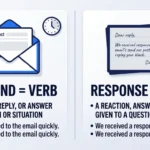
The word response is useful in emails, text messages, business reports, school assignments, and everyday conversations. However, using the same word too often can make your writing sound repetitive. Choosing the right alternative can help you express your meaning more clearly and match the tone of your message.
The best synonym depends on what you want to describe. You might need an answer to a question, a reply to an email, a reaction to unexpected news, or feedback on your work. This guide explains common synonyms for response, shows how they differ, and gives examples you can use in real situations.
Key Takeaways
- Answer: Use it for questions and problems.
- Reply: Use it for messages and conversations.
- Reaction: Use it for feelings or behavior.
- Feedback: Use it for opinions and suggestions.
- Acknowledgment: Use it to confirm receipt.
- Retort: Use it for a sharp or witty comeback.
- Response: Keep it when a broad, neutral word fits best.
What Does Response Mean?
A response is something a person says or does after receiving a question, message, request, event, or other form of information.
A response can take several forms:
- A written message.
- A spoken answer.
- An emotional reaction.
- A comment or opinion.
- An action taken to address a problem.
For example, if your manager asks for a project update, your written message is a response. If you smile after hearing good news, your smile is also a response.
The word is broad enough for casual conversations and formal writing. However, a more specific word can make your meaning clearer.
20 Common Synonyms for Response
Here are 20 alternatives, along with their meanings and the situations where they work best.
| Synonym | Meaning | Best Use |
|---|---|---|
| Answer | Information given to a question | Questions and tests |
| Reply | A spoken or written message | Emails and conversations |
| Reaction | A feeling, action, or change | News and events |
| Feedback | Opinions or suggestions | Work and performance |
| Acknowledgment | Confirmation of receipt or recognition | Emails and requests |
| Explanation | Information that makes something clear | Questions about reasons |
| Clarification | Extra information that removes confusion | Instructions and details |
| Comment | A remark about something | Discussions and posts |
| Statement | A clear expression of information or opinion | Official communication |
| Remark | A short spoken or written comment | Everyday conversation |
| Retort | A quick, often sharp answer | Arguments and dialogue |
| Rejoinder | A formal reply, often to a statement | Debates and formal writing |
| Comeback | A quick, clever reply | Casual conversations |
| Rebuttal | An answer that challenges a claim | Arguments and debates |
| Acknowledgement of receipt | Confirmation that something arrived | Business communication |
| Counterargument | A reason against another argument | Essays and discussions |
| Response message | A message sent to answer or address something | Digital communication |
| Follow-up | A later message or action | Work and customer service |
| Reaction statement | A statement expressing a view about an event | News and public comments |
| Action | Something done to address a situation | Problems and requests |
Quick tip: These words are related, but they are not interchangeable in every sentence. Choose the word that matches the exact meaning you want to express.
When to Use Each Synonym for Response
The right word depends on the message, the audience, and the result you want to describe.
1. Answer: When Someone Asks a Question
Use answer when someone asks a direct question or needs a solution to a problem.
Examples:
- Her answer explained the problem.
- I received an answer from my teacher.
- Please answer the final question.
Best for: Questions, exams, requests for information, and problems that need solutions.
2. Reply: For Emails, Texts, and Conversations
Use reply when someone responds to a message or something another person has said.
Examples:
- Thanks for your quick reply.
- She sent a reply to my email.
- I will reply to your message tonight.
Best for: Text messages, emails, letters, and everyday conversations.
3. Reaction: For Feelings and Behavior
Use reaction when you want to describe how someone feels or behaves after something happens.
Examples:
- His reaction to the news was surprising.
- Her first reaction was excitement.
- The audience had a positive reaction to the speech.
Best for: Emotions, unexpected events, social situations, and public reactions.
4. Feedback: For Opinions and Suggestions
Use feedback when someone shares comments that can help improve work, ideas, or performance.
Examples:
- Thank you for your feedback on my article.
- The manager gave me helpful feedback.
- We need customer feedback before making changes.
Best for: Workplace reviews, writing, customer opinions, and learning.
5. Acknowledgment: To Confirm Receipt
Use acknowledgment when you want to show that you received or noticed a message, request, or document.
Examples:
- I received an acknowledgment of my application.
- Please send an acknowledgment of receipt.
- Her email served as an acknowledgment of the request.
Best for: Formal emails, applications, business records, and document delivery.
6. Explanation: To Make Something Clear
Use explanation when the reply gives reasons or helps someone understand why something happened.
Examples:
- His explanation cleared up the confusion.
- We need an explanation for the delay.
- She provided an explanation for her decision.
Best for: Questions about reasons, mistakes, delays, and decisions.
7. Clarification: To Remove Confusion
Use clarification when you need extra details or clearer wording.
Examples:
- Thank you for the clarification.
- I requested clarification about the deadline.
- Her clarification helped everyone follow the instructions.
Best for: Unclear instructions, confusing messages, and missing details.
8. Comment or Remark: To Share a Thought
Use comment for an opinion or observation. Use remark for a short statement, especially in conversation.
Examples:
- She left a comment on my post.
- His comment helped the team.
- I was surprised by her remark.
Best for: Online discussions, meetings, conversations, and reviews.
9. Retort: For a Sharp or Witty Reply
A retort is a quick reply that often sounds angry, sharp, or clever.
Examples:
- He gave a sharp retort during the argument.
- Her witty retort made everyone laugh.
Best for: Fiction, dialogue, arguments, and descriptions of tense conversations.
Avoid this word in routine business emails because it can suggest hostility.
10. Rejoinder: For a Formal Reply
A rejoinder is a reply to something another person has said, often in a debate or formal exchange.
Examples:
- The lawyer prepared a rejoinder to the claim.
- Her rejoinder challenged his argument.
Best for: Formal discussions, legal writing, debates, and academic contexts.
For everyday messages, reply is usually simpler.
11. Comeback: For a Clever Reply
A comeback is a quick reply, often intended to be funny or clever.
Examples:
- She had a clever comeback ready.
- His comeback made his friends laugh.
Best for: Friendly teasing, jokes, casual conversation, and entertainment writing.
12. Rebuttal: To Challenge a Claim
A rebuttal gives reasons or evidence against a statement or argument.
Examples:
- The report included a rebuttal to the criticism.
- She presented a rebuttal to his main claim.
Best for: Debates, essays, formal arguments, and public statements.
A rebuttal does more than acknowledge a message. It challenges what was said.
13. Counterargument: To Present an Opposing View
A counterargument is a reason or point that challenges another argument.
Examples:
- The essay included a strong counterargument.
- He presented a counterargument during the debate.
Best for: School essays, research papers, debates, and discussions of different views.
14. Statement: For a Clear or Official Message
A statement expresses information, a position, or an opinion. It may serve as a response to a question or event.
Examples:
- The company issued a statement about the delay.
- She made a statement in response to the complaint.
Best for: Public announcements, official communication, and formal reports.
15. Follow-Up: For a Later Message or Action
A follow-up is a later message or action that checks progress, adds information, or continues an earlier discussion.
Examples:
- I sent a follow-up about the job application.
- The team scheduled a follow-up meeting.
Best for: Work emails, customer service, job applications, and ongoing requests.
A follow-up is not always a direct synonym for response. It describes what happens next.
16. Action: When Someone Does Something
Sometimes a response is an action rather than a spoken or written message.
Examples:
- The team took action to fix the issue.
- The school introduced new safety measures.
- The company addressed the complaint.
Best for: Problem-solving, workplace decisions, emergencies, and official steps.
Use action when the result matters more than the words someone says.
Formal Synonyms for Response
In professional or academic writing, your word choice should match the purpose of the message.
| Alternative | Best Situation | Example |
|---|---|---|
| Formal reply | Official communication | We received your formal reply. |
| Acknowledgment | Confirming receipt | This email confirms acknowledgment of your request. |
| Explanation | Giving reasons | Please provide an explanation for the delay. |
| Clarification | Clearing up details | We request clarification of the policy. |
| Rebuttal | Challenging a claim | The report contains a rebuttal to the allegation. |
| Rejoinder | Formal discussion | The author submitted a rejoinder. |
| Statement | Public or official communication | The company released a statement. |
| Feedback | Review or evaluation | We welcome feedback on the proposal. |
Quick tip: A formal word is useful only when it fits the situation. Simple words often make professional writing clearer.
Professional Alternatives to Response in Emails
If you use response several times in a business email, you can replace it with a more specific phrase. Choosing the right words also helps you write clear and professional email replies that match your message and audience.
| Instead of | Try | Example |
|---|---|---|
| Your response | Your reply | Thank you for your reply. |
| A quick response | A quick update | Could you send a quick update? |
| Response to my request | Confirmation | I am waiting for confirmation. |
| Response to my question | An answer | Thank you for answering my question. |
| Response to the issue | An update on the issue | Please share an update on the issue. |
| Response at a later date | Follow-up | I will follow up next week. |
| Positive response | Approval | We received approval for the plan. |
| Response to my feedback | Your comments | Thank you for your comments. |
Choose the phrase that describes what you actually need. For example, approval means permission or agreement, while acknowledgment may simply confirm that a message arrived.
Copy-Ready Email Examples
To thank someone for replying
Thank you for your prompt reply. I appreciate the information you shared.
To ask for an update
Could you please provide an update on my request when you have a chance?
To confirm receipt
This email confirms that we received your message.
To ask for more details
Could you please clarify the final deadline?
To promise a later reply
I will review the details and get back to you by Friday.
To request feedback
I would appreciate your feedback on the attached draft.

Synonyms for Response in Different Situations
Different situations call for different words. Use these examples to choose a suitable alternative.
In Everyday Conversation
- Reply: She replied to my question.
- Answer: He answered the phone.
- Reaction: Her reaction was unexpected.
- Comeback: That was a funny comeback.
- Remark: His remark made me smile.
In Business Communication
- Acknowledgment: We received your application.
- Confirmation: Your appointment is confirmed.
- Feedback: Please share your feedback.
- Explanation: We need an explanation for the delay.
- Follow-up: I will send a follow-up tomorrow.
In Academic Writing
- Answer: The student gave the correct answer.
- Counterargument: The essay presents a counterargument.
- Rebuttal: The author offers a rebuttal to the claim.
- Explanation: The results need further explanation.
- Reaction: The study examines people’s reactions to the event.
In Customer Service
- Acknowledgment: We have received your complaint.
- Update: We will provide an update soon.
- Resolution: The team found a resolution to the issue.
- Confirmation: Your refund has been confirmed.
- Follow-up: Our team will follow up with you.
These examples use words with related meanings, but each serves a different purpose. A resolution describes a solution, while an update gives new information.
Response vs. Answer vs. Reply vs. Reaction
These four words are closely related, but they do not always mean the same thing.
| Word | Main Meaning | Example |
|---|---|---|
| Response | A broad answer or reaction | We received a response to the request. |
| Answer | Information that addresses a question | She gave the correct answer. |
| Reply | A message or statement in return | He sent a reply to my email. |
| Reaction | A feeling, behavior, or response to an event | Her reaction was one of surprise. |

When Can You Use Them Interchangeably?
Response, answer, and reply can sometimes replace one another when describing a message.
For example:
- Original: I received a response to my email.
- Alternative: I received a reply to my email.
- Alternative: I received an answer to my email.
The first two sound natural in many situations. The third works best if the email contained a question that needed an answer.
However, you would not usually replace reaction with answer when describing someone’s facial expression after hearing surprising news.
The main rule: Check the meaning of the full sentence before replacing a word.
How to Choose the Right Synonym for Response
Follow these simple steps when editing a sentence.
- Identify the purpose. Decide whether you need an answer, opinion, reaction, or action.
- Check the tone. Choose a casual, neutral, or formal word.
- Consider the reader. Use familiar words for general audiences.
- Read the sentence again. Make sure the replacement sounds natural.
- Remove repetition. Use different words only when they preserve your meaning.
Common Mistakes to Avoid
- Using reaction for every written reply.
- Using feedback when you need a direct answer.
- Using rebuttal for a simple acknowledgment.
- Using retort in a polite business email.
- Using resolution when no problem has been solved.
- Choosing rare words just to sound formal.
Quick Checklist: Find the Best Alternative
Use this checklist when writing an email, article, report, or message.
- Need an answer to a question? Choose answer.
- Writing back to someone? Choose reply.
- Describing feelings? Choose reaction.
- Asking for opinions? Choose feedback.
- Confirming receipt? Choose acknowledgment.
- Explaining a reason? Choose explanation.
- Clearing up confusion? Choose clarification.
- Challenging an argument? Choose rebuttal.
- Sharing a public position? Choose statement.
- Continuing an earlier discussion? Choose follow-up.
Frequently Asked Questions
1. What is the most common synonym for response?
The most common alternatives are answer, reply, and reaction. Use answer for questions, reply for messages, and reaction for feelings or behavior.
2. What is a more formal word for response?
Acknowledgment, explanation, clarification, and statement may work in formal writing. The best choice depends on what the response is meant to do.
3. What is another word for response in an email?
Use reply, acknowledgment, confirmation, update, or follow-up. Choose the word that matches the message’s purpose.
4. What is the difference between a response and a reply?
A response can be an answer, an action, or a reaction. A reply usually refers to something said or written in return.
5. Is feedback a synonym for response?
Sometimes. Feedback is a type of response that shares opinions, comments, or suggestions. It is especially useful when someone wants to improve their work.
6. What is a professional way to say quick response?
You can say prompt reply, timely response, or quick update. For example, “Thank you for your prompt reply” works well in a business email.
7. What is a positive synonym for response?
Depending on the context, you can use approval, acceptance, appreciation, or encouraging reply. These words express different kinds of positive responses, so choose the one that fits.
8. What is the opposite of response?
Nonresponse means a failure or lack of response. In everyday writing, you can also say no reply, silence, or lack of response, depending on the situation.
Conclusion
The best synonyms for response include answer, reply, reaction, feedback, acknowledgment, and explanation. Each word serves a different purpose, so choose one that matches your message and audience. Use answer for questions, reply for messages, reaction for feelings, and feedback for opinions. With the right word, your writing will sound clearer, more natural, and more professional.

Emily Carter (Content Writer & Communication Specialist) is a content writer and communication specialist at AllTypeInfo.com. She writes clear, practical, and easy-to-follow guides on email responses, message replies, writing templates, and everyday communication tips. Her goal is to help readers communicate with confidence in both personal and professional settings.