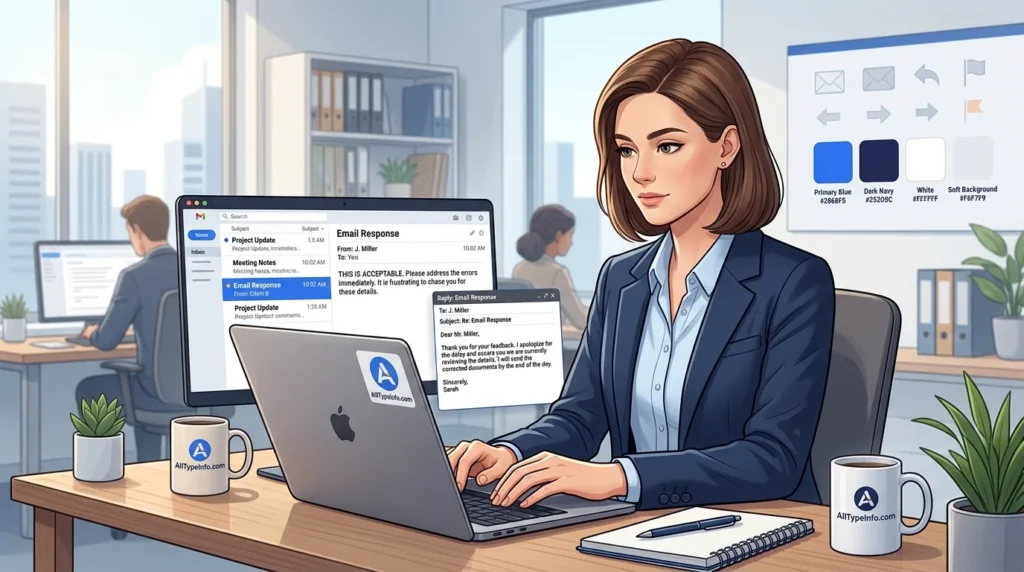
Receiving a rude email can be upsetting, especially when you are trying to do your job well. You may feel angry, insulted, or tempted to send a sharp reply. However, responding in the heat of the moment can turn a small problem into a bigger conflict. A calm, clear email helps you protect your professional image while keeping the conversation focused on the real issue.
Learning how to respond to a rude email professionally does not mean accepting disrespect or pretending that hurtful words are fine. It means choosing your words with care, stating the facts, and setting limits when needed. This guide includes practical steps, examples, and ready-to-use templates for replying to rude emails from coworkers, managers, clients, and other professional contacts.
Key Takeaways
- Pause before replying if you feel angry.
- Focus on facts instead of personal attacks.
- Keep your response short, clear, and respectful.
- Address the actual problem rather than every rude remark.
- Set clear boundaries when disrespect continues.
- Save email records if the issue needs to be reported.
- Ask a manager or HR for help when appropriate.
Why Should You Respond Professionally to a Rude Email?
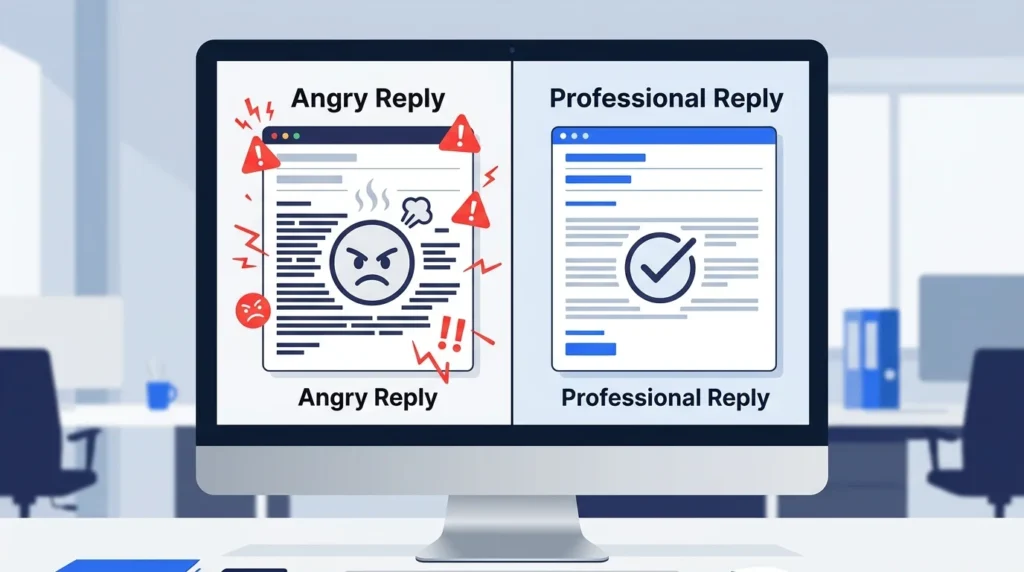
A rude email can make you feel that you need to defend yourself right away. Yet an angry reply may distract from the original issue and create a written record that reflects poorly on you.
A professional response helps you stay focused on the work, explain your position, and protect your boundaries. It also makes your message easier for others to review if the discussion later involves a manager or HR.
Here are some benefits of a calm response:
- Keeps the conversation focused on the issue.
- Reduces the chance of a heated argument.
- Shows that you can handle difficult situations.
- Creates a clear written record.
- Helps protect your professional boundaries.
Quick Tip: Being professional does not mean agreeing with the sender. You can disagree, correct false information, and refuse an unreasonable request without insulting anyone.
How to Respond to a Rude Email Professionally: 7 Steps
1. Read the Email Carefully
Read the message again before deciding how to respond. A short or direct email may sound rude even when the sender did not intend to offend you.
Look for the actual request, concern, or problem. Separate useful information from insults, blame, or unnecessary comments.
Ask yourself:
- What does the sender want?
- Is there a real issue to solve?
- Do I need to correct any false information?
- Is a reply necessary?
This simple check can help you avoid reacting to the wrong part of the message.
2. Wait Until You Feel Calm
Do not reply while you are angry or upset. Give yourself time to think about what you want to say.
For a routine issue, a short break may be enough. If the message is especially offensive, consider drafting a reply and reviewing it later.
Before sending your response:
- Remove angry words.
- Delete sarcasm and personal comments.
- Check your facts.
- Keep your goal in mind.
You do not need to reply immediately unless the situation is genuinely urgent. If you need more time, you can send a short acknowledgment and provide a clear time for your full response.
3. Keep Your Tone Neutral and Respectful
Use plain, professional language. Avoid matching the sender’s rude tone, even if you believe their behavior is unfair. Choosing the right words can make difficult conversations easier. Learn more about writing clear and professional replies to emails and messages to handle different situations with confidence.
Instead of writing:
Your email is completely unprofessional, and you need to learn how to speak to people.
Try this:
I’d like to keep our communication professional and focused on resolving the issue.
The second response states your concern without adding another personal attack.
Useful phrases include:
- Thank you for your message.
- I’d like to clarify a few points.
- Here is the current status.
- I see the issue differently.
- Let’s focus on the next steps.
- Could you clarify your main concern?
4. Address the Main Issue Directly
A professional reply should answer the real question or concern. Avoid spending the entire email discussing the sender’s tone unless that behavior needs to be addressed.
For example, suppose a coworker writes:
Did you even check the report before sending it? This is full of mistakes.
You could respond:
Hi [Name],
Thanks for pointing out the issues. I’ll review the report and correct any errors. Please send me the specific sections that need attention so I can address them accurately.
Best, [Your Name]
This response shows that you are willing to review the work without accepting an insulting tone as normal.
5. State the Facts Clearly
If the sender makes an incorrect claim, correct it with facts rather than accusations.
For example, if someone says you missed a deadline but you submitted the work on time, you can write:
Hi [Name],
I submitted the report on October 16, before the agreed deadline of October 17. I’ve attached the submission confirmation for reference. Please let me know if you need anything else.
Best, [Your Name]
Keep the explanation brief. Include dates, files, or other details that help clear up the issue.
Avoid statements such as You never read my emails or You always blame me. These phrases can shift the conversation from facts to personal conflict.
6. Set a Boundary if Needed
Sometimes, a polite reply is not enough. If the sender uses insults, personal attacks, or repeated disrespectful language, you can set a clear boundary.
For example:
Hi [Name],
I’m happy to discuss the project and work on a solution. I’d appreciate it if we could keep our communication respectful and focused on the work.
Regards, [Your Name]
A good boundary explains what you expect without threatening or insulting the other person.
You can also:
- Ask to discuss the issue in a meeting.
- Keep communication focused on work.
- Save the original messages.
- Seek help if the behavior continues.
7. Review Your Email Before Sending
Read your draft as if a manager, client, or HR representative might see it later.
Check that the message answers the issue and uses a suitable tone.
- Is the message clear?
- Are the facts correct?
- Have you removed sarcasm?
- Is the next step easy to identify?
- Does the email protect your boundaries?
If the message involves serious allegations, threats, or a workplace dispute, consider getting appropriate guidance before replying.
10 Professional Responses to a Rude Email
The best reply depends on who sent the email, what they said, and what you want to achieve. Use these examples as starting points and replace the details with your own.
1. A General Polite Response to a Rude Email
Use this when someone sends a rude message but you want to keep the conversation productive.
Hi [Name],
Thank you for your email. I’d like to clarify the issue and work toward a practical solution.
Could you please explain the main concern so I can address it directly?
Best regards,
[Your Name]
Why it works: It stays polite and asks the sender to focus on the issue.
2. A Firm but Professional Response
Use this when you need to defend your position without sounding aggressive.
Hi [Name],
I understand your concern, but I see the situation differently. Based on the information available, [briefly state the facts].
I’m happy to discuss this further so we can agree on the next steps.
Regards,
[Your Name]
Why it works: It lets you disagree without turning the email into an argument.
3. A Response to a Rude Email From Your Boss
When your manager sends a harsh email, address the work issue first. If needed, discuss the tone separately.
Hi [Manager’s Name],
Thank you for your feedback. I’ll review the points you raised and address the items that need attention.
Could you clarify which changes you would like me to prioritize? I want to make sure I meet the project requirements.
Best regards,
[Your Name]
Why it works: It keeps the discussion focused on expectations and next steps without creating an unnecessary conflict.
If your manager’s emails contain repeated insults or threats, keep a record and consider seeking appropriate workplace support.
4. A Response to a Rude Coworker
Use this when a coworker speaks disrespectfully but you still need to work together.
Hi [Name],
I understand that we need to resolve this issue. I’m happy to review the details and discuss a solution.
I’d appreciate it if we could keep our communication respectful and focused on the project.
Thanks,
[Your Name]
Why it works: It sets a boundary while keeping the working relationship in mind.
5. A Response to a Rude Client
When a client is upset, acknowledge the problem without accepting blame for facts that have not been confirmed.
Hi [Client’s Name],
Thank you for sharing your concerns. I’m sorry this situation has caused frustration.
I’ll review the details and check what can be done. I’ll update you by [date or time] with the next steps.
Best regards,
[Your Name]
Why it works: It shows that you are taking the concern seriously and gives the client a clear expectation.
6. A Response When Someone Blames You Unfairly
Use this when an email accuses you of a mistake you did not make.
Hi [Name],
I’d like to clarify a few details. [Briefly explain what happened and include relevant dates or records.]
Based on these details, my part of the task was completed as agreed. Please let me know if there is any additional information I should review.
Regards,
[Your Name]
Why it works: It corrects the record without attacking the sender.
7. A Response to a Rude Email With Personal Insults
If someone uses insulting language, you can ask them to keep future messages respectful.
Hi [Name],
I’m willing to discuss the issue and work toward a solution. However, personal remarks do not help us resolve the matter.
Please keep future communication focused on the issue and the steps needed to address it.
Regards,
[Your Name]
Why it works: It draws a clear line without returning the insult.
If the message includes threats or serious harassment, consider reporting it through the appropriate workplace channel rather than handling it alone.
8. A Response When You Need Time to Reply
You do not have to write a detailed response immediately, especially if the email raises several concerns.
Hi [Name],
I’ve received your email and will review the points you raised. I want to make sure my response addresses the concerns accurately.
I’ll get back to you by [date or time].
Best,
[Your Name]
Why it works: It acknowledges the message and gives you time to prepare a clear response.
9. A Response When You Disagree With Harsh Feedback
Sometimes, feedback contains a useful point but is delivered in an unfair or disrespectful way.
Hi [Name],
Thank you for sharing your feedback. I’ll review the points related to the project.
I would also like to clarify [specific point], as the current details may not reflect the full situation. Could we review this together?
Best regards,
[Your Name]
Why it works: It leaves room for useful feedback while allowing you to correct a misunderstanding.
10. A Response to Repeated Rude Emails
If the same person keeps sending disrespectful messages, a stronger boundary may be needed.
Hi [Name],
I’ve addressed the issue in my earlier messages. I’m available to discuss any remaining work-related concerns, provided we keep the conversation respectful and focused on the facts.
If needed, we can include [Manager’s Name] to help clarify the next steps.
Regards,
[Your Name]
Why it works: It avoids repeating the same argument and offers a clear way to move forward.
Short Professional Replies to a Rude Email
Sometimes, a long email is unnecessary. A short response may be enough to acknowledge the message, correct a detail, or move the discussion forward.
Here are brief replies you can adapt:
- To stay neutral: Thank you for your message. I’ll review the details.
- To correct a mistake: I’d like to clarify one point before we proceed.
- To disagree politely: I understand your view, but the facts suggest otherwise.
- To request details: Could you clarify which part needs attention?
- To set a boundary: Please keep our communication focused on the issue.
- To avoid an argument: Let’s focus on finding a practical solution.
- To ask for a meeting: I think a short discussion would help us resolve this.
- To request more time: I’ll review your concerns and respond by [date].
- To close the discussion: I believe we’ve addressed the main points. Please let me know if a specific issue remains.
- To involve a manager: I suggest including [Name] so we can agree on the next steps.
Choose the reply that fits the situation. A short, factual response is often more useful than a long explanation.
What to Say When You Want to Be Firm Without Being Rude
You can be direct without being disrespectful. The key is to replace emotional statements with clear, work-related language.
| Avoid saying | Try saying instead |
|---|---|
| You clearly don’t understand. | Let me clarify that point. |
| That’s not my problem. | This falls outside my current responsibilities. |
| Stop blaming me. | I’d like to review the facts before assigning responsibility. |
| Your email is rude. | I’d appreciate a more respectful tone. |
| I’ve already told you this. | As mentioned in my earlier email, [brief detail]. |
| You are completely wrong. | The available information suggests a different conclusion. |
| Do your job properly. | Could you please review the agreed requirements? |
| I’m done with this conversation. | I believe the next step is to involve the appropriate person. |
These alternatives help you state your position clearly without adding personal attacks.
Common Mistakes to Avoid When Replying to a Rude Email
Even a reasonable response can create more problems if the wording sounds angry or unclear.
1. Replying in Anger
An emotional reply may contain words you later regret.
Better approach: Draft your response, take a break, and review it before sending.
2. Using Sarcasm
Sarcastic comments can make a professional disagreement look personal.
Better approach: State what happened and what needs to change.
3. Apologizing for Everything
You can acknowledge someone’s frustration without accepting responsibility for something you did not do.
Better approach: Apologize when appropriate, and explain disputed facts separately.
For example, say, “I’m sorry the delay caused difficulty. I’ll check the current status and update you by Friday.”
4. Writing a Long Defensive Email
Too much explanation can hide your main point and invite further arguments.
Better approach: Use short paragraphs and address the main issue directly.
5. Ignoring Serious Misconduct
A single blunt email may not need formal action. Repeated insults, threats, discrimination, or harassment may require help from a manager, HR, or another appropriate channel.
Better approach: Save the original messages and follow your workplace’s reporting process.
6. Copying Too Many People
Adding several coworkers or senior managers can make a simple disagreement look like a public argument.
Better approach: Include only the people who need to take action or have a clear role in the issue.
7. Making Threats
Statements such as “You’ll regret this” can make the situation worse.
Better approach: State a clear, reasonable next step, such as asking a manager to help resolve the dispute.
Should You Reply to Every Rude Email?
No. Some messages do not need a direct response, especially if they contain no real question, request, or work-related issue.
Consider these options:
- Reply: When a decision, answer, or action is needed.
- Clarify: When the sender’s meaning is unclear.
- Wait: When you need time to review the facts.
- Set a boundary: When disrespect needs to be addressed.
- Escalate: When the behavior is repeated, threatening, or serious.
- Do not engage: When another reply would add nothing useful and no response is required.
Use your judgment and consider workplace rules. If the message involves a formal complaint, a legal concern, or a threat, do not assume that ignoring it is the right choice.
How to Handle a Rude Email From Different People
The relationship between you and the sender can affect how you respond. A message from your boss may need a different approach from one sent by a customer or an outside contact.
If the Email Comes From Your Boss
- Address the work request first.
- Ask for clear instructions when needed.
- Keep a record of serious or repeated incidents.
- Seek workplace support if the conduct continues.
If the Email Comes From a Coworker
- Keep the discussion focused on shared tasks.
- Correct mistakes using facts.
- Set respectful boundaries when needed.
- Ask your manager to help if direct discussion fails.
If the Email Comes From a Customer
- Acknowledge the customer’s concern.
- Explain what you can do.
- Give a realistic timeline.
- Follow company policies before making promises.
If the Email Comes From Someone Outside Work
- Keep your reply brief and factual.
- Avoid sharing private workplace details.
- Do not feel required to answer personal attacks.
- Save messages if the contact becomes threatening.
A Simple Checklist Before Sending Your Reply
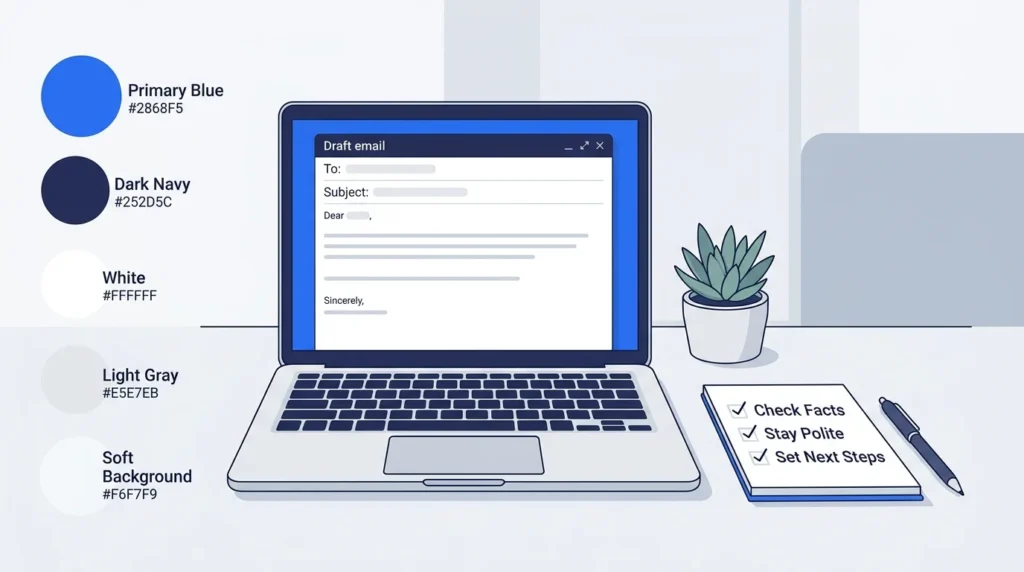
Use this checklist to review your message before you send it.
- I understand the sender’s main concern.
- I have checked the facts.
- My tone is calm and respectful.
- I have removed sarcasm and personal attacks.
- I have answered the main question.
- My next step is clear.
- I have set a boundary if needed.
- I have included only the necessary recipients.
- I have checked names, dates, and attachments.
A final review can help you catch wording that might otherwise create another disagreement.
Frequently Asked Questions
1. What is the best way to respond to a rude email professionally?
Stay calm, address the main issue, and use clear language. Correct false information with facts and set a respectful boundary if needed. Avoid matching the sender’s tone.
2. How do you respond to a rude email without sounding rude?
Use neutral phrases such as “I’d like to clarify a few points” or “Let’s focus on the next steps.” Avoid sarcasm, blame, and personal comments.
3. Should I ignore a rude email?
You can ignore a message that requires no response, but do not ignore important work requests, formal complaints, or threats. Follow the appropriate process when a serious issue needs attention.
4. How do you respond to a rude email from your boss?
Address the work-related concern and ask for clarification if needed. Keep your response factual and respectful. If the behavior is repeated or serious, save the messages and seek appropriate workplace support.
5. How do you respond to a rude email from a coworker?
Explain your position clearly and focus on the task. If the coworker uses insulting language, ask them to keep future communication respectful. Seek help if the behavior continues.
6. What should you avoid saying in a reply to a rude email?
Avoid insults, threats, sarcasm, and statements that attack someone’s character. Focus on specific actions, facts, and practical next steps.
7. Is it unprofessional to tell someone their email is rude?
Not necessarily, but the wording matters. A statement such as “I’d appreciate it if we kept our communication respectful” addresses the issue without labeling the sender.
8. Should I report a rude email to HR?
Consider reporting it if the email involves repeated harassment, threats, discrimination, or other serious workplace conduct. Keep the original messages and follow your organization’s reporting process.
Conclusion
Learning how to respond to a rude email professionally helps you handle difficult conversations without adding to the conflict. Read the message carefully, pause before replying, state the facts, and focus on the next step. If the sender crosses a line, set a clear boundary and seek help when needed.
You do not have to agree with an unfair accusation or accept disrespect to remain professional. A calm, direct response lets you protect your position while keeping the conversation focused on a useful outcome.

Emily Carter (Content Writer & Communication Specialist) is a content writer and communication specialist at AllTypeInfo.com. She writes clear, practical, and easy-to-follow guides on email responses, message replies, writing templates, and everyday communication tips. Her goal is to help readers communicate with confidence in both personal and professional settings.