Have you ever wondered whether to write I will respond to your email or I will response to your email? These words look similar and share a related meaning, so it is easy to mix them up. However, they have different jobs in a sentence. Choosing the correct word helps you write clear emails, messages, school assignments, and professional documents.
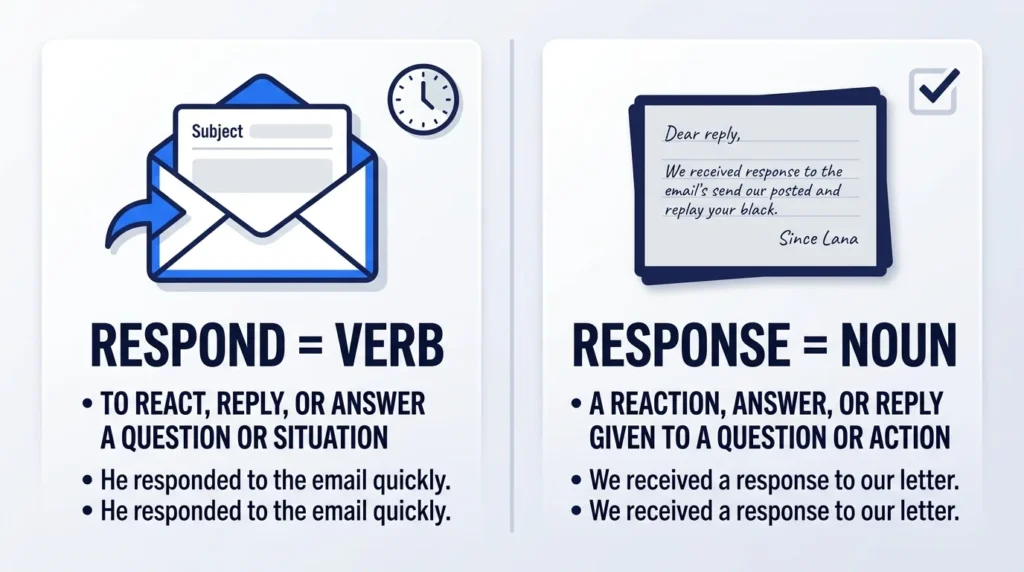
The main difference between response and respond is grammar. Respond is a verb, which describes the action of answering or reacting. Response is a noun, which names the answer or reaction itself. Once you learn this simple rule, you can use both words correctly in everyday English.
Key Takeaways
- Respond is a verb that means to answer or react.
- Response is a noun that means an answer or reaction.
- You respond to a message or question.
- You give, receive, or write a response.
- Use responded for a past action.
- Use responses for more than one answer or reaction.
- Both words can be used in formal and casual writing.
What Is the Difference Between Response and Respond?
Response and respond have related meanings, but they serve different grammatical roles.
| Feature | Respond | Response |
|---|---|---|
| Part of speech | Verb | Noun |
| Main meaning | To answer or react | An answer or reaction |
| Common use | Describe an action | Name an answer or reaction |
| Example | Please respond today. | I received your response. |
| Common phrase | Respond to a question | Response to a question |
| Word forms | Respond, responds, responded, responding | Response, responses |
The easiest rule is respond means to do something, while response names what is given or received.
Consider these examples:
- Respond: She responded to my email.
- Response: Her response was helpful.
- Respond: Please respond to the invitation.
- Response: We are waiting for your response.
Both words can describe the same situation. The difference is how each word works in the sentence.
What Does Respond Mean?
Respond is a verb. It means to answer, reply, or react to a question, message, event, or situation.
You can respond by speaking, writing, or taking action. For example, a student can respond to a teacher’s question, a company can respond to a complaint, and emergency workers can respond to a call for help.
Examples of Respond in Sentences
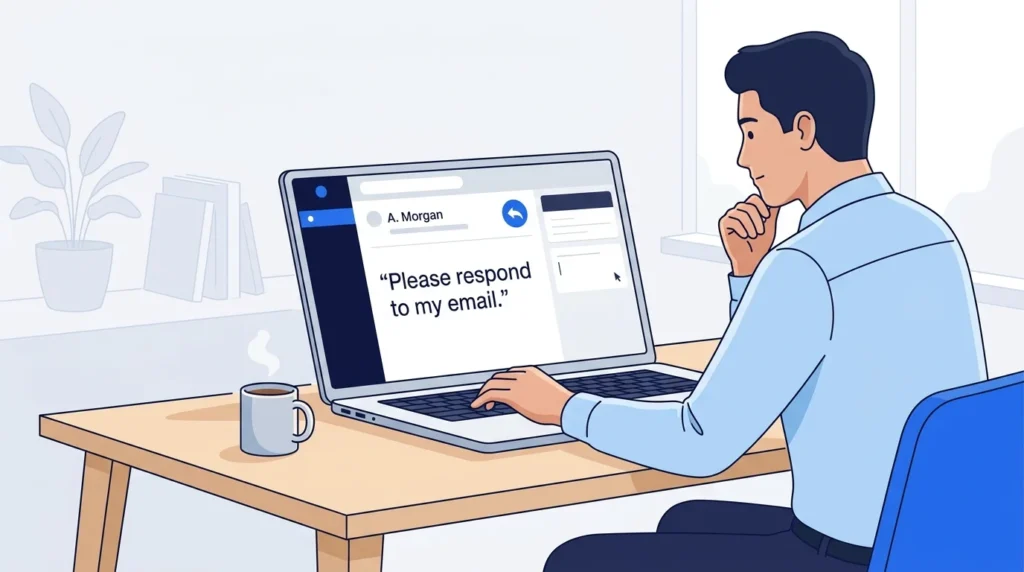
- Please respond to my email by Friday.
- She responds politely to every question.
- He responded to the message last night.
- The teacher asked us to respond in complete sentences.
- The company responded to the customer’s complaint.
- The audience responded with applause.
- The patient responded well to treatment.
In each example, respond or one of its forms describes an action or reaction.
Different Forms of Respond
Because respond is a verb, its form changes based on the subject and tense.
| Verb form | When to use it | Example |
|---|---|---|
| Respond | Base form | I respond to emails daily. |
| Responds | Present tense with he, she, or it | She responds quickly. |
| Responded | Past tense | He responded yesterday. |
| Responding | Ongoing action | They are responding now. |
Quick tip: If you can replace the word with answer or react and the sentence still makes sense, respond may be the correct choice.
For example, Please respond to my question means Please answer my question.
What Does Response Mean?
Response is a noun. It means an answer, reply, or reaction to something that happens or someone says.
A response can be spoken, written, emotional, physical, or shown through an action. It does not always need to be a spoken answer.
Examples of Response in Sentences
- Thank you for your quick response.
- Her response to the question was correct.
- We received a response from the manager.
- The customer’s response was positive.
- His response to the news surprised everyone.
- The team prepared a response to the complaint.
- The body can produce a response to a stimulus.
In these sentences, response names the answer or reaction.
Common Phrases With Response
Response often appears with words that show who gave the answer, what caused it, or how it was received.
- A response: We received a response.
- Your response: I appreciate your response.
- Quick response: Thank you for the quick response.
- Response to: Her response to the question was clear.
- Response from: We received a response from our teacher.
- Positive response: The proposal received a positive response.
- No response: There was no response to my message.
The plural form is responses.
Example: We received 25 responses to the survey.
Response vs. Respond: Sentence Examples
Comparing the words side by side makes the difference easier to see.
| Respond | Response |
|---|---|
| She responded to my question. | Her response was clear. |
| He responded politely. | His response was polite. |
| They responded to the complaint. | Their response addressed the complaint. |
| I will respond tomorrow. | I will send my response tomorrow. |
| The team responded quickly. | The team’s response was quick. |
| She responded to the invitation. | She sent a response to the invitation. |
Notice how the verb describes an action, while the noun identifies the answer or reaction.
When Should You Use Respond?
Use respond when your sentence describes someone answering, replying, or reacting.
1. When Asking Someone to Answer
Use respond when requesting an action.
Examples:
- Please respond to my question.
- Kindly respond by Monday.
- Can you respond to this message?
- Please respond to the invitation.
Incorrect: Please response to my email.
Correct: Please respond to my email.
2. When Describing a Past Action
Use responded when the action happened in the past.
Examples:
- She responded to my email yesterday.
- The manager responded to our request.
- He responded calmly to the criticism.
Do not use response as the main verb in these sentences.
3. When Describing a Reaction
Respond also works when someone reacts to an event, feeling, or situation.
Examples:
- The audience responded with laughter.
- He responded angrily to the comment.
- The child responded to her mother’s voice.
- The workers responded to the emergency.
These examples show that responding can involve more than giving a spoken answer.
When Should You Use Response?
Use response when you are talking about an answer or reaction as a thing.
1. After Words Like My, Your, His, or Her
Use response after a possessive word.
Examples:
- I received your response.
- Her response was thoughtful.
- His response surprised me.
- We appreciate their response.
Incorrect: Thank you for your respond.
Correct: Thank you for your response.
2. After Words Like A, The, or This
Response is a noun, so it can follow articles and other words that identify a thing.
Examples:
- I received a response.
- The response was helpful.
- This response answers the question.
- We are waiting for a response.
You would not normally say a respond when referring to an answer.
3. When Describing an Answer or Reaction
Use response when naming what someone said, wrote, or did in reaction to something.
Examples:
- Her response to the question was accurate.
- We received a positive response from customers.
- The company’s response addressed the issue.
- His response to the surprise was laughter.
Response vs. Respond in Emails and Messages
These words are common in emails, text messages, and workplace communication. Using them correctly helps your writing sound natural and professional. For more guidance, learn how to write clear and effective replies to emails and messages that sound natural and professional.
Examples for Everyday Messages
Asking someone to reply:
Please respond when you have a moment.
Waiting for an answer:
I am waiting for your response.
Thanking someone for replying:
Thank you for your quick response.
Describing a past reply:
She responded to my message this morning.
Requesting a formal answer:
Kindly respond to the request by Friday.
Each example uses the correct word for its grammatical role.
Examples for Professional Emails
| Situation | Example |
|---|---|
| Requesting an answer | Please respond to the proposal by Friday. |
| Thanking a colleague | Thank you for your prompt response. |
| Reporting an action | Our team responded to the inquiry. |
| Reporting a delay | We have not received a response yet. |
| Explaining a company action | The company responded to the complaint. |
A useful distinction is that respond often describes what a person or team does, while response often names the reply or reaction.
Common Grammar Mistakes With Response and Respond
Many mistakes happen because writers choose a word based on its meaning instead of its role in the sentence. Check these common errors before publishing an email or document.
| Incorrect sentence | Correct sentence | Why? |
|---|---|---|
| I will response tomorrow. | I will respond tomorrow. | A verb is needed after will. |
| Thank you for your respond. | Thank you for your response. | A noun is needed after your. |
| She gave a quick respond. | She gave a quick response. | A noun is needed after a quick. |
| Please response to the request. | Please respond to the request. | A verb is needed after please. |
| I received your respond. | I received your response. | A noun is needed after your. |
| He did not response. | He did not respond. | Use the base verb after did not. |
Mistake 1: Using Response After Will
Incorrect: I will response to your email.
Correct: I will respond to your email.
Rule: Use the base form of a verb after will.
Other examples:
- I will respond soon.
- She will respond later.
- They will respond tomorrow.
Mistake 2: Using Respond After Your
Incorrect: Thank you for your respond.
Correct: Thank you for your response.
Rule: Use the noun response after your when referring to an answer or reaction.
Other examples:
- I appreciate your response.
- We received your response.
- Your response was helpful.
Mistake 3: Forgetting To After Respond
In many sentences, respond is followed by to when you name the question, message, or situation being answered.
- Correct: He responded to my question.
- Incorrect: He responded my question.
However, to is not required in every sentence.
- She responded quickly.
- He responded with a smile.
- They responded by email.
Mistake 4: Using the Wrong Form After Did
Incorrect: She did not responded to my email.
Correct: She did not respond to my email.
After did or did not, use the base form of the verb.
More examples:
- Did he respond?
- They did not respond.
- Why did she respond so late?
Response vs. Respond vs. Reply
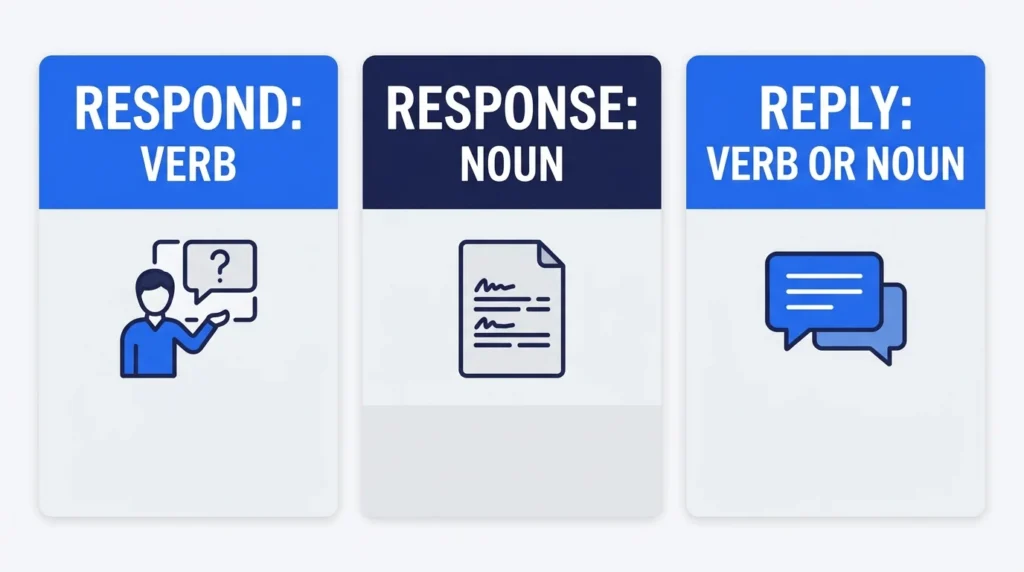
The words response, respond, and reply are related, but their grammatical roles differ.
| Word | Part of speech | Meaning | Example |
|---|---|---|---|
| Respond | Verb | To answer or react | Please respond to my message. |
| Response | Noun | An answer or reaction | I received your response. |
| Reply | Verb or noun | To answer, or the answer itself | Please reply to my email. |
Respond can describe spoken answers, written replies, or actions. Response names the answer or reaction. Reply can work as either a verb or a noun.
Compare these sentences:
- She responded to my email.
- She sent a response to my email.
- She replied to my email.
- I received her reply.
All four sentences are correct, but their grammatical structures differ.
Quick Test: Response or Respond?
Choose the correct word in each sentence. Try answering before checking the solutions.
1. Please _____ to my message today.responserespond
2. Thank you for your quick _____.respondresponse
3. She did not _____ to the email.respondresponse
4. We received a _____ from the manager.respondresponse
5. The team _____ to the complaint yesterday.respondedresponse
A Simple Way to Remember the Difference
Use these three steps when you are unsure which word belongs in a sentence.
- Check the action. If someone is answering or reacting, use respond or one of its verb forms.
- Check the noun. If you are naming an answer or reaction, use response.
- Read the sentence again. Make sure the word fits the grammar.
Here is a short example:
- Someone sends you an email.
- You respond to the email.
- You write a response.
- The sender receives your response.
This simple pattern works in school assignments, personal messages, business emails, and many other situations.
Frequently Asked Questions
1. What is the main difference between response and respond?
Respond is a verb that describes answering or reacting. Response is a noun that names the answer or reaction.
2. Is it correct to say I will response?
No. The correct sentence is I will respond. Use the base form of the verb after will.
3. Should I write thank you for your response or respond?
Write Thank you for your response. The word your calls for a noun in this sentence.
4. Is response a noun or a verb?
Response is a noun. It can name a spoken answer, written reply, emotional reaction, or physical reaction.
5. Is respond a verb?
Yes. Respond is a verb meaning to answer, reply, or react. Its common forms include responds, responded, and responding.
6. What is the plural form of response?
The plural form is responses.
Example: We received several responses to the survey.
7. Is responded correct grammar?
Yes. Responded is the past-tense form of respond.
Example: She responded to my email yesterday.
8. Can response and respond be used in the same sentence?
Yes. They can appear together when each word serves its correct role.
Example: Please respond to the email with a clear response.
Conclusion
The difference between response and respond comes down to grammar. Respond is a verb that describes an action, while response is a noun that names an answer or reaction. Write Please respond to my email when asking someone to answer, and write Thank you for your response when thanking them for the answer. Check whether your sentence needs an action or a noun, and choosing the correct word becomes much easier.

Emily Carter (Content Writer & Communication Specialist) is a content writer and communication specialist at AllTypeInfo.com. She writes clear, practical, and easy-to-follow guides on email responses, message replies, writing templates, and everyday communication tips. Her goal is to help readers communicate with confidence in both personal and professional settings.