
Writing a discussion response can feel difficult when you agree with a classmate but have nothing new to add. You may also worry about disagreeing without sounding rude or writing a reply that is too short. A good discussion response solves these problems by showing that you read the original post, thought about its main idea, and have something useful to contribute.
Learning how to write a discussion response helps you take part in online classes, college assignments, and group discussions with confidence. The key is to respond to a specific point, explain your thoughts, and support your answer with an example, course material, or a thoughtful question when appropriate.
Key Takeaways
- Read the original post and assignment instructions carefully.
- Address one specific idea from your classmate’s response.
- Add your own thought, example, or supporting evidence.
- Agree or disagree in a respectful way.
- Ask a relevant question to continue the discussion.
- Follow the required word count and citation rules.
- Check your response before submitting it.
What Is a Discussion Response?
A discussion response is a written reply to another person’s ideas in a class discussion, online forum, or academic conversation. It allows you to share your opinion, explain a different point of view, ask questions, and connect ideas to what you have learned.
In college courses, discussion responses often appear on online learning platforms. An instructor may ask students to reply to classmates after submitting their own posts.
A strong response does more than praise someone’s work. It explains why a point matters, adds a useful idea, or raises a question that encourages further thought.
The same principles apply to many forms of written communication. Learning how to communicate clearly and write helpful replies can help you respond to emails, messages, and other conversations in a clear and respectful way.
For example, a weak response might say:
Great post! I agree with everything you said.
A stronger response might say:
I agree with your point about time management. Creating a weekly study schedule can help students finish assignments before the deadline. Do you think setting daily goals would make this process easier?
The second response names a specific idea, adds a practical suggestion, and asks a question that invites another reply.
How to Write a Discussion Response Step by Step
Follow these steps to write a clear and useful discussion response.
Step 1: Read the Original Post Carefully
Read your classmate’s entire post before writing. Identify the main argument, supporting details, and any questions they have asked.
Pay attention to these points:
- What is the main idea?
- Which point interests you most?
- What evidence supports the argument?
- Do you agree or disagree?
- What could you add to the discussion?
Avoid writing your reply after reading only the first few sentences. You might miss an important detail or misunderstand the writer’s main point.
Step 2: Check the Assignment Instructions
Before writing, review the instructor’s requirements. Some assignments ask for personal opinions, while others require evidence from readings or research.
Check these details:
- Required word count.
- Number of peer responses.
- Citation style, if required.
- Questions you must answer.
- Submission deadline.
- Grading rubric.
There is no single word count for every discussion response. Follow your instructor’s rules rather than relying on a general guideline.
Step 3: Choose One Specific Point
Choose an idea from the original post that you can discuss in more detail. This helps your response stay focused.
You could select:
- An argument you support.
- An example that caught your attention.
- A claim that needs more evidence.
- A point that changed your opinion.
- A question that deserves further discussion.
For example, if a classmate writes about the benefits of group projects, you could focus on teamwork, communication, or sharing tasks fairly.
Avoid trying to discuss every sentence in the original post. One well-developed point is often more useful than several unrelated comments.
Step 4: State Your Response Clearly
Open with a sentence that connects directly to your classmate’s idea. You can agree, offer another view, or explain what you found useful.
Here are some natural ways to begin:
- I agree with your point about…
- Your example of… stood out to me.
- I had a different view of…
- I would like to add something about…
- Your explanation made me consider…
- One point I would like to explore is…
Choose an opening that matches your real opinion. Avoid using praise that does not relate to the post.
Step 5: Add a New Idea or Supporting Detail
After introducing the point, explain your own thinking. You can use an example, course reading, personal observation, or reliable evidence when the assignment allows it.
For instance:
I agree that group projects can improve teamwork. They also help students practice dividing tasks and meeting shared deadlines.
The second sentence adds information instead of repeating the first.
When using course readings, explain how the material supports your point. Do not add a quote or fact without explaining its connection to the discussion.
Step 6: Ask a Relevant Question
A thoughtful question can help keep the discussion going. Ask about a specific part of the topic rather than using a question that could fit any post.
Examples include:
- What other methods could help solve this problem?
- How might this idea work in a different situation?
- What challenges could affect this approach?
- Would your conclusion change with different evidence?
You do not always need to end with a question. Use one when it adds value or when your instructor requires it.
Step 7: Review and Submit Your Response
Read your draft once more before posting. Make sure it answers the assignment and responds directly to your classmate.
Use this final check:
- Does the reply address a specific point?
- Have you added a useful idea?
- Is the tone respectful?
- Are claims supported when needed?
- Have you followed the required format?
- Have you corrected spelling and grammar?
A short review can help you catch unclear sentences and repeated ideas.
A Simple Discussion Response Format
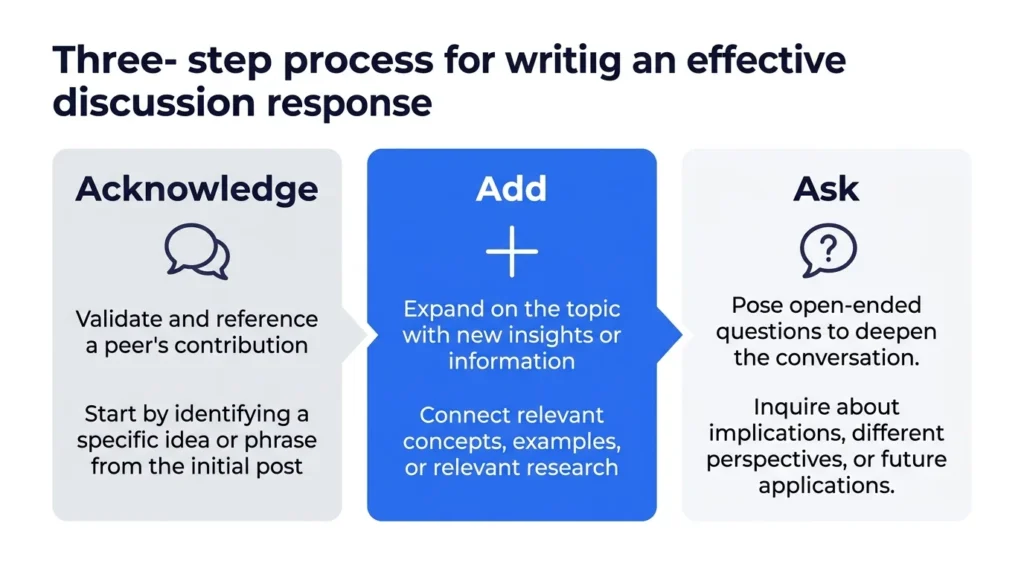
If you are unsure how to organize your reply, use this three-part format: Acknowledge, Add, Ask.
1. Acknowledge
Mention a specific point from your classmate’s post.
2. Add
Share a new idea, example, reason, or piece of evidence.
3. Ask
End with a relevant question if it fits the assignment.
You can use this format for many college discussion boards. However, adjust it to match the assignment. Some instructors expect a longer analysis, citations, or a direct answer without a question.
Copy-Ready Discussion Response Template
Use this template as a starting point. Replace the bracketed sections with your own ideas.
I agree with your point about [specific topic] because [your reason]. Your example of [specific detail] shows how [main idea]. I would also add that [new point or supporting evidence]. How do you think [relevant question] might affect the outcome?
If you disagree with the original post, change the opening to explain your different view respectfully.
Discussion Response Examples for Different Situations
The following examples show how to write a discussion response for common classroom situations. Each example uses a different approach.
1. Example of Agreeing With a Classmate
Classmate’s main point: Students benefit from making a study schedule because it helps them manage their time.
Sample response:
I agree with your point about making a study schedule. Planning study time can help students finish assignments without rushing at the last minute. I also think setting small daily goals can make large projects easier to manage. What strategies do you use to stay on schedule during busy weeks?
Why this works:
- It identifies a clear point.
- It adds a practical suggestion.
- It asks a relevant question.
2. Example of Disagreeing Politely
Classmate’s main point: Online classes are always easier than traditional classroom lessons.
Sample response:
I see your point about the flexibility of online classes, but I do not think they are easier for every student. Some learners may struggle to stay focused without face-to-face support. Others may have trouble finding a quiet place to study. Do you think online classes work better for students who prefer independent learning?
Why this works:
- It recognizes the other person’s view.
- It explains a different opinion.
- It avoids personal criticism.
3. Example of Adding Evidence
Classmate’s main point: Reading every day can improve writing skills.
Sample response:
I agree that regular reading can help improve writing skills. Reading different types of texts also exposes students to new vocabulary, sentence patterns, and ways to organize ideas. I would connect this point to our course reading about clear communication. Do you think reading fiction and nonfiction helps writers in different ways?
Why this works:
- It develops the original idea.
- It connects the topic to coursework.
- It opens the door to further discussion.
Use a specific reading or source when your instructor asks for evidence. Do not claim that a source supports your point unless you have checked it.
4. Example of Sharing a Different Perspective
Classmate’s main point: Working alone is the best way to complete school projects.
Sample response:
I understand why working alone can be helpful, especially when a project requires focus. However, group work can also help students share ideas and learn from different viewpoints. I think the best choice depends on the task and the skills needed. Which types of projects do you think are better suited to group work?
Why this works:
- It considers more than one viewpoint.
- It gives a reason for the different opinion.
- It avoids treating one approach as best in every case.
5. Example of a Short Discussion Response
Some assignments allow brief replies. Even a short response should add something meaningful.
Sample response:
Your point about setting goals stood out to me. Breaking a large task into smaller steps can make it easier to manage. I also think tracking progress can help students stay on task.
This reply is brief but gives a clear reason and a new idea.
6. Example of a Response to a Question
If your classmate asks a direct question, answer it before adding more detail.
Classmate’s question: How can students reduce stress before an exam?
Sample response:
I think students can reduce exam stress by preparing early and following a simple study plan. Taking short breaks and getting enough sleep can also help them feel more prepared. I would suggest reviewing difficult topics several days before the exam instead of waiting until the last night. Which study method has worked best for you?
Why this works:
- It answers the question directly.
- It offers practical suggestions.
- It invites another useful reply.
How to Write a Strong Academic Discussion Response
A college discussion response should show thought and connect clearly to the topic. You do not need complicated words to make a good argument.
Support Your Ideas With Evidence
Use evidence when the assignment calls for it. Suitable evidence may include:
- Assigned textbook chapters.
- Lecture notes.
- Academic articles.
- Reliable research findings.
- Relevant examples from real life.
Explain how the evidence supports your point. A quote by itself does not show why it matters.
Connect Your Reply to Course Material
Show how the discussion relates to what you are learning.
For example:
Your point about motivation connects to the concept we studied this week. Clear goals may help explain why some students remain focused on long assignments.
Use the correct course concept and explain the connection in your own words.
Keep Your Tone Respectful
Academic discussion involves different opinions. Focus on the argument rather than the person who wrote it.
| Instead of writing | Try writing |
|---|---|
| You are wrong. | I see this point differently because… |
| That makes no sense. | Could you explain how this supports your argument? |
| I agree with everything. | I agree with your point about… |
| Your idea is bad. | One possible limitation of this approach is… |
| This is obvious. | One reason this point matters is… |
Respectful wording makes disagreement easier to discuss without weakening your argument.
Follow the Required Citation Style
If your instructor asks for sources, use the required citation style, such as APA or MLA. Include citations for borrowed ideas, facts, and direct quotes as required.
Before submitting, check:
- Whether sources are required.
- Which citation style to use.
- Whether direct quotes need page numbers.
- Whether a reference list is required.
- Whether personal examples are allowed.
Never present another person’s ideas as your own.
Common Discussion Response Mistakes to Avoid
A response can be polite and still fail to add value. Watch for these common problems.
- Writing only “I agree.” Explain why you agree.
- Repeating the entire post. Focus on one useful point.
- Going off topic. Keep your reply linked to the prompt.
- Disagreeing rudely. Challenge the idea, not the writer.
- Making unsupported claims. Add evidence when needed.
- Using vague praise. Name the point you found useful.
- Ignoring the rubric. Follow the stated requirements.
- Adding an unrelated question. Ask about the topic being discussed.
- Submitting without proofreading. Correct spelling and unclear sentences.
A useful response does not have to be long. It needs to answer the task, develop an idea, and follow the course rules.
How Long Should a Discussion Response Be?
The required length depends on your instructor, course, and assignment. Some tasks ask for a few sentences, while others require a full paragraph or several paragraphs.
Use these general examples only as a guide:
| Response type | Possible length | Main goal |
|---|---|---|
| Brief classroom reply | 2–4 sentences | Add one useful thought |
| Standard peer response | 1–2 paragraphs | Develop a point with reasons |
| Detailed academic reply | Several paragraphs | Analyze evidence and compare ideas |
These are flexible examples, not universal requirements. Your assignment instructions take priority.
If a word count is given, meet it without adding filler. A focused response is usually easier to read than one filled with repeated ideas.
Quick Checklist Before Posting
Use this checklist to review your work before you submit it.

- I read the complete original post.
- I checked the assignment instructions.
- I addressed a specific point.
- I added my own idea or explanation.
- I used evidence when required.
- I kept my tone respectful.
- I checked the word count.
- I included citations when needed.
- I corrected spelling and grammar.
- I submitted the reply before the deadline.
Frequently Asked Questions
1. How do you start a discussion response?
Start by referring to a specific point from the original post. You can agree, offer a different opinion, or mention an idea that caught your attention.
2. What makes a good discussion response?
A good response addresses the topic, explains a clear point, and adds something useful. It may include evidence, an example, or a relevant question.
3. How do you respond to a classmate you disagree with?
Recognize the point they made, state your different view, and explain your reasons. Keep your comments focused on the idea rather than the person.
4. Can I use first person in a discussion response?
Yes, if your assignment allows it. Phrases such as “I agree” and “I think” can introduce your view, but explain your reasons instead of stopping there.
5. Should every discussion response end with a question?
No. A question can encourage further discussion, but it is not always required. Follow your instructor’s directions and ask a question only when it fits the topic.
6. How many words should a discussion response have?
There is no single word count for all assignments. Check your course instructions and grading rubric before writing.
7. How can I make my discussion response sound natural?
Use your own words, refer to a specific point, and explain your actual opinion. Avoid copying templates word for word or using phrases that do not fit the conversation.
8. Do discussion responses need citations?
Some do and others do not. If the assignment requires evidence from readings or research, use the required citation style and give credit to the original source.
Conclusion
Learning how to write a discussion response becomes easier when you follow a clear structure. Read the original post, select one specific idea, explain your view, and add a useful example or piece of evidence when appropriate. You can also ask a relevant question to keep the conversation going.
Before submitting, check your instructor’s requirements and make sure your reply adds something beyond simple agreement. A clear, respectful, and focused discussion response can help you share your ideas and take part in a more useful academic conversation.

Emily Carter (Content Writer & Communication Specialist) is a content writer and communication specialist at AllTypeInfo.com. She writes clear, practical, and easy-to-follow guides on email responses, message replies, writing templates, and everyday communication tips. Her goal is to help readers communicate with confidence in both personal and professional settings.