
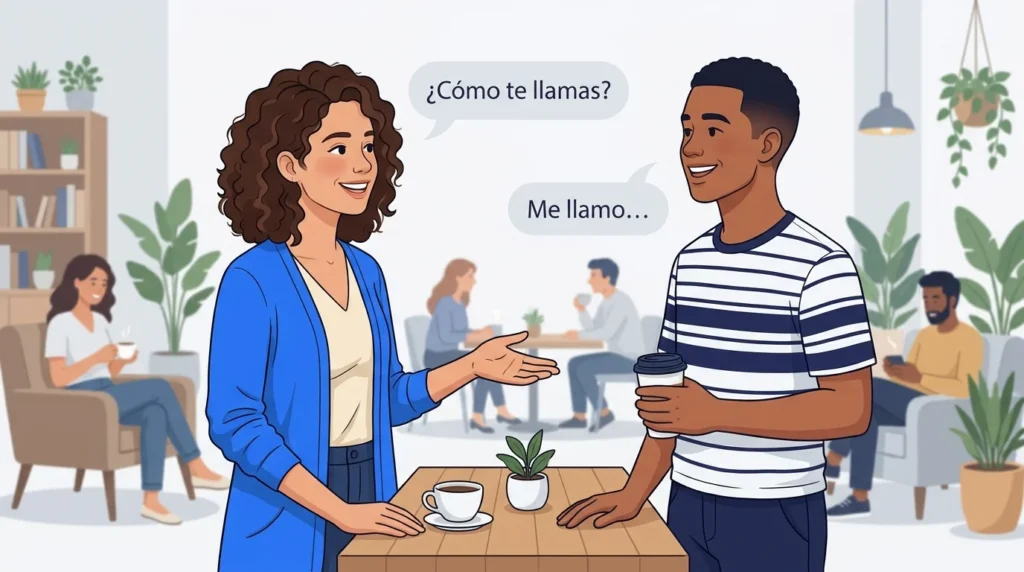

Have you ever heard someone ask, “¿Cómo te llamas?” and wondered what to say next? This common Spanish question means “What is your name?” It often comes up when meeting someone new, talking to a classmate, or starting a friendly conversation. Learning a simple reply can help you feel more comfortable speaking Spanish.
The easiest answer is Me llamo [your name], which means “My name is [your name].” You can also say Soy [your name] or Mi nombre es [your name]. Each option works in a slightly different way, and knowing when to use them can help you sound more natural.
Key Takeaways
- Me llamo… is the most common answer.
- Soy… is a short, natural alternative.
- Mi nombre es… means “My name is…”
- Mucho gusto means “Nice to meet you.”
- ¿Y tú? means “And you?”
- ¿Cómo te llamas? is an informal question.
- ¿Cómo se llama usted? is a polite, formal version.
What Does ¿Cómo Te Llamas? Mean?
The Spanish phrase ¿Cómo te llamas? translates to “What is your name?” in English.
Here is a simple breakdown:
| Spanish word | English meaning |
|---|---|
| Cómo | How |
| Te | Yourself, in this expression |
| Llamas | You call |
| ¿Cómo te llamas? | What is your name? |
The phrase comes from the Spanish verb llamarse, which means “to be called.”
Although the words literally suggest “What do you call yourself?”, the natural English meaning is “What is your name?”
Learning Spanish introductions is a great first step. You can also explore our guide to ways to respond to common greetings to learn how to reply naturally in everyday conversations.
When Do People Use This Question?
People use this phrase when they want to learn someone’s name.
Common situations include:
- Meeting a new friend.
- Talking to a classmate.
- Introducing yourself at an event.
- Starting a casual conversation.
- Meeting someone while traveling.
Example:
Person A: ¡Hola! ¿Cómo te llamas?
Person B: Me llamo Daniel.
English translation:
Person A: Hi! What’s your name?
Person B: My name is Daniel.
This is a simple and natural way to introduce yourself in Spanish.
7 Best Ways to Respond to ¿Cómo Te Llamas?
There are several correct ways to answer this question. The best choice depends on how formal or casual the conversation is.
1. Me Llamo… (My Name Is…)
Me llamo… is the most common and useful response for Spanish learners.
Use it when someone asks your name in everyday conversation.
Examples:
- Me llamo Sarah. (My name is Sarah.)
- Me llamo James. (My name is James.)
- Me llamo Emily. (My name is Emily.)
- Me llamo Michael. (My name is Michael.)
Sample conversation:
Person A: Hola, ¿cómo te llamas?
Person B: Me llamo Sarah. ¿Y tú?
Person A: Me llamo Carlos.
English translation:
Person A: Hi, what’s your name?
Person B: My name is Sarah. And you?
Person A: My name is Carlos.
Best for: Everyday introductions, school, travel, and meeting new people.
2. Soy… (I Am…)
Soy… means “I am.” You can use it to introduce yourself by name.
Examples:
- Soy Alex. (I’m Alex.)
- Soy Maria. (I’m Maria.)
- Soy Daniel. (I’m Daniel.)
This answer is short, friendly, and easy to remember.
Sample conversation:
Person A: ¿Cómo te llamas?
Person B: Soy Alex.
Person A: ¡Mucho gusto!
Person B: ¡Igualmente!
English translation:
Person A: What’s your name?
Person B: I’m Alex.
Person A: Nice to meet you!
Person B: Likewise!
Best for: Casual conversations and quick introductions.
3. Mi Nombre Es… (My Name Is…)
Mi nombre es… means “My name is…”
This response is clear and correct. It can sound slightly more formal or deliberate than Me llamo…, depending on the setting.
Examples:
- Mi nombre es Olivia.
- Mi nombre es William.
- Mi nombre es Isabella.
Sample conversation:
Person A: Buenos días. ¿Cuál es tu nombre?
Person B: Mi nombre es Olivia.
English translation:
Person A: Good morning. What is your name?
Person B: My name is Olivia.
Best for: Classroom introductions, presentations, and situations where you want to state your name clearly.
4. Me Llamo… ¿Y Tú? (My Name Is… And You?)
This response answers the question and invites the other person to share their name.
The phrase ¿Y tú? means “And you?”
Examples:
- Me llamo Emma. ¿Y tú?
- Me llamo Noah. ¿Y tú?
- Soy Lucas. ¿Y tú?
Sample conversation:
Person A: ¡Hola! ¿Cómo te llamas?
Person B: Me llamo Emma. ¿Y tú?
Person A: Soy Diego.
English translation:
Person A: Hi! What’s your name?
Person B: My name is Emma. And you?
Person A: I’m Diego.
Best for: Friendly introductions when you want to keep the conversation going.
5. Me Llamo… Mucho Gusto (My Name Is… Nice to Meet You)
Mucho gusto means “Nice to meet you.”
Adding this phrase makes your introduction sound warm and polite.
Examples:
- Me llamo Sophia. Mucho gusto.
- Me llamo Ethan. Mucho gusto.
- Soy Mia. Mucho gusto.
Sample conversation:
Person A: Hola, ¿cómo te llamas?
Person B: Me llamo Sophia. Mucho gusto.
Person A: Mucho gusto, Sophia.
English translation:
Person A: Hi, what’s your name?
Person B: My name is Sophia. Nice to meet you.
Person A: Nice to meet you too, Sophia.
Best for: Meeting someone for the first time, social events, and introductions.
6. Mi Nombre Es… Pero Me Dicen… (My Name Is… But People Call Me…)
Use this phrase if you want to share your full name and nickname.
The phrase me dicen means “they call me” or “people call me.”
Examples:
- Mi nombre es Alexander, pero me dicen Alex.
- Me llamo Elizabeth, pero me dicen Liz.
- Mi nombre es Benjamin, pero me dicen Ben.
Sample conversation:
Person A: ¿Cómo te llamas?
Person B: Me llamo Benjamin, pero me dicen Ben.
Person A: ¡Mucho gusto, Ben!
English translation:
Person A: What’s your name?
Person B: My name is Benjamin, but people call me Ben.
Person A: Nice to meet you, Ben!
Best for: Sharing a nickname or explaining what friends call you.
7. Me Llamo… ¿Y Usted? (My Name Is… And You?)
If you are speaking with someone formally, you can use ¿Y usted? to ask their name in return.
However, the question itself is usually phrased formally as ¿Cómo se llama usted?
Examples:
- Me llamo Daniel. ¿Y usted?
- Mi nombre es Laura. ¿Y usted?
Sample conversation:
Person A: Buenos días. ¿Cómo se llama usted?
Person B: Me llamo Daniel. ¿Y usted?
Person A: Me llamo Roberto.
English translation:
Person A: Good morning. What is your name?
Person B: My name is Daniel. And you?
Person A: My name is Roberto.
Best for: Formal introductions, professional settings, and conversations where you want to show respect.
How to Pronounce ¿Cómo Te Llamas?
The phrase is pronounced approximately:
KOH-moh teh YAH-mahs
Say it slowly at first, then try speaking it at a natural pace.
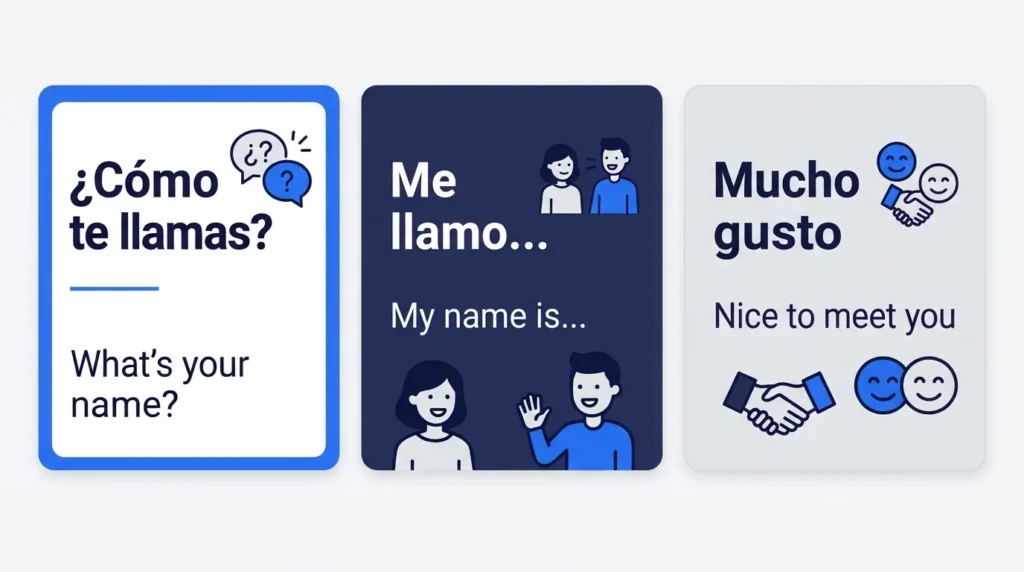
| Spanish phrase | Simple pronunciation | English meaning |
|---|---|---|
| ¿Cómo te llamas? | KOH-moh teh YAH-mahs | What’s your name? |
| Me llamo… | meh YAH-moh | My name is… |
| Soy… | soy | I am… |
| Mucho gusto | MOO-choh GOOS-toh | Nice to meet you |
| ¿Y tú? | ee too | And you? |
| ¿Y usted? | ee oos-TEHD | And you? (formal) |
Tips for Saying the Phrase Clearly
- Say cómo with a clear opening sound.
- Pronounce the ll in llamas like the English “y” in many Spanish accents.
- Keep te llamas flowing together.
- Practice the full question aloud several times.
Pronunciation varies by region, so you may hear small differences between Spanish speakers.
Formal vs. Informal Responses
Spanish has different ways to address people, depending on the level of formality. Choosing the right question can help you sound polite.
| Situation | Spanish question | English meaning |
|---|---|---|
| Casual conversation | ¿Cómo te llamas? | What’s your name? |
| Speaking respectfully | ¿Cómo se llama usted? | What is your name? |
| Asking for someone’s name | ¿Cuál es tu nombre? | What is your name? |
| Asking formally | ¿Cuál es su nombre? | What is your name? |
When Should You Use the Formal Version?
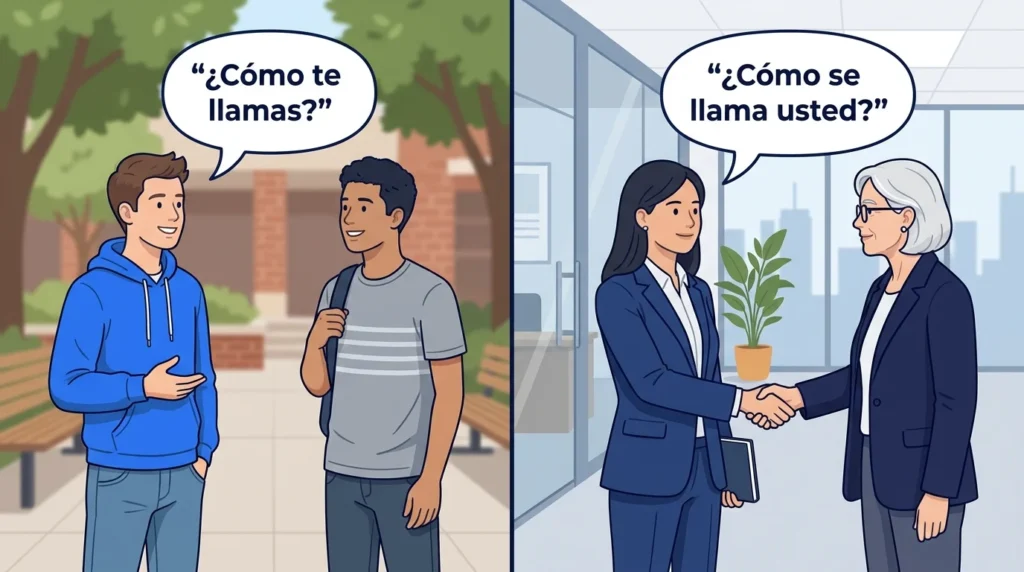
Use ¿Cómo se llama usted? when you want to show respect or when the setting calls for formal language.
For example, you might use it when meeting an older person, speaking with a customer, or introducing yourself in a formal setting.
The informal ¿Cómo te llamas? is common with friends, classmates, children, and people you know well.
Regional customs differ, so the best choice also depends on the person and setting.
Example of a formal introduction:
Person A: Buenos días. ¿Cómo se llama usted?
Person B: Me llamo Patricia. Mucho gusto.
Person A: Mucho gusto, Patricia.
English translation:
Person A: Good morning. What is your name?
Person B: My name is Patricia. Nice to meet you.
Person A: Nice to meet you too, Patricia.
How to Respond in Different Situations
The right response can depend on where you are and who is asking.
Responding in a Spanish Class
Keep your answer simple if a teacher or classmate asks your name.
Examples:
- Me llamo Olivia.
- Soy Daniel.
- Me llamo Ethan. Mucho gusto.
Tip: Start with Me llamo… if you are new to Spanish.
Responding While Traveling
You may hear this question when meeting local people or other travelers.
Examples:
- Me llamo Jessica.
- Soy Ryan. ¿Y tú?
- Me llamo Alex. ¡Mucho gusto!
A short answer is enough. You do not need to give your full name unless you want to.
Responding in a Professional Setting
Use a clear, polite introduction when meeting a new colleague or client.
Examples:
- Me llamo Laura. Mucho gusto.
- Mi nombre es David. Encantado de conocerle.
- Me llamo Robert. Es un placer conocerle.
The phrase Encantado de conocerle means “Pleased to meet you.” Encantada is commonly used by a female speaker, while encantado is commonly used by a male speaker.
These forms are useful in formal introductions, though the most natural wording can vary by region.
Responding When You Feel Shy
You do not need a long answer to sound friendly.
Try one of these:
- Me llamo Emma.
- Soy Ben.
- Me llamo Lily. Mucho gusto.
A smile and a clear answer can make a simple introduction feel more natural.
Common Mistakes to Avoid
Spanish beginners sometimes mix up the question and the answer. Here are a few mistakes to watch for.
1. Repeating the Question Instead of Answering
Incorrect response:
Person A: ¿Cómo te llamas?
Person B: ¿Cómo te llamas?
This repeats the question instead of giving your name.
Better response:
Person B: Me llamo Carlos.
2. Using the Wrong Verb Form
The question uses te llamas, while your answer uses me llamo.
- Question: ¿Cómo te llamas?
- Answer: Me llamo Ana.
The words change because the speaker changes from asking about you to talking about themselves.
3. Forgetting the Accent Mark
The correct spelling is ¿Cómo te llamas?
The word cómo takes an accent mark in this question. Also, Spanish questions use an opening question mark and a closing question mark.
4. Thinking You Must Give Your Full Name
You can answer with your first name.
For example:
- Me llamo Julia.
- Soy Mateo.
You can share your full name if the situation requires it.
5. Using an Informal Question in Every Situation
Although ¿Cómo te llamas? is widely used, a formal situation may call for ¿Cómo se llama usted?
Choose the form that fits the setting.
A Simple Spanish Introduction Checklist
Use this quick checklist when practicing your answer.
- Start with Me llamo…
- Say your name clearly.
- Add Mucho gusto if you are meeting someone.
- Ask ¿Y tú? in a casual conversation.
- Use ¿Y usted? in a formal conversation.
- Practice the full exchange aloud.
Frequently Asked Questions
1. What is the best response to ¿Cómo te llamas?
The most common response is Me llamo [your name]. For example, Me llamo Sarah means “My name is Sarah.”
2. Can I answer ¿Cómo te llamas? with Soy?
Yes. Soy [your name] means “I am [your name].” For example, Soy Daniel means “I’m Daniel.”
3. What does Me llamo mean in English?
Me llamo means “My name is” or “I am called.” It is the usual way to introduce yourself in Spanish.
4. How do I ask someone their name after answering?
Say ¿Y tú? in an informal conversation. In a formal conversation, say ¿Y usted?
5. Is ¿Cómo te llamas? formal or informal?
It is informal because it uses te, the familiar form of “you.” The formal version is ¿Cómo se llama usted?
6. How do I respond politely to ¿Cómo te llamas?
Say Me llamo [your name]. Mucho gusto. This means “My name is [your name]. Nice to meet you.”
7. Can I use my nickname when answering?
Yes. You can give your nickname or explain it by saying Me llamo Elizabeth, pero me dicen Liz, meaning “My name is Elizabeth, but people call me Liz.”
8. What should I say if I do not speak Spanish well?
Keep your answer short. Say Me llamo [your name] and use a friendly tone. You can learn longer phrases as your Spanish improves.
Conclusion
The easiest way to respond to ¿Cómo te llamas? is to say Me llamo [your name]. You can also use Soy [your name] for a shorter introduction or Mi nombre es [your name] for a clear, slightly more formal reply.
Practice these phrases aloud and learn to add Mucho gusto or ¿Y tú? when the situation calls for it. With a few simple expressions, you can answer confidently and take part in everyday Spanish conversations.
