
Islamic greetings and responses are a common part of daily life for Muslims around the world. Expressions such as Assalamu Alaikum, Wa Alaikum Assalam, Mashallah, and Alhamdulillah help people greet each other, show gratitude, share happiness, and express good wishes. Learning these phrases can help you communicate politely with Muslim friends, coworkers, neighbors, and family members.
You do not need to speak Arabic fluently to use these expressions. Many have simple meanings and short replies that are easy to learn. This guide explains common Islamic greetings, their meanings, the best responses to use in different situations, and how to avoid common mistakes. If you want to learn more everyday greetings and suitable replies, explore our guide to common greetings used in daily conversations.
Key Takeaways
- Assalamu Alaikum means peace be upon you.
- Wa Alaikum Assalam is the standard reply to the Islamic greeting.
- Mashallah expresses admiration for something good.
- Alhamdulillah means all praise belongs to Allah.
- Ramadan Mubarak is a greeting for the holy month of Ramadan.
- Eid Mubarak is a common greeting for Eid celebrations.
- Simple, respectful replies are suitable for most everyday situations.
What Are Islamic Greetings?
Islamic greetings are words and expressions Muslims use to greet others, offer good wishes, express gratitude, and share important moments. Many come from Arabic and have religious meaning, while others are common phrases used in Muslim communities around the world.
The most widely recognized Islamic greeting is Assalamu Alaikum, which means peace be upon you. Its usual response is Wa Alaikum Assalam, meaning and upon you be peace.
Muslims also use expressions such as Bismillah, Inshallah, Mashallah, and Alhamdulillah in daily conversations. Each phrase serves a different purpose, so the right response depends on what the speaker means.
Common Islamic Greetings and Their Responses
The table below covers common Islamic greetings and expressions, their meanings, and suitable replies.
| Islamic Greeting or Expression | Meaning | Common Response |
|---|---|---|
| Assalamu Alaikum | Peace be upon you | Wa Alaikum Assalam |
| Assalamu Alaikum wa Rahmatullah | Peace and Allah’s mercy be upon you | Wa Alaikum Assalam wa Rahmatullah |
| Assalamu Alaikum wa Rahmatullahi wa Barakatuh | Peace, Allah’s mercy, and blessings be upon you | Wa Alaikum Assalam wa Rahmatullahi wa Barakatuh |
| Marhaba | Hello or welcome | Marhaba |
| Ahlan wa Sahlan | Welcome | Ahlan bik or Ahlan wa Sahlan |
| Ramadan Mubarak | Blessed Ramadan | Ramadan Mubarak to you too |
| Eid Mubarak | Blessed Eid | Eid Mubarak to you too |
| JazakAllah Khair | May Allah reward you with goodness | Wa iyyak or Wa iyyaki |
| Mashallah | What Allah has willed | Thank you, or another suitable reply |
| Alhamdulillah | All praise belongs to Allah | May Allah bless you, or I’m glad to hear that |
Note: Arabic expressions have several English spellings. Replies may also differ by region, language, and personal preference.
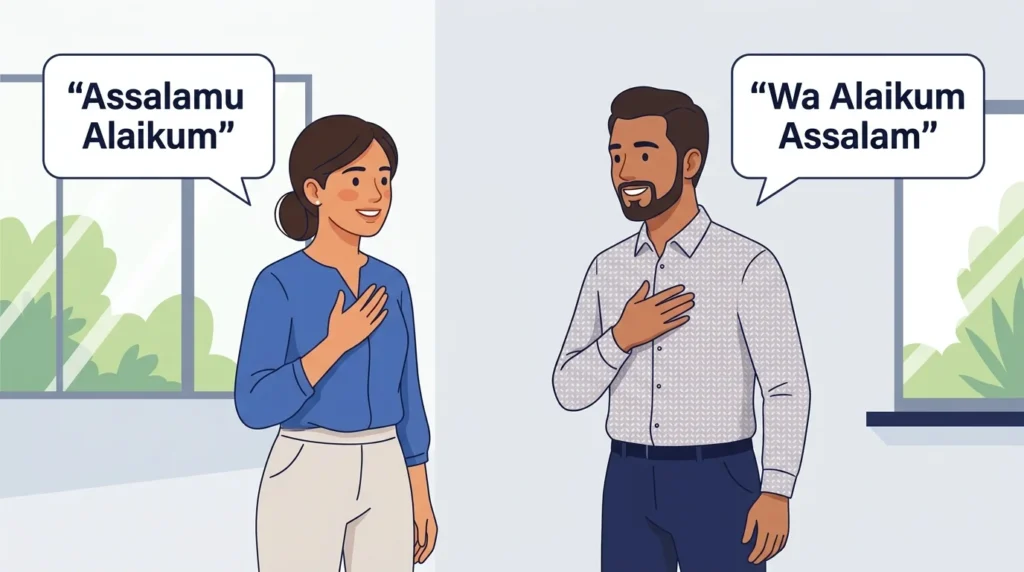
1. How to Respond to Assalamu Alaikum
Assalamu Alaikum is one of the most common Islamic greetings. Muslims use it when meeting people, entering homes, starting conversations, or greeting others in messages.
The phrase means peace be upon you. It expresses a wish for peace and well-being.
Best Responses to Assalamu Alaikum
Here are three common forms of response.
- Wa Alaikum Assalam: And upon you be peace.
- Wa Alaikum Assalam wa Rahmatullah: And upon you be peace and Allah’s mercy.
- Wa Alaikum Assalam wa Rahmatullahi wa Barakatuh: And upon you be peace, Allah’s mercy, and blessings.
The first response is short and suitable for everyday conversations. The longer versions return the greeting with additional good wishes.
Example Conversation
Person A: Assalamu Alaikum!
Person B: Wa Alaikum Assalam! How are you?
Person A: Alhamdulillah, I’m doing well.
If someone greets you with the full greeting, you can return it in full. You can also use a simple response if that is easier for you.
2. How to Respond to Mashallah
Mashallah is an Arabic expression commonly used when admiring something good. It can express appreciation, happiness, or recognition of something Allah has willed.
People may say it when they see a beautiful home, a child’s achievement, a wedding, a new job, or another positive event.
Best Responses to Mashallah
The right reply depends on the situation.
- Thank you! A simple and friendly response.
- JazakAllah Khair. May Allah reward you with goodness.
- Alhamdulillah. All praise belongs to Allah.
- Thank you, that means a lot. A warm reply in everyday English.
Example Conversations
Person A: Mashallah, your new home looks beautiful!
Person B: Thank you! Alhamdulillah, we’re happy with it.
Another example:
Person A: Mashallah, your daughter did a great job.
Person B: JazakAllah Khair for your kind words.
There is no single required reply to Mashallah in every situation. Choose a response that fits the compliment and sounds natural.
3. How to Respond to Alhamdulillah
Alhamdulillah means all praise belongs to Allah. Muslims use it to express gratitude, acknowledge blessings, or describe how they are doing.
For example, someone may say Alhamdulillah when asked about their health, after receiving good news, or when talking about something they appreciate.
Common Responses to Alhamdulillah
Use the context to choose a suitable reply.
- I’m glad to hear that. When someone says they are doing well.
- May Allah bless you. A kind and respectful response.
- Alhamdulillah, that’s good news. When sharing happiness.
- May Allah keep you well. When someone mentions their good health.
Example Conversation
Person A: How are you today?
Person B: Alhamdulillah, I’m doing well.
Person A: I’m glad to hear that.
You do not always need to respond with another Arabic phrase. A kind English reply is also suitable.
4. How to Respond to Ramadan Mubarak
Ramadan Mubarak means blessed Ramadan. Muslims commonly use it to wish others a blessed and peaceful month of Ramadan.
The greeting is often shared before Ramadan begins and throughout the month. People use it in face-to-face conversations, text messages, social media posts, and family group chats.
Best Replies to Ramadan Mubarak
- Ramadan Mubarak to you too!
- Khair Mubarak!
- Thank you. May you have a blessed Ramadan.
- Ramadan Kareem to you and your family.
- May Allah accept your prayers and good deeds.
These replies work well for friends, relatives, coworkers, and other people who celebrate Ramadan.
Example Conversation
Person A: Ramadan Mubarak!
Person B: Ramadan Mubarak to you too. May Allah bless you and your family.
A short response is perfectly fine. You can also add a personal wish if you know the person well.
5. How to Respond to Eid Mubarak
Eid Mubarak means blessed Eid. Muslims use it during Eid al-Fitr and Eid al-Adha to exchange greetings and good wishes.
Eid al-Fitr marks the end of Ramadan, while Eid al-Adha is associated with the annual Hajj season and the story of Prophet Ibrahim.
Common Replies to Eid Mubarak
- Eid Mubarak to you too!
- Khair Mubarak!
- Thank you. Wishing you a happy Eid.
- May Allah bless you and your family.
- Eid Saeed! A greeting meaning happy Eid.
Example Conversation
Person A: Eid Mubarak!
Person B: Khair Mubarak! I hope you and your family have a wonderful Eid.
You can keep your response short or include a warm wish for the person’s family.
6. How to Respond to JazakAllah Khair
JazakAllah Khair means may Allah reward you with goodness. It is a common expression of thanks used when someone helps you, offers a kind gesture, or does something beneficial.
The phrase is more than a simple thank-you because it includes a prayer for the other person’s reward.
Common Replies to JazakAllah Khair
- Wa iyyak: And to you too, commonly said to a man.
- Wa iyyaki: And to you too, commonly said to a woman.
- Wa iyyakum: And to you too, commonly used when addressing a group.
- You’re welcome. A simple English reply.
- Ameen, thank you. A warm response in a suitable context.
Example Conversation
Person A: JazakAllah Khair for helping me with my work.
Person B: Wa iyyak. I’m happy I could help.
If you are unsure which Arabic form to use, a simple English response such as You’re welcome is fine.
7. How to Respond to Inshallah
Inshallah means if Allah wills. Muslims often use it when talking about future plans, hopes, or events they expect to happen.
For example, a person may say Inshallah when discussing a meeting, a trip, an upcoming visit, or a personal goal.
Suitable Replies to Inshallah
- Inshallah! A natural reply when sharing the same hope.
- I hope so too. A friendly English response.
- May Allah make it easy. When discussing a plan or challenge.
- Looking forward to it, inshallah. When confirming future plans.
Example Conversation
Person A: I’ll visit you next weekend, inshallah.
Person B: Inshallah! I look forward to seeing you.
The expression shows hope that something will happen, while recognizing that the future is not fully within human control.
8. How to Respond to Bismillah
Bismillah means in the name of Allah. Muslims often say it before starting an activity, such as eating, beginning a task, or starting something important.
Unlike Assalamu Alaikum, Bismillah is not usually a greeting that requires a fixed reply.
What Can You Say After Bismillah?
Your response depends on the situation.
- Go ahead. When someone is about to begin a task.
- May Allah bless it. When the phrase is used before a meaningful activity.
- Ameen. When responding to a prayerful statement, if appropriate.
- Nothing is needed. In many everyday situations.
Example Conversation
Person A: Bismillah, let’s begin.
Person B: Sure, let’s get started.
You do not need to reply with another Arabic phrase every time you hear Bismillah.
9. How to Respond to Grazie
Grazie is an Italian word meaning thank you. It is not an Islamic greeting, but you may hear it when speaking with Italian speakers or people who use Italian expressions.
The usual response is Prego, which means you’re welcome. Another option is Di niente, meaning it’s nothing or no problem.
Common Replies to Grazie
- Prego. You’re welcome.
- Di niente. It’s nothing.
- Figurati. No problem, in an informal setting.
- You’re welcome. A suitable English response.
Example Conversation
Person A: Grazie for your help!
Person B: Prego!
If someone thanks you in Italian, you can answer in Italian or English. Your choice depends on the conversation.
10. Islamic Greetings for Different Situations
The best greeting depends on the setting, your relationship with the person, and the occasion.
| Situation | Suitable Greeting or Reply |
|---|---|
| Meeting a Muslim friend | Assalamu Alaikum |
| Replying to a Muslim greeting | Wa Alaikum Assalam |
| Greeting someone during Ramadan | Ramadan Mubarak |
| Celebrating Eid | Eid Mubarak |
| Thanking someone for help | JazakAllah Khair |
| Admiring something good | Mashallah |
| Expressing gratitude | Alhamdulillah |
| Talking about future plans | Inshallah |
| Beginning an activity | Bismillah |
| Responding to Italian thanks | Prego |
These expressions have different meanings. Use them in the right context rather than treating them as interchangeable greetings.
11. Can Non-Muslims Use Islamic Greetings?
Yes. Non-Muslims can use Islamic greetings respectfully when greeting Muslim friends, coworkers, neighbors, or members of a Muslim community.
Assalamu Alaikum is a greeting that wishes peace upon another person. Learning to use it correctly can help make everyday conversations more welcoming.
Here are a few simple tips:
- Say the greeting clearly and respectfully.
- Learn the usual response, Wa Alaikum Assalam.
- Ask about pronunciation if you are unsure.
- Respect the other person’s customs and preferences.
- Use a simple hello if that feels more natural.
You do not need to be Muslim to learn the meaning of a greeting. The main point is to use it with respect and care.
12. Common Mistakes When Using Islamic Greetings
Learning a few common expressions is easy, but their meanings can become confusing if they are used in the wrong situation.
Avoid these mistakes:
- Mixing up Mashallah and Inshallah: One expresses admiration; the other refers to future plans.
- Confusing Alhamdulillah with JazakAllah Khair: One expresses praise and gratitude to Allah; the other is a prayer of thanks for another person.
- Using Ramadan Mubarak as an everyday greeting: It is mainly associated with the month of Ramadan.
- Expecting one fixed reply to every expression: Many phrases allow different natural responses.
- Ignoring the meaning of the words: Learning the meaning helps you reply with care.
- Assuming every Muslim speaks Arabic: Muslims use many languages in daily life.
A simple way to avoid confusion is to learn what each expression means before memorizing its reply.
13. Quick Checklist for Using Islamic Greetings
Use this checklist when learning or practicing common Islamic expressions.
- Learn the meaning of each phrase.
- Practice the correct pronunciation.
- Remember Wa Alaikum Assalam.
- Use Ramadan Mubarak during Ramadan.
- Use Eid Mubarak for Eid celebrations.
- Choose replies that fit the conversation.
- Respect differences in language and custom.
You can learn these expressions gradually. Start with Assalamu Alaikum and Wa Alaikum Assalam, then practice other phrases as they come up in daily conversations.
Frequently Asked Questions
1. What is the most common Islamic greeting?
Assalamu Alaikum is one of the most widely used Islamic greetings. It means peace be upon you, and the usual response is Wa Alaikum Assalam.
2. What is the correct reply to Assalamu Alaikum?
The standard reply is Wa Alaikum Assalam. A longer response is Wa Alaikum Assalam wa Rahmatullahi wa Barakatuh, which returns the greeting with wishes of peace, mercy, and blessings.
3. What should I say after someone says Mashallah?
You can say Thank you, Alhamdulillah, or JazakAllah Khair, depending on the situation. There is no single reply required for every use of Mashallah.
4. How do you reply to Alhamdulillah?
Your reply depends on the context. If someone says they are feeling well, you can say I’m glad to hear that. If they are sharing gratitude, a kind response such as May Allah bless you may fit.
5. What is the best reply to Ramadan Mubarak?
You can say Ramadan Mubarak to you too, Khair Mubarak, or Thank you, may you have a blessed Ramadan. Each is a friendly way to return the greeting.
6. What does Khair Mubarak mean?
Khair Mubarak is a common response to greetings such as Eid Mubarak. It expresses a wish for goodness and blessings in return.
7. Can I use Islamic greetings if I am not Muslim?
Yes. You can use Islamic greetings respectfully when speaking with Muslims. Learning their meanings and usual responses helps you use them naturally.
8. Are all Islamic phrases greetings?
No. Some phrases greet people, while others express thanks, admiration, hope, or a wish for blessings. For example, Assalamu Alaikum is a greeting, while Bismillah is often said before starting an activity.
Conclusion
Islamic greetings and responses help people share peace, gratitude, kindness, and good wishes in daily life. From Assalamu Alaikum and Wa Alaikum Assalam to Mashallah, Alhamdulillah, Ramadan Mubarak, and Eid Mubarak, each expression has its own meaning and purpose.
Start by learning a few common phrases and their suitable replies. Pay attention to the situation, respond politely, and ask questions when you are unsure. With practice, you can use these expressions naturally and show respect for the people and traditions behind them.

Emily Carter (Content Writer & Communication Specialist) is a content writer and communication specialist at AllTypeInfo.com. She writes clear, practical, and easy-to-follow guides on email responses, message replies, writing templates, and everyday communication tips. Her goal is to help readers communicate with confidence in both personal and professional settings.