Have you ever sent an important email and waited days for a reply? Maybe you contacted a potential employer, asked a client a question, or sent a message after a business meeting. As time passes, you may wonder if you should send another email or wait a little longer.
So, how long should you wait before a follow-up email? The answer depends on the situation, the importance of your message, and whether the recipient gave you a deadline. In most everyday work situations, waiting 2–5 business days is a reasonable starting point. Job applications, interviews, sales emails, and urgent requests may need different timing.
Key Takeaways
- Wait 2–5 business days for many routine work emails.
- Send an interview thank-you email within 24 hours.
- Wait about 5–10 business days after a job application.
- Follow up after a promised response date has passed.
- Keep your follow-up short, polite, and clear.
- Send another reminder only when it makes sense.
- Respect requests not to contact someone again.
How Long Should You Wait Before a Follow-Up Email?
For a general professional email, wait around 2–5 business days before sending a polite reminder. This gives the recipient time to read your message and respond while keeping your request from getting lost.
However, this is a general guideline, not a strict rule. Some people reply within hours, while others need several days to review a request or make a decision.
Use the following table to choose a suitable time.
| Situation | Suggested Waiting Time |
|---|---|
| Routine work email | 2–5 business days |
| Email to a busy colleague | 2–3 business days |
| Job application | 5–10 business days |
| Interview thank-you email | Within 24 hours |
| Interview status update | 5–10 business days after the interview, unless told otherwise |
| Business meeting follow-up | Within 1 business day |
| Sales or client inquiry | 2–5 business days |
| Email with a stated deadline | After the deadline passes |
| Second follow-up | Another 5–7 business days, if appropriate |
These timeframes are practical starting points. Follow any instructions or deadlines provided by the recipient.
Why Is Follow-Up Email Timing Important?
The timing of your follow-up can affect how your message is received. Sending another email too soon may create unnecessary pressure. Waiting too long may cause a request to lose attention.
A good follow-up helps you do three things:
- Remind the recipient about your original message.
- Make your next step clear.
- Show that you respect the recipient’s time.
The goal is to keep communication moving without making the other person feel rushed.
Avoid Following Up Too Soon
Sending another email a few hours after your first message is usually unnecessary unless the matter is urgent.
The recipient may be attending meetings, working on a deadline, or waiting for information from someone else. A lack of response does not always mean that your email was ignored.
Give the person a reasonable amount of time before checking in.
Do Not Wait Too Long for Important Matters
Waiting several weeks for a simple reply may delay your work.
If you need approval, feedback, or an answer to move forward, a polite reminder can help. If the request has a deadline, make that deadline clear in your original email whenever possible.
How Long Should You Wait in Different Situations?
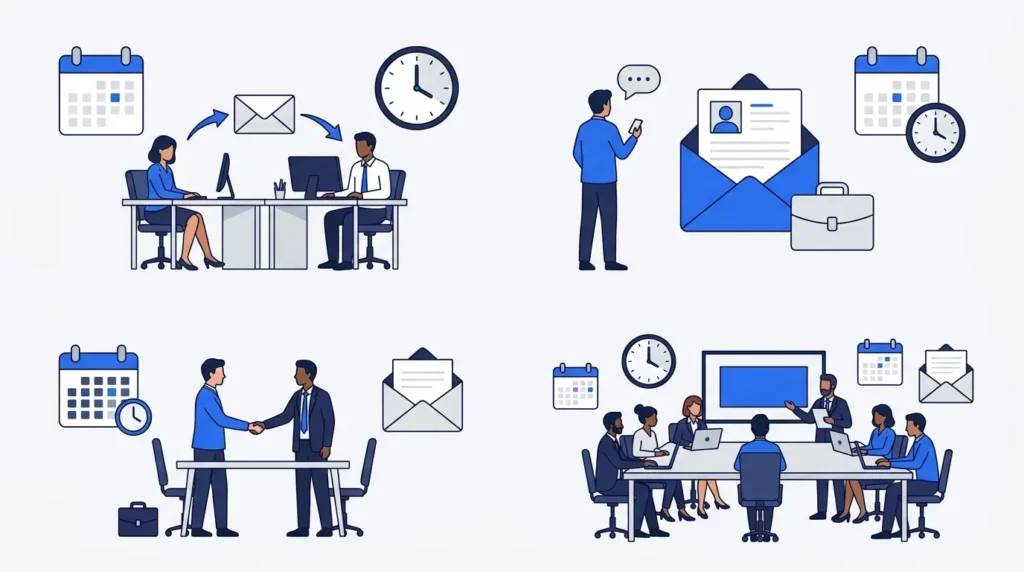
The right waiting period changes based on why you sent the email. Here are practical guidelines for common situations.
1. After Sending a General Work Email
Wait about 2–5 business days before following up on a routine work email.
For example, you may have asked a coworker to review a document or confirm a meeting time. If the person has not replied after a few business days, send a short reminder.
Example email:
Subject: Follow-Up on the Project Document
Hi Alex,
I wanted to follow up on the project document I sent earlier this week. When you have a chance, could you share your feedback?
Thanks for your time.
Best, [Your Name]
If the request is time-sensitive, mention the date you need the answer rather than sending repeated reminders.
2. After Submitting a Job Application
A common guideline is to wait about 5–10 business days before following up on a job application.
Some employers need longer to review applications, compare candidates, and arrange interviews. Check the job posting first to see whether it gives a response timeline.
If the employer states that candidates will hear back within two weeks, wait until that period ends before checking in.
Example email:
Subject: Follow-Up on [Job Title] Application
Dear [Hiring Manager’s Name],
I hope you are doing well. I am following up on my application for the [Job Title] position, submitted on [Date].
I remain interested in the opportunity and would appreciate any update you can share about the hiring process.
Thank you for your time.
Best regards, [Your Name]
Keep applying for other roles while you wait. Do not depend on one employer’s reply.
3. After a Job Interview
An interview involves two different types of follow-up emails.
Send a thank-you email within 24 hours. Thank the interviewer for their time, mention something relevant from your conversation, and confirm your interest in the role.
If you need to ask about the hiring decision, use a separate follow-up after the timeline given by the employer has passed. If no timeline was provided, waiting about 5–10 business days after the interview is a reasonable starting point.
Example email:
Subject: Follow-Up on [Job Title] Interview
Dear [Interviewer’s Name],
Thank you for speaking with me about the [Job Title] position. I enjoyed learning more about the role and your team.
I wanted to check whether there are any updates on the hiring process. I remain very interested in the opportunity.
Thank you again for your time.
Best regards, [Your Name]
Avoid asking for an immediate decision unless the employer has invited you to do so.
4. After a Business Meeting
Send a meeting follow-up within one business day when you need to share notes, confirm decisions, or assign next steps.
This email can be sent soon after the meeting because its purpose is to record what happened, not to chase an unanswered message.
If you are waiting for someone to complete a task discussed during the meeting, follow up based on the agreed deadline.
Example email:
Subject: Follow-Up on Today’s Meeting
Hi Jordan,
Thanks for meeting with me today. I wanted to confirm our next steps:
- I will prepare the project draft.
- You will review the budget.
- We will reconnect next Tuesday.
Please let me know if I missed anything.
Best, [Your Name]
5. After Sending a Sales Email
For a sales inquiry or initial business proposal, waiting about 2–5 business days before a first follow-up is often reasonable.
The best timing depends on the offer, the recipient’s role, and any deadline discussed. A major proposal may need more review time than a simple request for a meeting.
Your follow-up should remind the person of the value of your offer without repeating the entire original message.
Example email:
Subject: Following Up on My Proposal
Hi [Name],
I wanted to check whether you had a chance to review the proposal I sent on [Date].
I would be happy to answer any questions or discuss the next steps when convenient.
Best regards, [Your Name]
6. After Asking for Feedback or Approval
Wait about 2–5 business days for routine feedback or approval, unless you agreed on another timeline.
If the approval is needed before a project can continue, explain that clearly. Give the recipient a specific date when possible.
For example:
Hi Taylor,
I wanted to check on the approval for the draft. Could you share your feedback by Thursday so I can keep the project on schedule?
Thanks, [Your Name]
A clear deadline is more helpful than sending several messages that simply ask whether there is an update.
How Many Times Should You Follow Up?
There is no single number that fits every situation, but a useful general approach is to send one initial follow-up and consider a second if the matter still needs attention.
Use this simple plan:
- Send your original email.
- Wait the appropriate number of business days.
- Send one polite follow-up.
- Wait another 5–7 business days if a second message is justified.
- Stop if there is still no reply and no clear reason to continue.
For job applications, sales outreach, and networking, repeated messages can become unwelcome. Two follow-ups are often enough for an unanswered request, though some situations call for fewer.
Do not keep emailing someone who has asked you to stop. Also, respect any instructions that say not to contact the person directly.
When Should You Send a Second Follow-Up?
A second follow-up may make sense when:
- The request is still relevant.
- You have a clear reason to check in.
- The recipient has not asked you to stop.
- Your message requires an answer or decision.
It may not make sense when:
- The deadline has passed and the matter is no longer relevant.
- You have received a clear refusal.
- The person has asked you not to contact them.
- The request was optional and no longer needs attention.
Should You Count Calendar Days or Business Days?
For most professional follow-up emails, count business days, which usually means Monday through Friday, excluding public holidays.
For example, if you send an email on Thursday and want to wait three business days, your waiting period normally ends on Tuesday, assuming there are no holidays.
| Original Email Sent | Three Business Days Later |
|---|---|
| Monday | Thursday |
| Tuesday | Friday |
| Wednesday | Monday |
| Thursday | Tuesday |
| Friday | Wednesday |
This method gives the recipient time during the regular workweek.
If you are emailing someone in another country, consider their local workdays and public holidays. Some businesses also operate on different schedules.
What Is the Best Time of Day to Send a Follow-Up Email?
There is no guaranteed best hour for a follow-up email. A practical choice is to send it during the recipient’s normal working hours.
Consider these tips:
- Send routine work emails during business hours.
- Avoid sending repeated reminders late at night.
- Check time zones before contacting overseas clients.
- Schedule messages for the recipient’s workday when useful.
- Send urgent requests through the agreed communication channel.
The message itself usually matters more than choosing a perfect hour. A clear subject line and a polite request help the recipient see why you are writing.
How to Write a Polite Follow-Up Email
A good follow-up email is short, respectful, and easy to answer. You do not need to repeat every detail from your first message.
Use this simple structure.
1. Write a Clear Subject Line
Make it easy for the recipient to identify the original topic.
Examples:
- Follow-Up on the Project Proposal
- Checking In About Our Meeting
- Request for an Application Update
- Follow-Up on the Invoice
- Checking In on the Draft
2. Start With a Polite Greeting
Address the recipient by name when possible.
Examples:
- Hi Alex,
- Hello Jordan,
- Dear Ms. Taylor,
Choose a greeting that matches your relationship with the recipient.
3. Mention Your Original Email
Briefly explain what you are following up on.
Examples:
- I wanted to follow up on the proposal I sent last week.
- I am checking in about the document we discussed.
- I wanted to ask whether there are any updates on my application.
4. Make One Clear Request
Tell the recipient what you need.
Examples:
- Could you share your feedback by Friday?
- Do you have an update on the hiring process?
- Would you be available for a short call next week?
5. End With a Polite Closing
Thank the recipient and sign your name.
Examples:
- Thank you for your time.
- I appreciate your help.
- Thanks, and I look forward to hearing from you.
Common Follow-Up Email Mistakes to Avoid
Even a well-timed follow-up can create a poor impression if the message is unclear or demanding.
Sending Too Many Emails
Repeated messages can make the recipient feel pressured. Wait a reasonable amount of time between emails and stop when further contact is not appropriate.
Sounding Impatient
Avoid phrases that blame the recipient for not replying.
Instead of writing:
Why haven’t you responded to my email?
Try:
I wanted to check in on my previous message and see whether you have any updates.
The second version is more respectful and leaves room for a normal delay.
Writing a Long Message
Your recipient may be busy. Keep your follow-up focused on one topic and one request.
- Use a clear subject line.
- Mention the original message.
- Ask one direct question.
- Remove unnecessary details.
Ignoring the Recipient’s Timeline
If someone says they will reply by Friday, give them time to meet that commitment. If Friday passes without a response, a brief check-in the next business day or shortly afterward may be appropriate.
Using an Unclear Subject Line
A subject such as Hello or Quick Question does not tell the recipient what you need.
Use a subject line that connects to the original request.
Quick Checklist Before Sending Your Follow-Up
Use this checklist before you press send.
- I have waited an appropriate amount of time.
- I have checked the promised response date.
- My subject line explains the topic.
- My message is short and polite.
- I have made one clear request.
- I have checked the recipient’s name.
- I have removed demanding language.
- I have checked spelling and grammar.
- I have respected any contact instructions.
Frequently Asked Questions
1. How long should you wait before a follow-up email?
For many routine professional emails, wait about 2–5 business days. For job applications, allow around 5–10 business days. Adjust your timing based on urgency and any response date the recipient gave you.
2. Is it rude to follow up after one day?
Not always. A follow-up after one day can be appropriate for urgent requests, meeting notes, or agreed next steps. For an ordinary unanswered email, waiting a few business days is usually more considerate.
3. How long should I wait after sending a job application?
A practical starting point is 5–10 business days. Check the job posting for a stated timeline and wait until that period ends before contacting the employer.
4. When should I send a follow-up email after an interview?
Send a thank-you email within 24 hours. For a later status update, follow the employer’s timeline. If no date was given, waiting about 5–10 business days after the interview is a reasonable option.
5. How long should I wait before sending a second follow-up email?
Wait another 5–7 business days after the first follow-up when the matter still needs attention. For many unanswered requests, a second follow-up is enough.
6. Should I send a follow-up email on Friday?
You can, especially if the message is time-sensitive. For routine work emails, sending during normal business hours is a sensible choice. If the recipient is unlikely to read it before the weekend, waiting until Monday is also reasonable.
7. What should I do if someone never replies to my follow-up email?
If you have sent one or two polite follow-ups without a response, consider moving on. Try another contact method only if it is appropriate for the situation, and respect any request not to make further contact.
Conclusion
How long you should wait before a follow-up email depends on the reason for your message. For routine work emails, 2–5 business days is a useful starting point. Job applications often call for 5–10 business days, while interview thank-you emails should be sent within 24 hours.
The best approach is to give people time, follow any stated deadlines, and keep your message brief and polite. A thoughtful follow-up can keep communication moving without putting unnecessary pressure on the recipient.

Emily Carter (Content Writer & Communication Specialist) is a content writer and communication specialist at AllTypeInfo.com. She writes clear, practical, and easy-to-follow guides on email responses, message replies, writing templates, and everyday communication tips. Her goal is to help readers communicate with confidence in both personal and professional settings.